

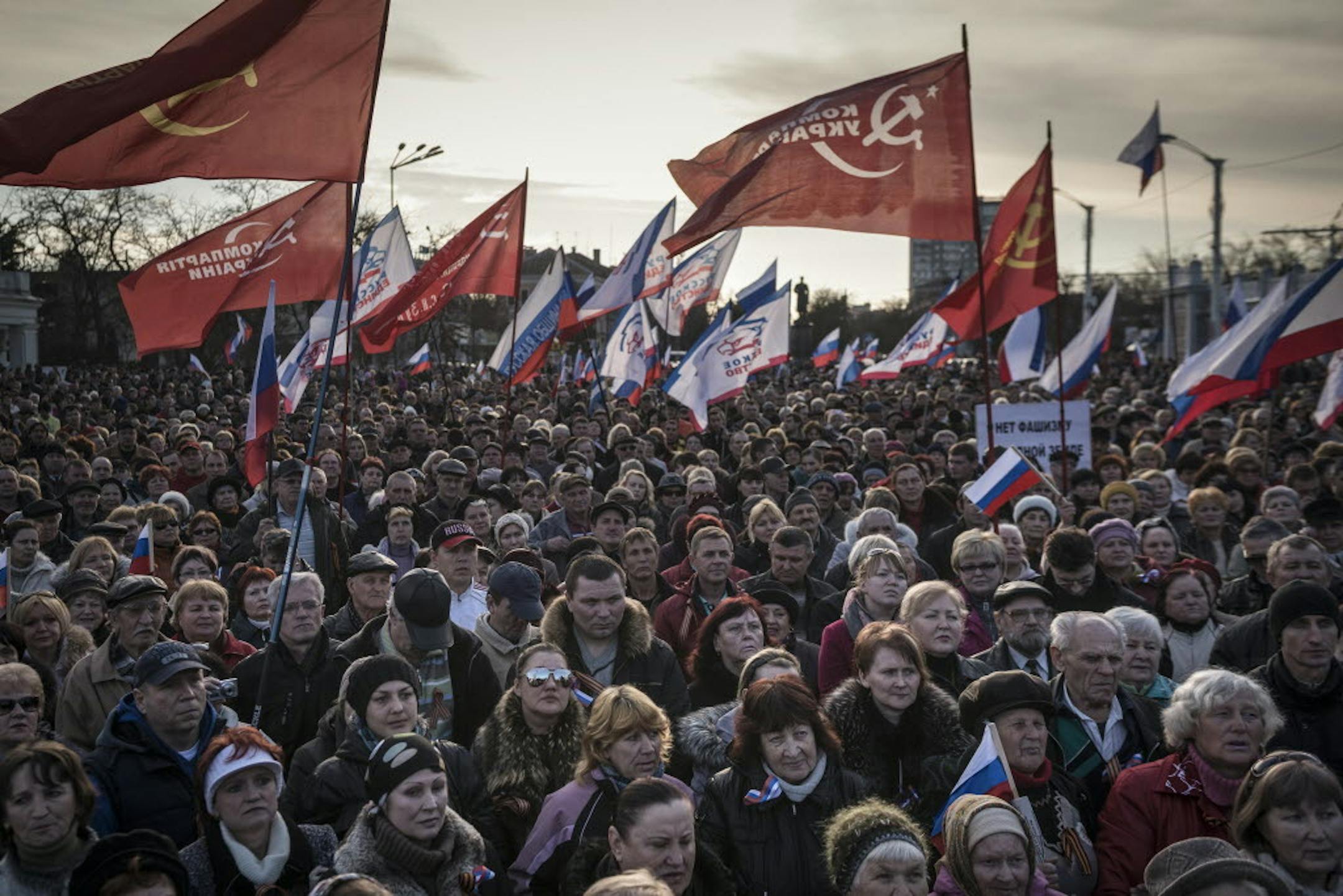
Russia invades Ukraine. The United States responds with threats of unspecific "costs" Moscow will incur if it doesn't reverse course. We offer Putin-esque photos of Obama in almost comically aggressive postures on a telephone call with the Russian leader. We threaten not to invite Russian President Vladimir Putin to future summits of global big shots. NATO dispatches some of its elite corps of press release writers to offer up limp admonitions. And the U.S. president's critics are left wondering aloud: Is this the weakest American president since Jimmy Carter? Or is it unfair to Carter to include him in that question? House Intelligence Committee Chairman Mike Rogers illustrated the critique, suggesting that "Putin is playing chess" while "we're playing marbles."
Or alternatively, in the view of the president's defenders, perhaps Barack Obama is just doing as much as a responsible president, respectful of his mandate and the current limitations on American power, can do.
The situation in Crimea is, of course, not the only factor in raising questions about the nature of contemporary American leadership. Looking around the world today we see as daunting an array of global crises and brewing problems as we have seen at any one time in recent history: Ukraine, Syria, Venezuela, Iran, Egypt, Libya, Iraq, Afghanistan, Pakistan, Turkey, Israel-Palestine, North Korea, China-Japan, Thailand, Burma, the Central African Republic, South Sudan, Somalia, Nigeria, Mali, economic problems in faltering big emerging powers, and the climate crisis. It seems the lid has come off the pot worldwide. It forces a bigger question: Is this an aberrant moment or the beginning of a trend? Are the mechanisms we have for helping to stabilize volatile situations failing? Did they ever work well enough? And what does this have to do with the current crop of governments of the world's most powerful nations, notably the United States? Are their domestic problems and political predilections and the character of their leaders part of the problem? Is there any way they can become part of the solution?
Each crisis cited above, of course, is its own complex situation. In the case of Ukraine, the United States has made diplomatic efforts behind the scenes to address it. It is good to hear that energetic and creative Secretary of State John Kerry is flying to Kiev to meet with the interim government. Further, what Russia does in its near abroad is certainly not solely the concern of the United States. The European Union and the world's other powers have been equally ineffective or inert or both, thus persuading Putin that he could act with impunity while violating the sovereignty of an important nation. And beyond economic and political wrist-slaps, it is hard to know what the West can do without escalating the situation. Certainly, the current situation in Ukraine echoes what happened in Georgia when Russia effectively snapped up the separatist regions of Abkhazia and South Ossetia and the United States, then under President George W. Bush, also did nothing but watch and vigorously complain. (It is worth noting that subsequent Russian provocations have effectively gone unchallenged by the Obama administration.)
But, even while acknowledging all that, we can be relatively certain that one of the reasons that Putin has taken the action he has — why he has felt free to order troops into Crimea and indeed why he has felt so free to meddle in the affairs of Ukraine since the beginning of the current crisis — is because he has felt there would be no consequences — at least none serious enough to dissuade him.
This is the message that America's recent foreign-policy actions — or rather its relative inaction and fecklessness — from Syria to the Central Africa Republic, from Egypt to Anbar province, from the East China Sea to the Black Sea, have helped to send. We have gone from Pax Americana to Lox Americana.
Our policy time and time again has effectively been to just lie there like a fish.
The world knows this now. They saw Obama hesitate to act in Syria years ago when his advisers were calling for it and he could have made a difference. They saw him blink when Syria crossed the red line he had drawn not once but 12 times. They saw him blink again when he almost took the most limited of military actions against Bashar Assad's regime, his team supported it, the ships were in place, and he punted. They have even seen, thanks to recent reporting by David Sanger at The New York Times, that when the NSA gave him cyber-options to use against the Syrians — the lightest and theoretically most risk-free of all light-footprint options — he refused to act.


