

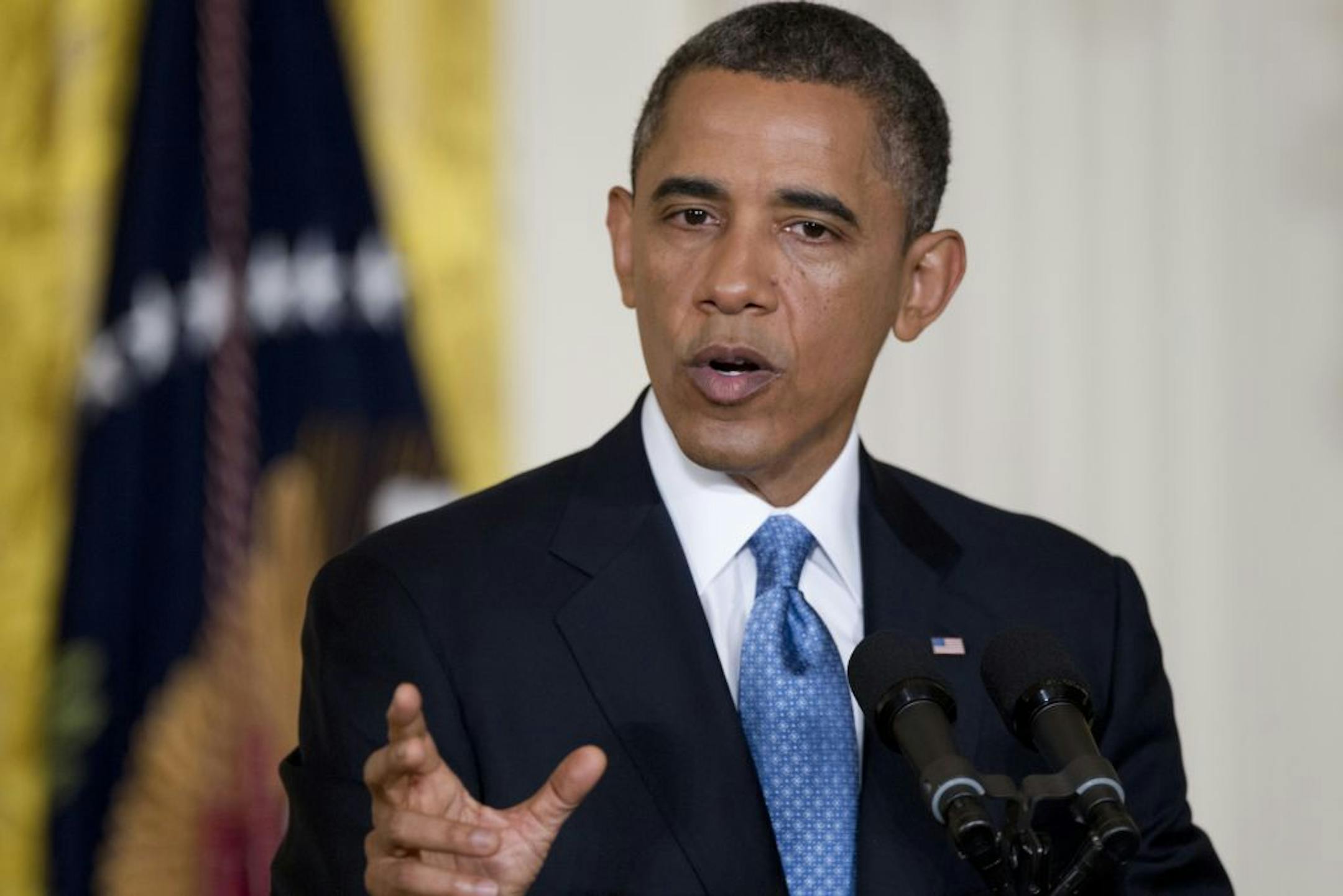
WASHINGTON - President Barack Obama said Tuesday he will bring home within a year about half of the 66,000 U.S. troops now in Afghanistan, shrinking the force to the size he found it when he entered the White House vowing to reinvigorate a stalemated war.
More will leave the battlefield in 2014, he said, but he did not spell out what U.S. military presence would remain after 2014, when the U.S.-led combat mission is scheduled to end. The stated goal is to prepare Afghanistan's army and police to handle the Taliban insurgency largely on their own by then.
Obama said that his war goals could be achieved by bringing 34,000 U.S. troops home by this time next year, leaving somewhere between 32,000 and 34,000 to support and train Afghan forces. That is about the number in Afghanistan when he took office in January 2009; in a series of moves designed to reverse the Taliban's battlefield momentum, he tripled the total American force before starting to scale it back in the summer of 2011.
Obama's new move, announced in his State of the Union speech, coincides with a major shake-up in his war command. Gen. Joseph Dunford took over Sunday for Gen. John Allen as the commander of all allied forces in Afghanistan, and Defense Secretary Leon Panetta is planning to retire as soon as his replacement is confirmed. Obama has nominated former Sen. Chuck Hagel to take the Pentagon post, and the Senate Armed Services Committee voted 14-11 Tuesday to advance the nomination to the full Senate for a vote possibly later this week.
Without going into specifics, Obama said the phase-out of American combat troops in Afghanistan will continue in 2014.
"This drawdown will continue. And by the end of next year, our war in Afghanistan will be over," he said, adding that al-Qaida is no longer the threat it was on 9/11.
"The organization that attacked us on 9/11 is a shadow of its former self," he said. "Different al-Qaida affiliates and extremist groups have emerged — from the Arabian Peninsula to Africa. The threat these groups pose is evolving. But to meet this threat, we don't need to send tens of thousands of our sons and daughters abroad, or occupy other nations."
Obama's decision also reflects Obama's determination to wind down a war that is the longest in America's history. He has many other security problems to consider around the globe — from North Korea's development of nuclear weapons to civil war in Syria to the worrisome spread of al-Qaida affiliated terrorist groups in the Middle East and North Africa.


