
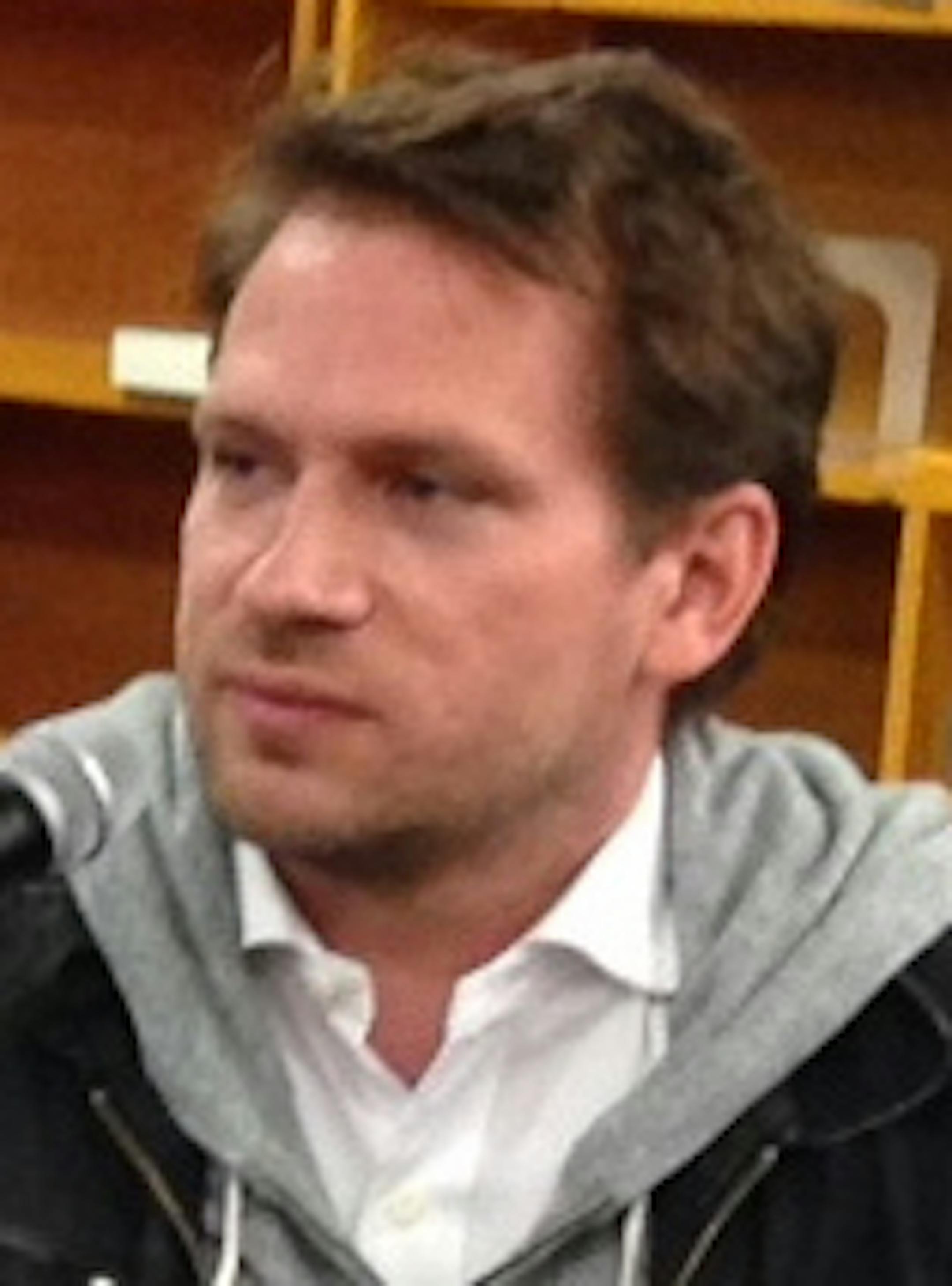
November 2013: Freeman and Erdrich in conversation about the writing life

Louise Erdrich turns the tables on critic John Freeman, interviewing him about the writing life.

August 17, 2014 at 9:56PM
Book critic, editor and author John Freeman promoting his book,“How to Read a Novelist,” at Magers & Quinn Bookstore in Minneapolis. Photo by Laurie Hertzel
John Freeman promoting his book,“How to Read a Novelist,” at Magers & Quinn Bookstore in Minneapolis. Photo by Laurie Hertzel (The Minnesota Star Tribune)

How does it go when the tables are turned and the interviewer becomes the interviewee? Judging by a recent conversation at Magers & Quinn Bookstore in Minneapolis, it goes a little shy, a little sweet and very interesting.

Book critic, editor and author John Freeman was in town promoting "How to Read a Novelist," a collection of author interviews he conducted for the New York Times, the Wall Street Journal, the Star Tribune and elsewhere. (In his interview with Erdrich, he called her "quiet and self-effacing," words that could have been used to describe Freeman himself.)

So during his book tour, novelists have been seizing the opportunity to query him ("It's an obscure form of therapy," Freeman joked) — in Seattle, Nicola Griffith; in Brooklyn, Geoff Dyer; and in Minneapolis, Erdrich, who was respectful and admiring. "This book is absolutely wonderful," she said. "I read some of the pieces over and over."

But she had plenty of questions. For instance: Was there any author Freeman didn't like?

"I like most people, because I'm from California," he said, but then went on to talk about novelist John Irving's pugnaciousness and ego, the wrestling ring in his house, the long hallway of books, "and they're all John Irving books."

Freeman almost reflexively tried to turn the questions back onto Erdrich, who was having none of it. Each time, she'd smile a serene Mona Lisa smile and remind Freeman that she wasn't the one being interviewed this time.

"As an interviewer, your job is not to try to catch someone with food in their teeth," Freeman said.

"Your job is to catch them as they really are. Critics and novelists are often put at odds with each other, but we both use the same tools."

Freeman was not a reader as a child. "Some time at 8, or 7, I stopped reading on my own," he said. But later, when he was reintroduced to literature, "It just cracked my head open."

His parents were social workers, "and they looked at weakness not as weakness, but as the human condition. And that's the job of a novelist."

After college, he began reviewing books — first for Publishers Weekly, and then for newspapers and magazines around the country. He became editor of the literary magazine Granta, expanding its presence around the globe, highlighting writers from Spain, South America, Pakistan and elsewhere.

Although his life is now books he must read — keeping up with what's new, reviewing what's about to come out — Erdrich wondered whether there are books he re-reads.

"Mostly poetry," Freeman said. "Because poetry is meant to be read over and over. Adrienne Rich — I just don't know how she makes those shifts in voice. James Wright — there's a bare-knuckled sadness to his poems."

And what about the dedication, Erdrich asked: "For my father, who asked the right questions." What questions did he ask?

"He just kept asking me from a very early age what I wanted to do with myself," Freeman said. "I took from him that life was extremely serious, at a young age."

Laurie Hertzel • 612-673-7302, On Twitter: @StribBooks

about the writer

about the writer

Laurie Hertzel

Senior Editor

Freelance writer and former Star Tribune books editor Laurie Hertzel is at lauriehertzel@gmail.com.

See Moreicon

More from Minnesota Star Tribune

See More
card image
J. SCOTT APPLEWHITE, ASSOCIATED PRESS/The Minnesota Star Tribune

The "winners" have all been Turkeys, no matter the honor's name.

In this photo taken Monday, March 6, 2017, in San Francisco, released confidential files by The University of California of a sexual misconduct case, like this one against UC Santa Cruz Latin Studies professor Hector Perla is shown. Perla was accused of raping a student during a wine-tasting outing in June 2015. Some of the files are so heavily redacted that on many pages no words are visible. Perla is one of 113 UC employees found to have violated the system's sexual misconduct policies in rece