

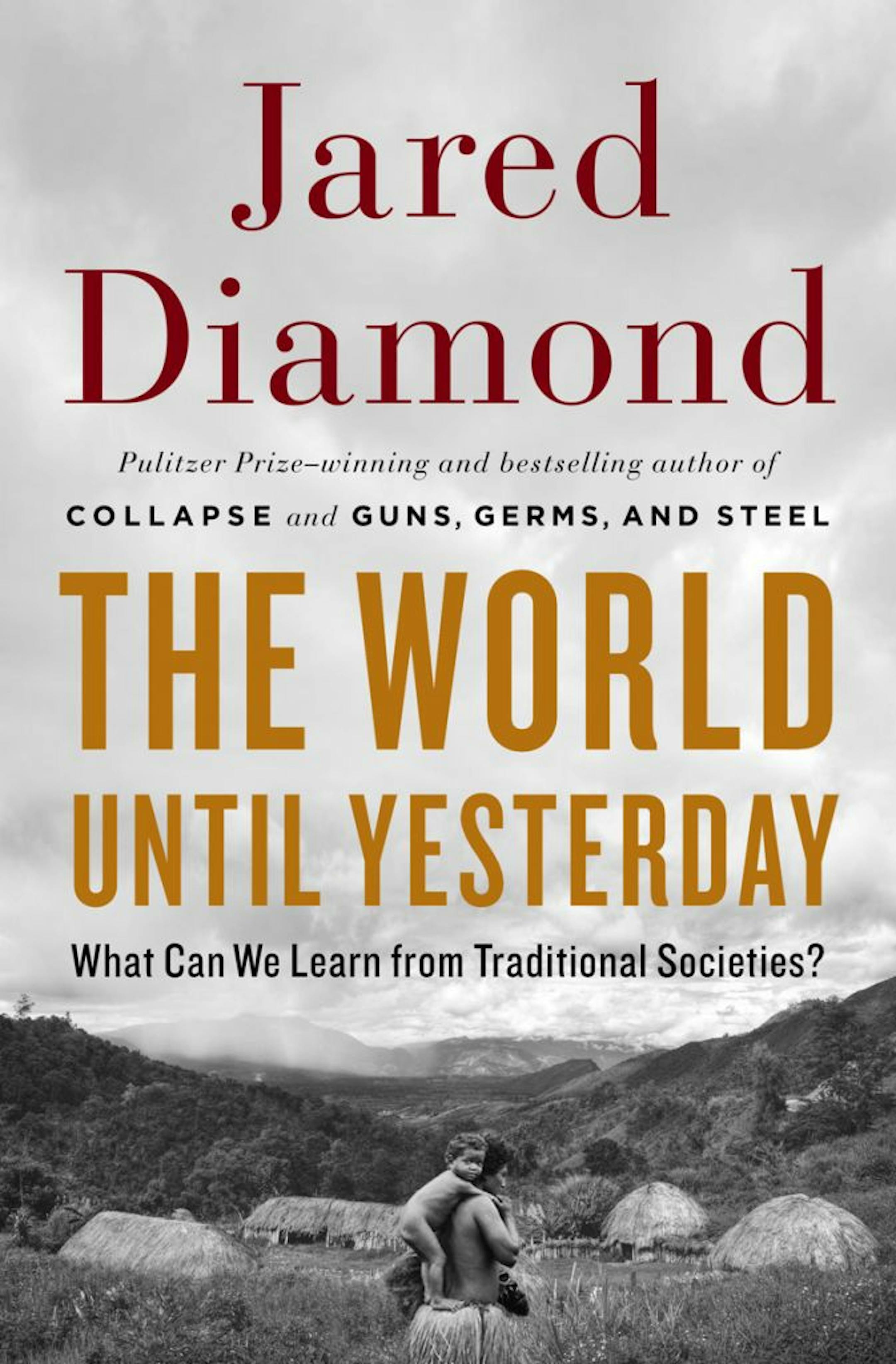
When Jared Diamond writes about the modern state societies in which we currently live, he is speaking about the past 11,000 years, an eyelash of time compared with the 6 million years of human evolution. In New Guinea, Diamond's study area for the past half-century, the modern world arrived as recently as 1931, when visitors found villagers still using stone tools and wearing grass skirts and feather headdresses.
Often, the tendency is to romanticize those traditional communities and attribute Western contact as the downfall to the "peaceful" existence of the innocent native. In the dense, challenging and smart "The World Until Yesterday," Diamond, who won a Pulitzer Prize for "Guns, Germs, and Steel," says that to give traditional societies a pass while criticizing our own is to do disservice to both worlds. Diamond, professor of geography at UCLA, suggests that it is progress, for example, that the ritualized strangling of widows has ended (as was once the custom among the Kaulong people), or that we do not murder strangers on sight, another common occurrence in some traditional communities.
"Almost all of us would say good riddance to chronic warfare, infanticide and abandoning the elderly. We understand why small-scale societies often have to do those cruel things, or get trapped into doing them."
By focusing his infectious intellect and incredible experience on nine broad areas -- peace and war, young and old, danger and response, religion, language and health -- and sifting through thousands of years of customs across 39 traditional societies, Diamond shows us many features of the past that we would be wise to adopt.
Among them are the benefits of raising children in extended, multigenerational families and play groups, feeding them less salt and sugar, and opening them to the richness of other cultures by teaching them more than just one language. After all, there are 7,000 languages still in existence from which to choose.
When it comes to children, Diamond gleans his most convincing argument from observations by Westerners who have lived among hunter-gatherer groups: that our modern, overly protective society has made our children increasingly antisocial, isolated and risk-averse. They are struck by how children in small-scale communities seem to be better equipped to cope with the challenges of the world and still enjoy their lives with confidence and daring.
Diamond suggests that "the hunter-gatherer lifestyle worked at least tolerably well for the nearly 100,000-year history of behaviorally modern humans. ... The lessons from all those experiments in child-rearing that lasted for such a long time are worth considering seriously."
Stephen J. Lyons' latest book is "The 1,000-Year Flood: Destruction, Loss, Rescue, and Redemption Along the Mississippi River." He is currently at work on a book about the Driftless Area of the Upper Midwest.


