

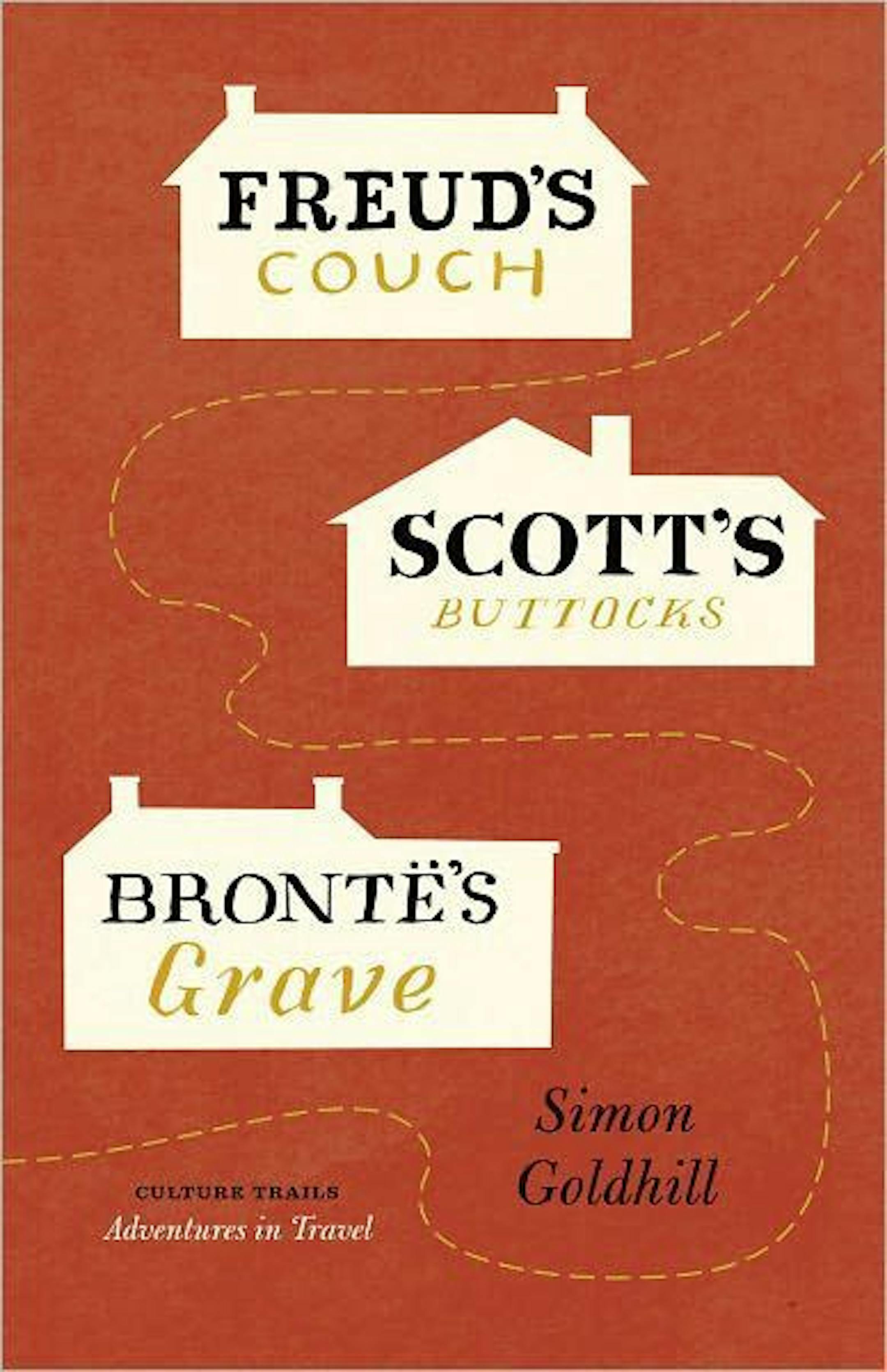
When Simon Goldhill's editor suggested as a premise for a book that Goldhill "make a pilgrimage," the notion of a dedicated journey appealed to him. Yet the touristy notion of trekking to holy sites did not appeal to him, nor did the solitude of a Kerouac voyage of self-discovery. His solution -- a natural one to a Cambridge professor of Victorian literature -- was to travel from Scotland to London, accompanied by his wife and two friends, to explore the British homes of figures who represent the landmarks of Victorian culture: Walter Scott, William Wordsworth, the Brontës, Shakespeare (just wait) and Sigmund Freud.
Half cultural history, half travelogue, all immensely entertaining, "Freud's Couch, Scott's Buttocks, Brontë's Grave" (University of Chicago, 129 pages, $22.50) is a short book that nonetheless gives Goldhill the scope to puzzle out connections between domiciles and the personalities of the people who resided in them. We learn first about the rise during Victorian times of the author as inspirational sage and the devotees who came to admire and have their lives touched and altered: the birth of celebrityhood.
Scott, the author of "Ivanhoe" and the Waverly novels, constructed Abbotsford as a public museum to himself, with many guest rooms to accommodate arriving pilgrims. The imposing manor is a shrine to Scottish nationalism and the rooms are full of military and religious memorabilia, which reflected Scott's persona: collector, curator and literary lion. Wordsworth's Dove Cottage, by contrast, lies in the formerly remote Lake District and reflects not only the poet's spiritual attachment to nature but also the austere lifestyle he and his sister maintained.
Goldhill has little patience with commodified hokum. While generations of readers, himself included, have taken pleasure in the erotic passions and windy atmospherics of "Jane Eyre" and "Wuthering Heights," Goldhill sees Haworth Parsonage, the much-visited home of the Brontë sisters, as a "back-invention" -- that is, a place retrofitted to correspond to the compelling myth of the "sisters' life as suffering artists" that was generated after their death. The sisters, he shows, lacked for little, least of all intellectual stimulation.
Yet Haworth has come to stand for "every woman's home, the repression of the inner self in social propriety."
Similarly, it was the Victorians who bowdlerized and fictionalized Shakespeare, acclaiming him as a national hero to help sanction "the national project of empire and rule." Victorian "improvements" turned Stratford into a theme park. After multiple renovations through the centuries, only the cellar of Shakespeare's "birthplace" remains Elizabethan, and Goldhill dryly observes that it is impossible to determine whether Shakespeare was actually born in his birthplace. But no matter. As one early Victorian writer expressed it, "Let us not disturb the belief."
Ultimately, Goldhill prefers the books to the relics, and he comes away from his journey a disgruntled but ever-curious pilgrim. His prose sparkles and he asks probing questions about how we appreciate art and how historical knowledge (and packaged fabrications) affect our pleasure. For the benefit of fellow pilgrims, he includes a "How to Get There" chapter.
Tom Zelman teaches English at the College of St. Scholastica in Duluth.


