

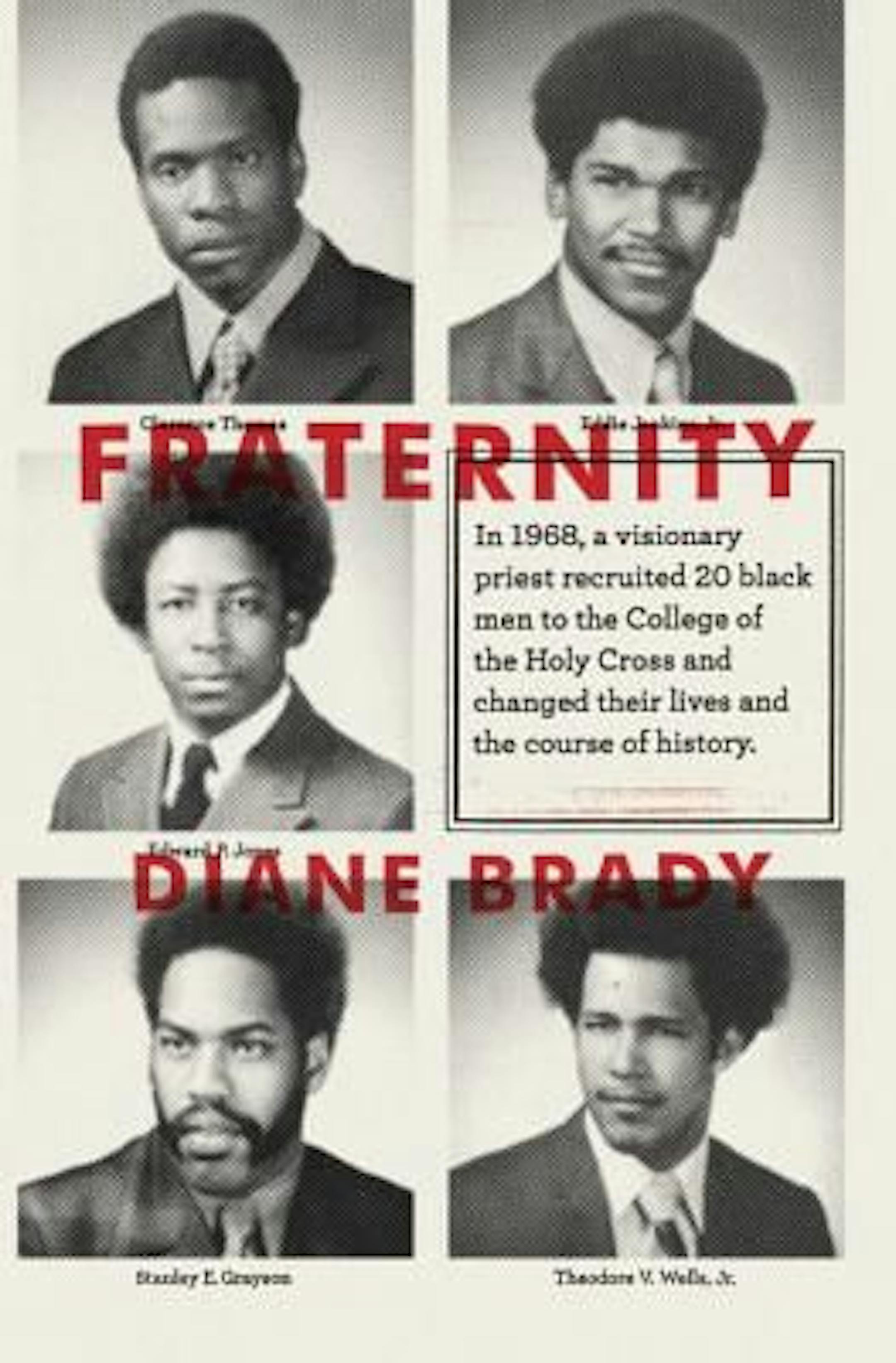
Discussions about desegregation of the nation's college campuses in the 1960s tend to begin and end with the unrest that followed James Meredith's groundbreaking enrollment at the University of Mississippi, or perhaps Gov. George Wallace's "stand in the schoolhouse door" to deny black youths entrance to the University of Alabama.
In her new book, "The Fraternity," Diane Brady tells of a seminal civil rights moment that happened in central Massachusetts in 1968. That's when the Rev. John Brooks, a shrewd, Vatican-trained priest outraged by the assassination of Martin Luther King Jr., recruited about two dozen bright black students to help him use the College of the Holy Cross in Worcester, Mass. -- an exclusive, nearly all-white Catholic school -- as an instrument for social change.
As the driving force of the experiment, Brooks is at the center of Brady's narrative, but she weaves his story with those of seven recruits, describing how they overcame a demanding, uncomfortable environment. They include Ted Wells, on a path to become one of the nation's most powerful trial lawyers, and Eddie Jenkins, a star athlete who went on to play for the Miami Dolphins, pro football's last undefeated championship team.
Yet the most complex recruit -- and maybe the most interesting character in the book -- is a frustrated seminarian from backwoods Georgia named Clarence Thomas. Yes, that Clarence Thomas -- the nation's second African-American Supreme Court justice and affirmative-action foe. He entered Holy Cross as a Brooks recruit, forged bonds with his black classmates and fought with them for equal treatment.
Brady offers glimpses of how the stubborn, independent-minded Thomas, conflicted about his own skin color, came to view race and Brooks' willingness to bend the rules for them, opinions he seems to hold today: "Thomas wondered how many men in the eclectic class of 1973 would graduate and go on to forge successful careers. ... [Their treatment] felt condescending somehow, like Brooks thought they might not be tough enough to cope" on their own.
The plain-spoken priest, however, had much at stake: the tens of thousands he'd spent from the school's threadbare endowment; the respect of white undergrads resentful about the recruits' special treatment; the donations of influential alumni concerned that increasing Holy Cross' black population would permanently stain their alma mater.
The recruits faced pressure, too, balancing Holy Cross' rigorous curriculum against expectations that they would soar or fail, while navigating the school's blind spots on race -- a situation that led to a confrontation that nearly ended Brooks' experiment.
A business journalist by trade, Brady isn't flashy or profound in her prose; she thoroughly researched "Fraternity" and interviewed many of the men, but wrote it as an omniscient narrator, which was a bit frustrating. I wanted to hear more from them, in detail: What happened? How did it feel? What did you see?


