
Noelle's story: The danger of one bite

May 15, 2013 at 3:44PM
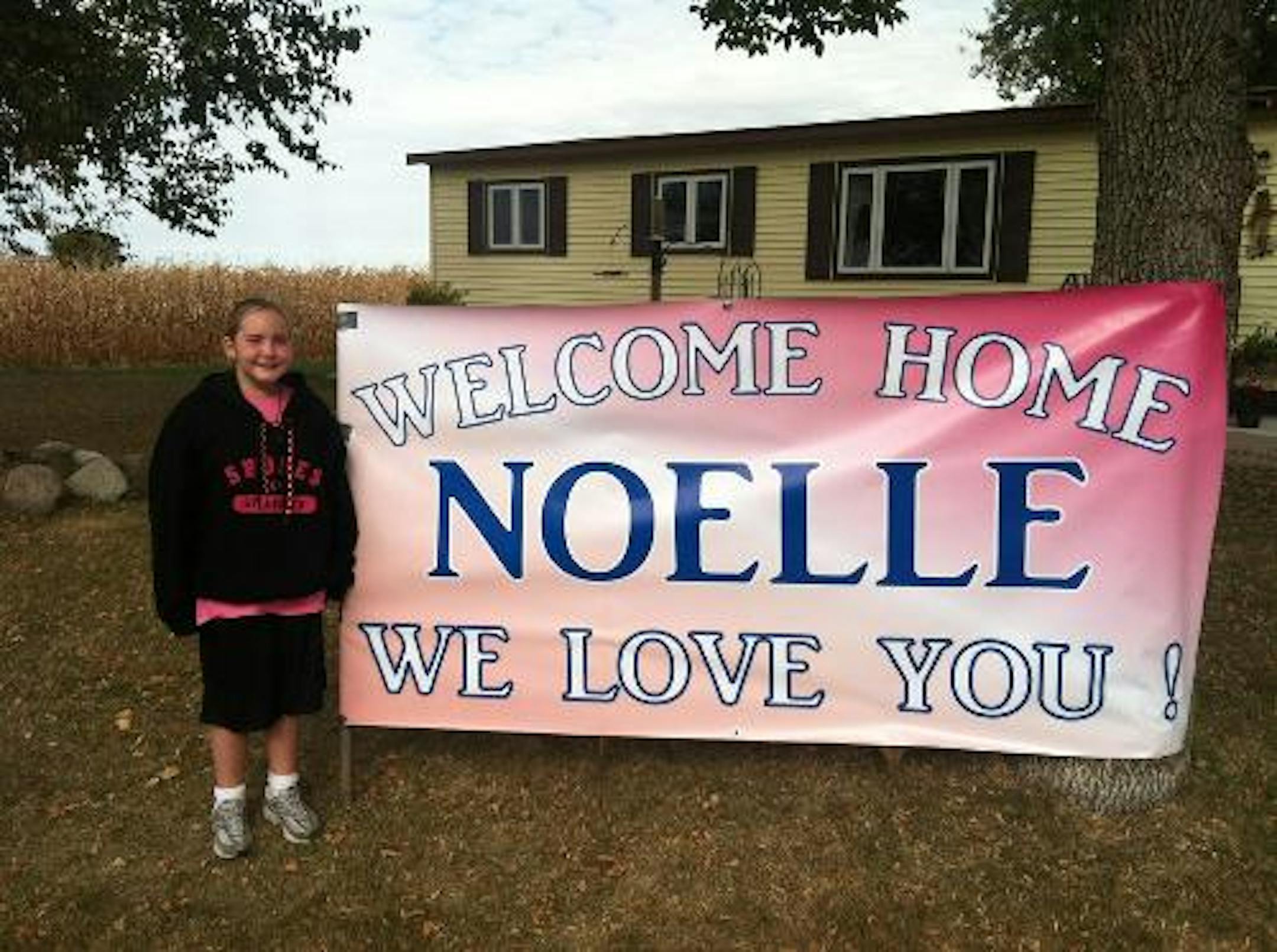
Noelle Dilley returns home after 31 days in the hospital.
Noelle Dilley is home and well after she suffered a severe allergic reaction to a cupcake that contained peanut butter.Noelle Dilley returns home after 31 days in the hospital. (The Minnesota Star Tribune)

Noelle Dilley knew the moment she bit into what looked like a chocolate cupcake it was contaminated. Tears streamed down her face as she ran to her mom.

The cupcake had peanut butter in it. Noelle, 10 at the time, is severely allergic to peanuts.

She and her family were at a late summer church picnic. The cupcake looked tempting. It would be for most 10-year-old kids. Who would have thought it contained the one ingredient Noelle can't have.

Noelle was tested and diagnosed with a peanut allergy – among other allergies – when she was about 3 years old after suffering a reaction to a small amount of peanut butter, said her mom, Renae Zaeska. The Atwater, Minn., family was told that with every peanut exposure, the reaction would be worse than the previous one for Noelle.

When Noelle was 5, one bite of a Butterfinger candy bar turned into a helicopter ride and a five-day stay at St. Cloud Hospital.

This reaction would be worse, Zaeska thought.

Noelle's mouth started to burn. He ears ached. Her stomach hurt. On this day – of all days – Zaeska didn't have Noelle's EpiPen.

She grabbed Noelle and sped to the emergency room at Meeker Memorial Hospital in Litchfield, Minn. By the time they reached the ER, Noelle's eyes had started to swell and she began to wheeze. The medical team used an EpiPen and steroids. But Noelle needed additional care.

For the second time in her life, she traveled in a helicopter. She was taken to Children's Hospitals and Clinics of Minnesota where she spent 31 harrowing days.

At Children's, Noelle went into cardiac arrest and CPR was performed. Her heart started pumping again, but her lungs were so inflamed and full of mucous she was unable to use them. She was ultimately put on ECMO (extracorporeal membrane oxygenation), a technique that provides cardiac and lung support to patients whose heart and lungs are severely distressed.

She underwent surgery, endured numerous procedures including bronchoscopy and was tested time and time again as she recovered.

"After this whole accident, I'm terrified…I pray to God that we never have to go through this again," Zaeska said. "I wish I could put a bubble around her."

"For four minutes, she was gone," she said.

Noelle and her family were able to stay at the Ronald McDonald House inside Children's during the hospitalization.

"In the pediatric intensive care unit (PICU) at Children's, we all have been privileged to care for Noelle and adore her family. To see her so desperately ill, knowing that her heart and lungs stopped working, to help rescue her from her critical illness, then to see her walk out of this hospital is indescribable. This is exactly why we embrace caring for children," said Dr. Ken Maslonka, PICU medical director.

After the incident, the fifth-grader worked with a tutor at home and continued physical, occupational and speech therapy before returning to school.

Noelle's school has taken various precautions to help protect her and students with food allergies, Zaeska said.

School staff has eliminated peanuts and peanut products in the food served to children, Zaeska said. They've created a peanut-free zone for Noelle at lunch. They've also added a wash basin where kids can wash their hands before entering the classroom.

The school can't limit what parents send with their kids, however, Zaeska said.

Noelle's parents read labels, know which companies use peanuts in food process, and check out which restaurants are "safe" and take steps to prevent cross-contamination.

Their days of dining outside the home will be fewer since Noelle's hospitalization.

"We've told Noelle that we won't eat out like we used to," Zaeska said.

According to the Food Allergy and Anaphylaxis Network (FAAN), nearly 6 million or 8 percent of children have food allergies. Peanuts are a top food allergen.

"The best advice for families with severe food allergies is: know to the best of your ability what your child is allergic to, always be prepared for an acute allergic reaction every moment of every day, do your best to keep your child in a safe environment away from the offending allergens at home, school, restaurants," Maslonka said.

about the writer

about the writer

Brady Gervais

More from Minnesota Star Tribune

See More
card image
J. SCOTT APPLEWHITE, ASSOCIATED PRESS/The Minnesota Star Tribune

The "winners" have all been Turkeys, no matter the honor's name.

In this photo taken Monday, March 6, 2017, in San Francisco, released confidential files by The University of California of a sexual misconduct case, like this one against UC Santa Cruz Latin Studies professor Hector Perla is shown. Perla was accused of raping a student during a wine-tasting outing in June 2015. Some of the files are so heavily redacted that on many pages no words are visible. Perla is one of 113 UC employees found to have violated the system's sexual misconduct policies in rece