

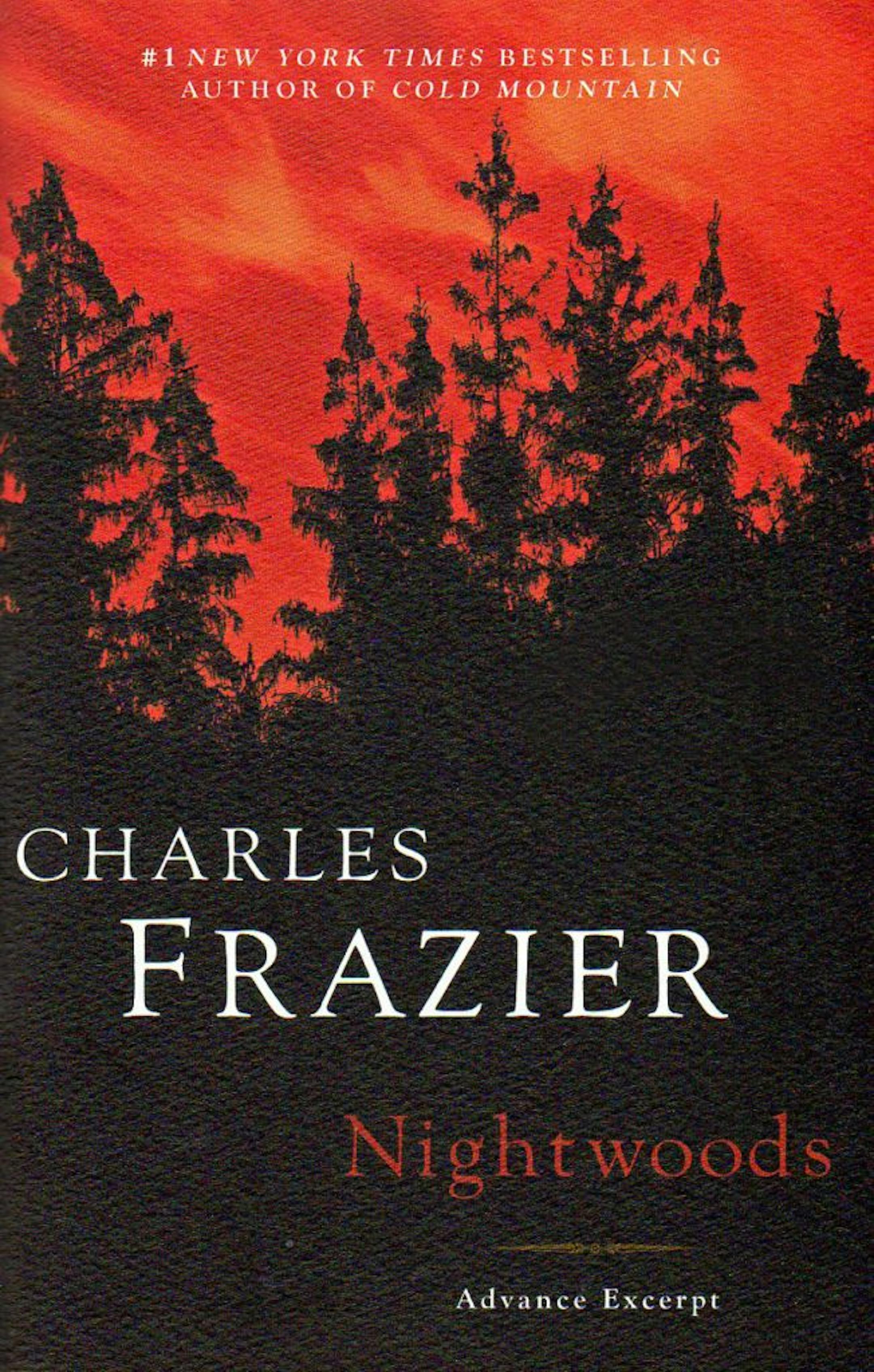
Novelist Charles Frazier is best known for "Cold Mountain," his National Book Award-winning, tragically romantic historical novel set in Appalachia during the Civil War. His follow-up, "Thirteen Moons," was also an ambitious historical novel set against the Appalachian landscape. Thus, even a cursory knowledge of his work makes it impossible to pick up Frazier's new novel without the expectation that it will be a dense historical novel, probably one described by the words "sweeping" or "epic."
In fact, his new novel, "Nightwoods," isn't really sweeping or epic, in the best possible way. Instead, it's taut and chilling. With short chapters and a quickly moving plot, "Nightwoods" has the rich, poetic writing that Frazier is justly famous for, but instead of luxuriating in historical detail, "Nightwoods" takes the reader on fast-paced journey, one that is often violent and sometimes quite thrilling.
Our protagonist is a reclusive woman named Luce. As the novel opens, Luce's quiet life as the caretaker of an abandoned resort in Appalachia (although moving from the 19th to the 20th century, "Nightwoods" sticks to Frazier's beloved Appalachia) is disrupted by the arrival of two children. The pair were orphaned when their mother, Luce's sister, was murdered by their stepfather, Bud. Traumatized by what they have seen, the siblings are ominously silent and act out in frightening ways, killing chickens and setting fires: The novel begins with the sentence, "Luce's new stranger children were small and beautiful and violent."
Although always in third person, the novel shifts focus, alternating between the perspectives of several different characters. We begin close to Luce's perspective, but throughout the novel we are close to the children (neurotically linked by tragedy, they have a shared point of view); the town's small-statured but intimidating sheriff, Lit; the resort's new landlord, Stubblefield, who becomes Luce's uneasy suitor; and the murderer, Bud.
Convinced that the children have money that their mother took from him, Bud tracks them to Luce's remote location and integrates himself with the locals by becoming a transporter of moonshine. Throughout the book, Bud's threats to Luce and the children become more and more intense, endangering the fragile peace that Luce, Stubblefield and the damaged children have managed to find.
With its reclusive, introspective heroine, poetic prose and obsessed, violent antagonist, "Nightwoods" almost reads like the deliciously twisted love child of Marilynne Robinson's "Housekeeping" and Cormac McCarthy's "No Country for Old Men." Yet there is always an earthy, offbeat beauty to the writing that is all Frazier's own, and it's this beauty, along with his vividly human characters (even Bud the killer is complicated and sometimes endearing) that make "Nightwoods" such a fresh, engrossing read.
- Laura C.J. Owen is a freelance writer living in Tucson, Ariz. Read more of her writing at www.lauracjowen.com.


