

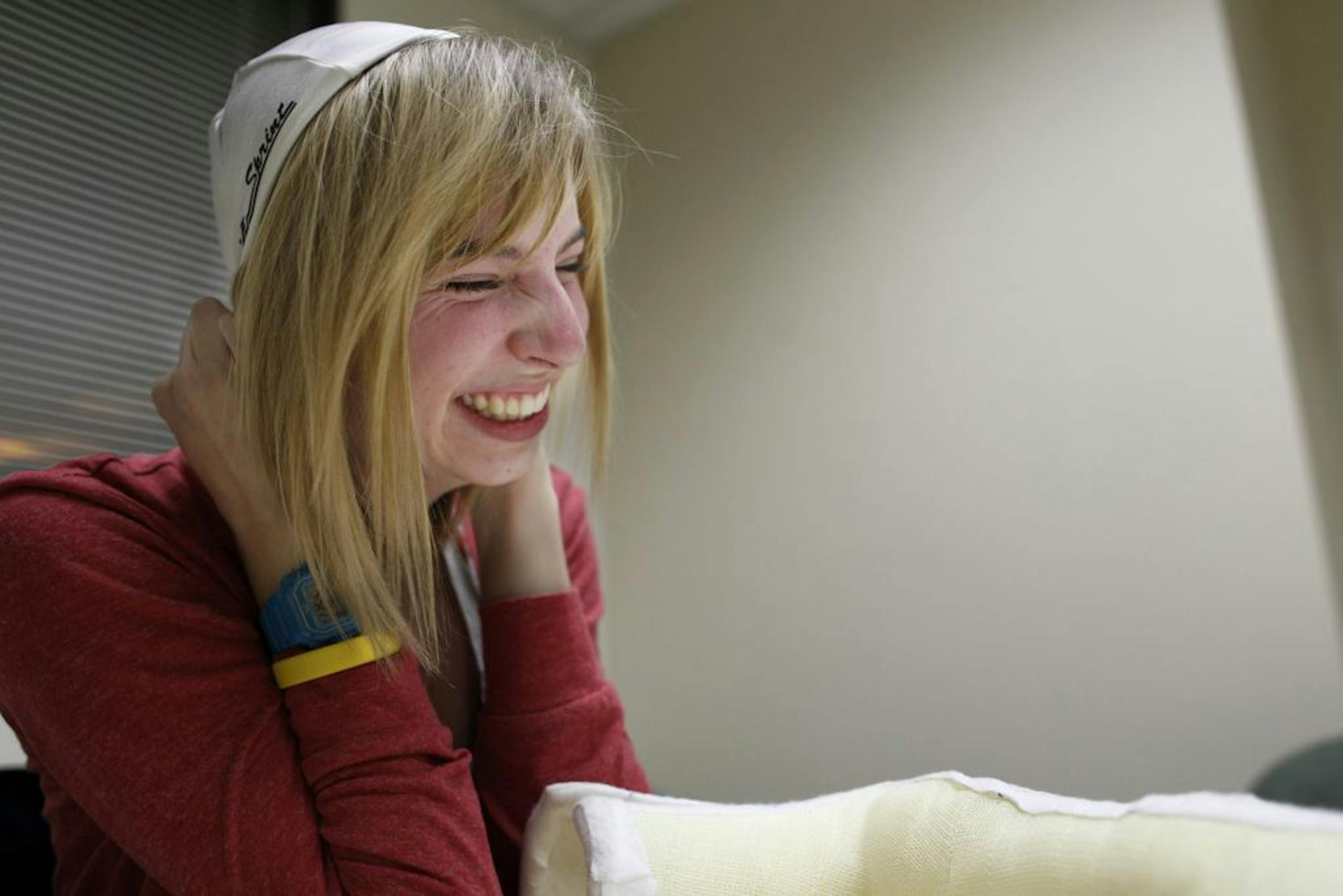
Is it possible to experience elation putting in your own ponytail or firmly shaking hands with a stranger?
Just look at Maddy Evans' beaming face for the answer. Maddy, 16, completed a study at the University of Minnesota and Gillette Children's Specialty Healthcare, using a combination of brain stimulation and occupational therapy to help children who have had a stroke increase their hand function. Maddy now buttons her coat with both hands, can put in her own ponytail and, yes, reaches for a stranger's hand with her right one. She never used to use her right hand.
"It helped. If anything, it helped with my confidence," the 16-year-old from Lakeville said in an interview last week. "I'm using it a lot more than I used to."
The new stimulation therapy uses a noninvasive magnetic field on the healthy side of the brain. Gillette, with 2010 revenue of $164 million, has a long history of innovation in pediatric medicine.
But what the folks who ran the study cannot say yet is whether the therapy is boosting gains children achieve from occupational therapy. They need 30 children between the ages of 8 and 16 to complete the study. Seventeen children have completed it; 13 more are needed by August 2012, when funding runs out.
Bernadette Gillick of the Brain Plasticity Lab at the University of Minnesota said so far researchers have seen "statistically significant" gains, with no adverse effects.
The study, funded by a $1 million challenge grant from the National Institutes of Health, is on the frontier of medical technology -- using physical therapy and new stimulation therapy in concert. A successful trial may lead to greater use of technology in the treatment of strokes in children.
The combination therapy works like this: Children who have suffered a stroke that has limited function on one side of their body receive therapy for 13 days -- alternating between the electronic stimulation one day and something called constraint-induced therapy the next. Basically, they have a cast placed on their unaffected arm to force them to use their stroke-affected arm. Children wear the cast all 13 days while occupational therapists work with them to increase strength, flexibility and hand function in their stroke-affected side.


