

Nothing trumpets an immigrant's success better than building a castle in the new country. Which is what Swedish-born newspaper publisher Swan Turnblad did more than a century ago when he erected a turreted mansion that is now home to the American Swedish Institute.
It's an immigrant's dream writ large — proof that he and his people belong in this town, this state, this country. But times change and so do the immigrants, their stories and their dreams.
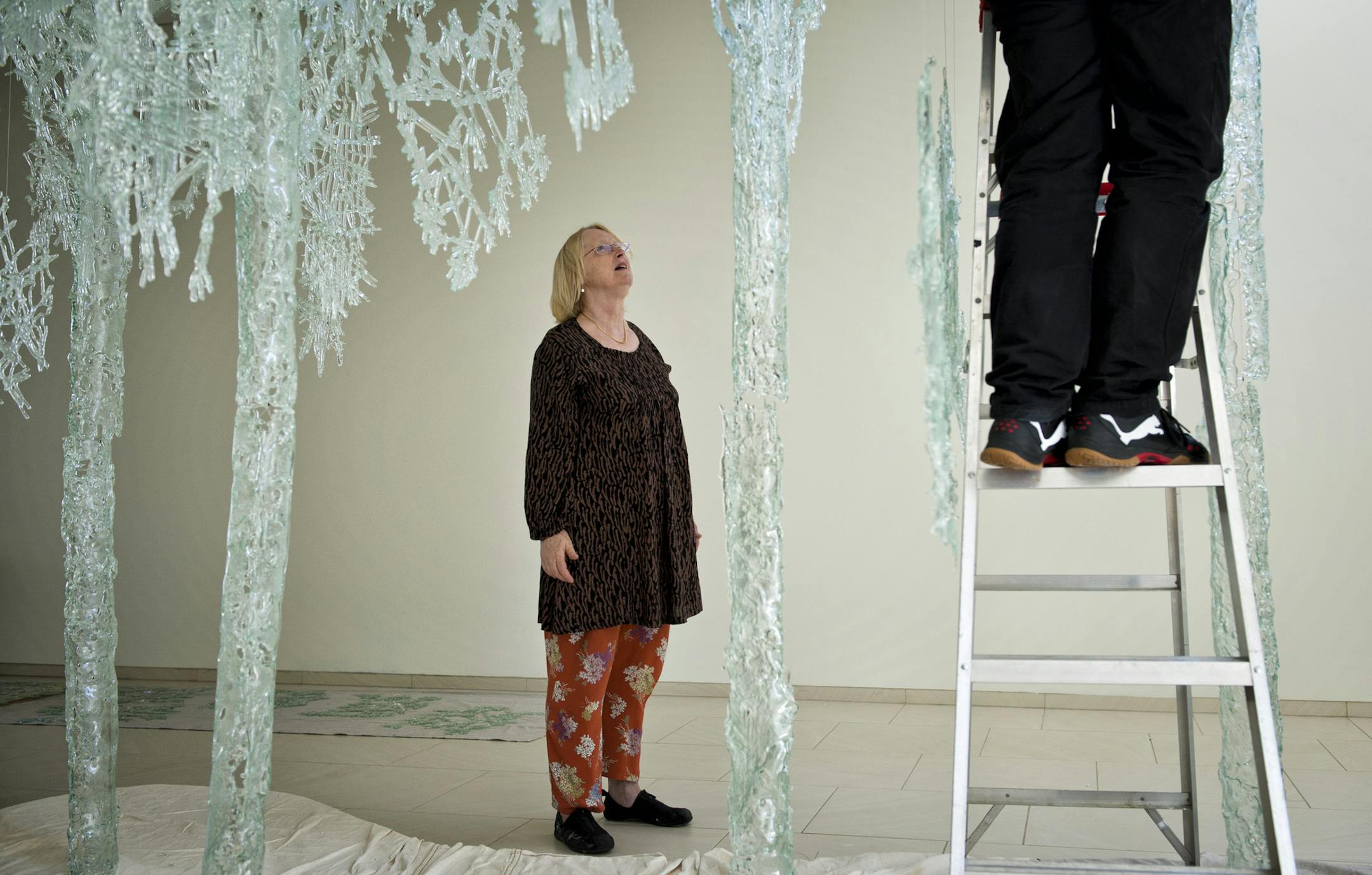
Standing recently in the institute's new addition, which echoes a traditional Swedish farmstead rather than a castle, glass artist Ingalena Klenell had a different notion of immigrant life as she and her artist husband, Ragnar, finished installing her newest project, "Homeland."
The ambitious centerpiece of "Pull, Twist, Blow," an exhibit of contemporary glass art that runs through Oct. 13, Klenell's installation consists of a half-dozen glass trees clustered together. Their hollow trunks are about 5 inches in diameter and at least 6 feet tall, topped with sparkling crystalline crowns of glass shaped to suggest abstract leaves and branches. Made by pouring molten glass into molds, her forest is a fragile fantasy reminiscent of the frost landscapes that materialize on old windows on bitter winter days.
" 'Homeland' is about longing," Klenell said. "It's about leaving home and then constructing an image of home, of cutting roots and planting new roots in a new land. Sometimes it works and sometimes it doesn't. But you try. That is what immigrants do."
Swedish landscape scenes — of conifer-edged lakes and boats bobbing in sunny coves — can be glimpsed behind her trees. The scenes are simple snapshots that Klenell enlarged and printed onto a translucent material that she then fused to irregular sheets of glass that now dangle from the ceiling. Suffused with light from the gallery's windows, the sheets look like big transparent postcards, their shimmering landscapes hovering like fragments of a dream or memories of vistas long ago glimpsed from a lakeside cabin.
Glass by 10 other Swedes — mostly young, iconoclastic artisans — is installed in the castle's ornate solarium and salons. Complementary pieces by eight Minnesota glass artists line the sunny concourse that connects the two wings of the institute, setting up a smart dialogue about how art glass is evolving in the United States and Sweden.
The exhibit comes at a critical juncture in Swedish culture, Klenell said. Recent news reports tell of riots in suburban Stockholm, where impoverished immigrants — many of them refugees from war-torn African and Middle Eastern nations — are struggling to find work and acceptance. Their troubles are shocking to Swedes, who have long prided themselves on their egalitarian principles and embrace of foreigners. But the attitude of native Swedes is changing, and some are less welcoming of immigrants as the nation struggles to adjust to international forces beyond its control.


