

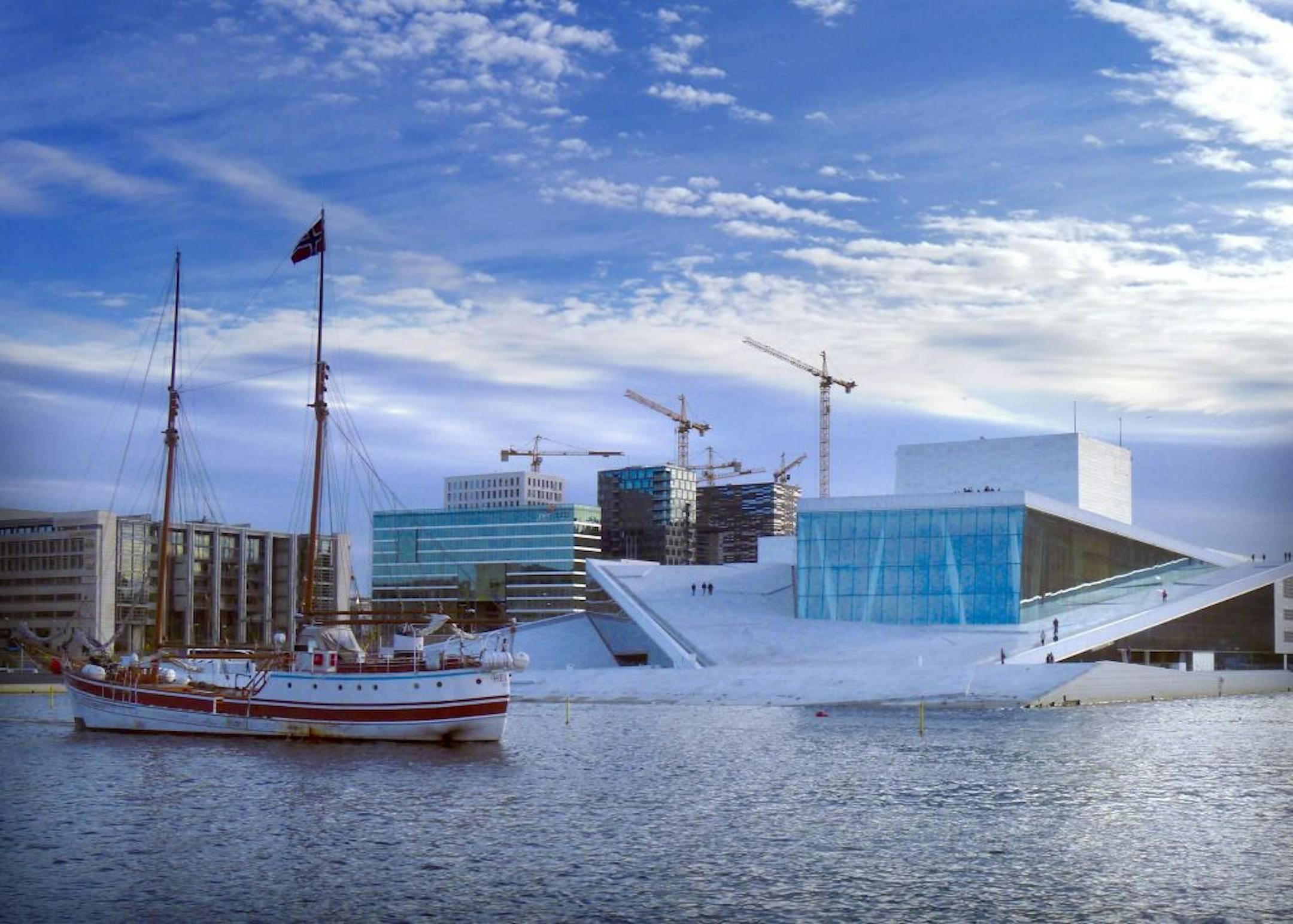
There still may be an Old Country throughout Norway, but not in its capital city, where new structures are not only cool, but iconic, and ancient neighborhoods are as heady as a shot of aquavit.
Consider the stunning Oslo Opera House. With its sharp angles of white marble and blue glass, it resembles the tip of an iceberg bobbing in the fjord. The building, which opened in 2008, seems like the icon destined to define modern Oslo, drawing comparisons to the distinctive sails of the Sydney Opera House.
Oh, but then you visit the engineering marvel of the Holmenkollen Ski Jump. The world's newest jump appears unsupported as it stretches into the sky, as slim and elegant as an egret's neck. Illuminated at night and visible from downtown, surely this is the icon destined to define modern Oslo.
Oslo, a city since 1048, is a mix of the venerable old and the cutting-edge new.
The yards-thick walls of the ancient Akershus Fortress look down on the chic restaurants of the Aker Brygge district -- including a huge T.G.I. Friday's that, to Americans, must be like Norwegians encountering the Bachelor Farmer in Minneapolis. Lofoten Fiskerestaurant is considered one of the city's finest sources of seafood, yet offers lutefisk as a specialty from October through December. At state-of-the-art Holmenkollen, folklore has a place in a 22-foot statue of a troll lurking among a stand of pines at the foot of the jump.
Holmenkollen also is home to the world's oldest ski museum, covering more than 4,000 years of people schussing, exploring and competing on slats of wood.
A spacious viewing platform at the top affords a stunning vista of Oslo and islands dappling the fjord. An open field visible on Bygdøy, one of the larger islands, is part of the Royal Farm that the king and queen use as their summer residence. The city itself lies in a gentle bowl, and the roots of the name Oslo are in the word "meadow." It's all very bucolic.
The atmosphere at the top of the ski jump, however, is not. In fact, one of the notable design features is a permanent windscreen of steel mesh and glass panels that protects jumpers from the buffeting winds. Then the Danish architects took function and made it fantastical by illuminating the jump with lights that cast an otherworldly glow into the sky. On a hill that has hosted ski jump competitions since 1892, the rising beam is meant to symbolize "extending tradition."


