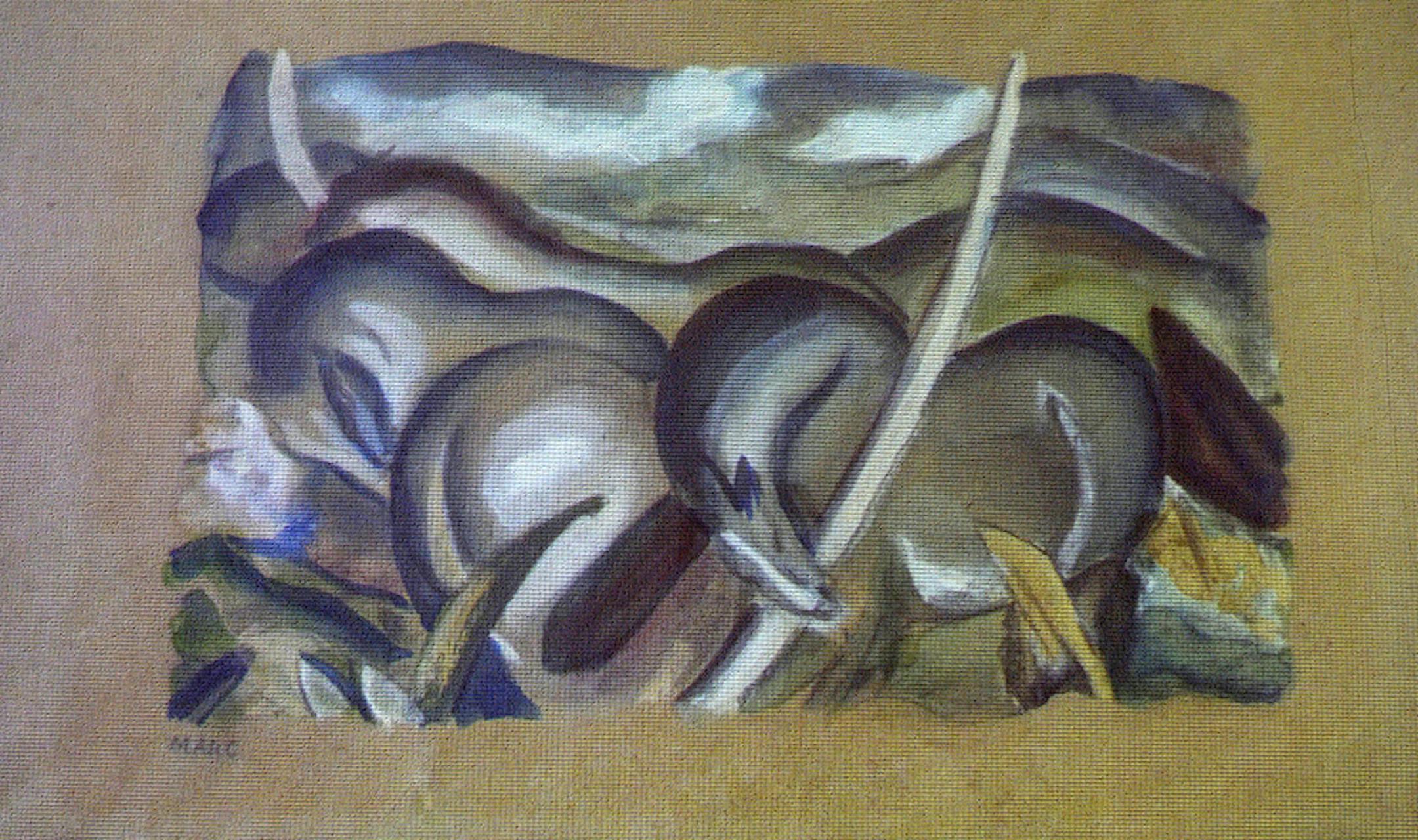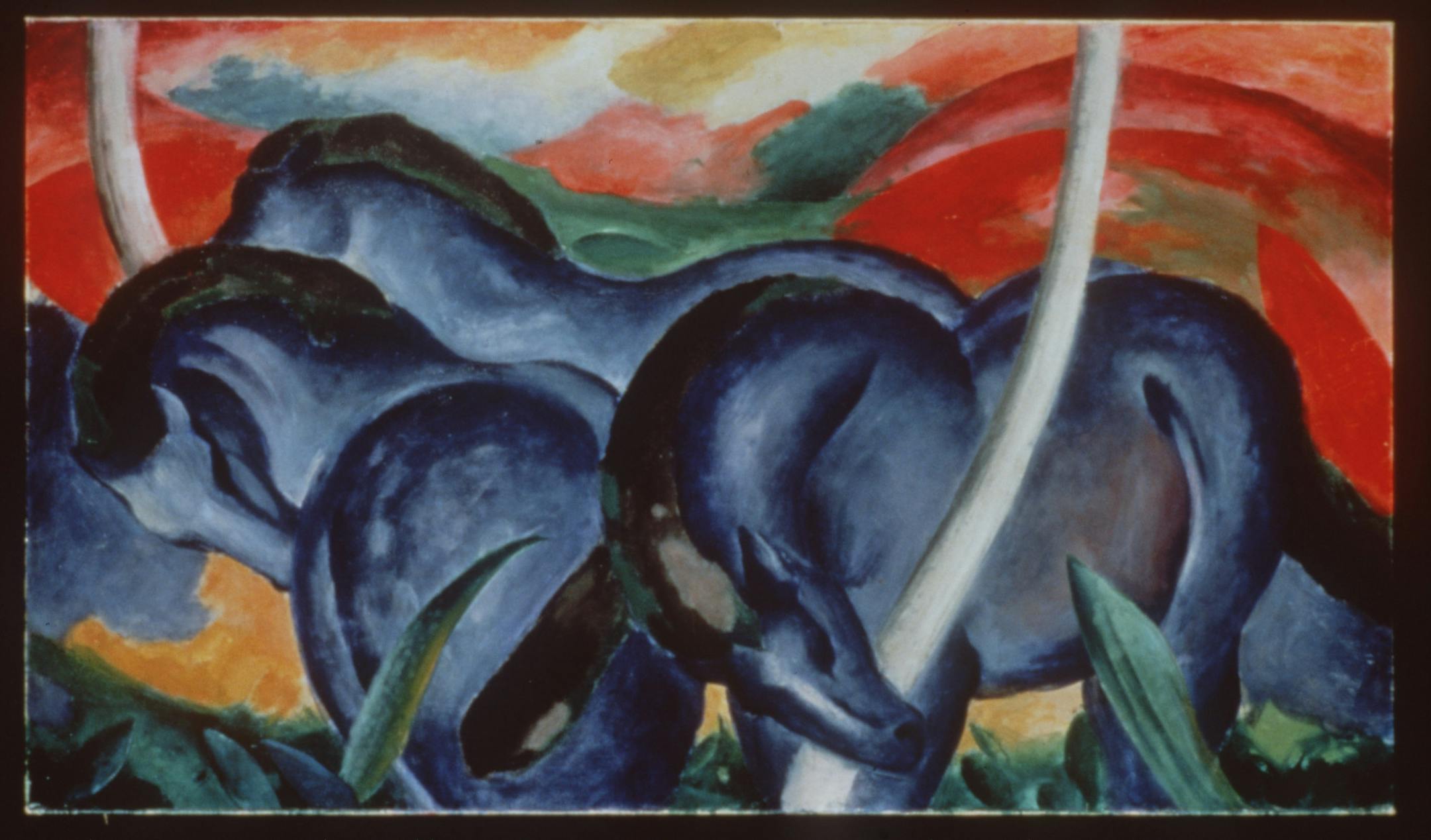
The recent discovery in Germany of 1,400 artworks apparently stolen by the Nazis sparked a worldwide buzz, especially in Minneapolis, where Walker Art Center owns a masterpiece that bears a startling resemblance to one of the long-hidden images.
The Walker's painting, "The Large Blue Horses" by Franz Marc, is a sensuous 6-foot-wide picture of three cobalt-blue animals preening in a red and yellow landscape. The symbolic image has been a Walker favorite since it was acquired the very week that the Japanese bombed Pearl Harbor and plunged the United States into World War II.
The newly discovered German work is more enigmatic. Judging from an image released this month, it is almost identical to the Walker's painting in composition, with three curvaceous horses nuzzling in front of undulating hills, but in naturalistic shades of taupe and gray. It appears to be a watercolor, pastel or gouache and is likely much smaller than the Walker's big oil painting.
German officials have not released any information about it, so experts are reluctant to speculate about the pictures' relationship. "We don't want to make any assumptions about whether it was a study, or another version, or a drawing done after the painting," said Walker curator Siri Engberg.
A billion-dollar hoard
No one is certain where the newfound Marc came from. In February 2012, German officials found it with a horde of art in the Munich apartment of Cornelius Gurlitt, an 80-something recluse whose father had sold art on behalf of the Nazis during WWII. A German magazine estimated the art to be worth upward of $1.35 billion.
Officials are still unraveling the case and have not even published a list of the art, let alone tracked down the museums, collectors and heirs who might claim it. That process is expected to take years. Based on an important Marc catalog, some scholars think the work was owned by the Moritzburg Museum in Halle, Germany.
"The whole discovery is astounding," said Joan Rothfuss, a former Walker curator who helped organize a 2001 show of paintings by Marc and others that traveled to Germany. "What's interesting is to compare this mostly monochromatic piece and the Walker's painting, which is a riot of color. Is it a study? Or a version in which he just worked out his composition?"
Marc masterpiece
The Walker's painting is "one of Franz Marc's great masterpieces," said Peter Nisbet, chief curator at the Ackland Art Museum in Chapel Hill, N.C., and an expert on 20th-century German art who was lead curator of the 2001 exhibit.