
Opinion | Smaller classes mean restored trust in Minneapolis Public Schools

New enforceable limits bring classrooms closer to research-backed optimal sizes. Now the district must deliver.

November 14, 2025 at 7:16PM
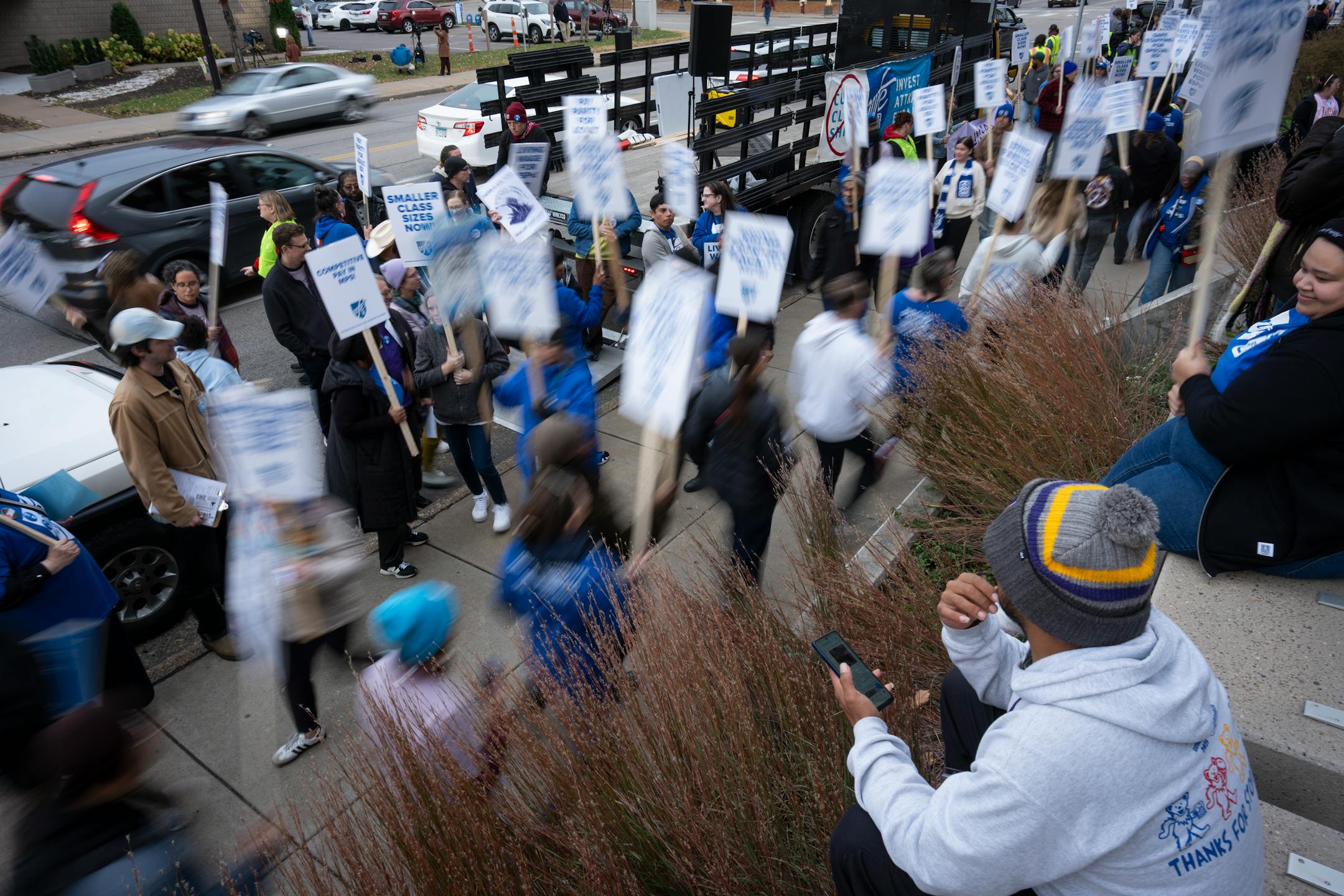
Hundreds of people march with signs during a Minneapolis Federation of Educators rally at Minneapolis Public School headquarters on Oct. 28. (Renée Jones Schneider/The Minnesota Star Tribune)

Opinion editor’s note: Strib Voices publishes a mix of guest commentaries online and in print each day. To contribute, click here.

•••

Minneapolis Public Schools has lost nearly 1 in 4 students since 2018, a sharper decline than any other large district in Minnesota. Parents cite many reasons, but one comes up again and again: classrooms too crowded for real learning.

This isn’t about teacher quality. Parents still trust teachers. What they don’t trust is a system that allowed classrooms to become too crowded for students to feel seen, supported or challenged. The newly negotiated teacher contract, which includes enforceable class-size caps, is a needed reset.

For the first time, the district is bound by class-size limits — the core demand teachers fought for, joined by parents who insisted the numbers mean something.

According to figures shared by the Minneapolis Federation of Educators, the new agreement lowers the maximum class size across nearly all grades by roughly 10 to 15%: Kindergarten and first grade now cap at 20 to 24 students, third through fifth at 24 to 29, middle school at 33 to 36, and high school at 37 to 38. For the first time, the district is bound by these limits rather than broad targets.

Teachers and parents pressed together for that accountability, including those who turned out at district offices last week to make sure the new numbers would be honored.

The progress is real, but the numbers are still too high. Even with these reductions, many classes remain above what research identifies as optimal for focused, individualized learning: roughly 15 to 20 students in early grades, 20 to 25 in upper elementary, and no more than 28 in secondary schools.

As a parent and former educator, I don’t see this as a union win or a district concession. I see it as restoring something that should never have been negotiable — the number of times in a day a teacher can truly see, reach and respond to each student.

In a room of 18, a teacher notices when a child stops trying. In a room of 30, she catches it too late. That difference is what this debate is really about.

Decades of research show what families know: smaller classes work. Tennessee’s Project STAR experiment, still the only large-scale randomized study in U.S. education, found that students in smaller classes learned more in every subject, especially in the early grades. Princeton economist Alan Krueger confirmed the gains, and Harvard’s Raj Chetty extended the analysis in a 2011 American Economic Review study, showing that the advantages persisted into adulthood through higher earnings and broader life outcomes.

Globally, this pattern holds. The OECD’s Education at a Glance report makes the connection clear: Countries with top-performing systems — Finland, Japan, Denmark — keep class sizes small enough for teachers to reach every student, every day.

We act as if large classes are an unavoidable side effect of tight budgets. They’re not. When efficiency becomes the goal, schools lose what no spreadsheet can measure: the instant when learning becomes visible, when a teacher sees a student grasp an idea that once felt out of reach.

Ask any teacher about class size, and they won’t quote averages. They’ll describe a room quiet and calm enough to work. In a small class, there’s time to stop at a desk, notice confusion, and stay until it’s resolved. In a large class, the teacher is moving constantly — skimming, redirecting, trying to give everyone just enough, knowing some won’t get what they need.

Private schools average about 17 students per class; public schools 22 to 24, based on national data. Smaller classes give teachers more time with students. That shouldn’t require tuition to achieve.

Even a small increase in class size changes everything. When a room grows from 20 to 26, each added student divides the teacher’s attention a little further, leaving less time to move through the room and notice who needs help. Quiet students slip through. What’s saved in staffing is lost in connection and learning.

That’s why this moment matters. These limits, though imperfect, represent a standard — the first in years forged by shared insistence. Families and teachers have a measure they can hold the district to. It’s not a final victory, but it’s a start toward rebuilding trust.

School board members appear to understand the stakes. Teachers and families certainly do. The question now is whether district leadership will follow through.

Class size is more than a statistic; it reveals how much human presence we’re willing to afford our children in the hours that shape them most.

The contract has drawn a line. If the district keeps it, Minneapolis can begin rebuilding the faith that public education still belongs to everyone — and that learning, here, still happens one child at a time.

Edward F. Kouneski is a psychologist emeritus based in Minneapolis who writes about health, education, ethics and public policy.

about the writer

about the writer

Edward F. Kouneski

More from Commentaries

See More
card image
Tribune News Service

By partnering with trusted faith-based providers embedded in the communities they serve.

card image
card image