

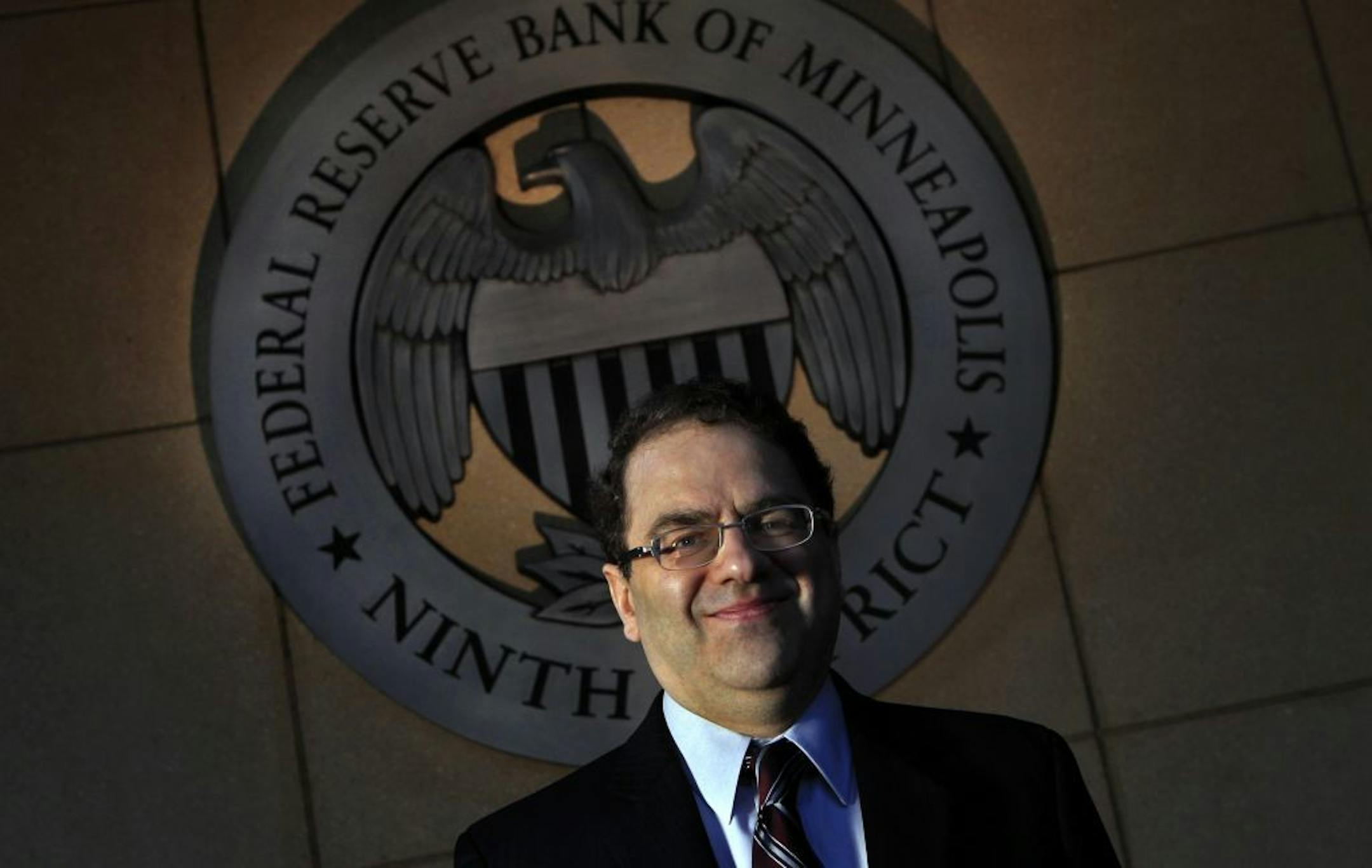
The Federal Reserve's transparency campaign swept into Minnesota on Tuesday, as Minneapolis Fed President Narayana Kocherlakota delivered his first-ever media briefing on the state's economy.
Speaking at the headquarters of the Federal Reserve's Ninth District in downtown Minneapolis, Kocherlakota outlined the state's better-than-average progress recovering from the Great Recession and forecast a slow national recovery. He said he expects real national gross domestic product to grow at an annual rate of between 2.5 percent and 3 percent in each of the next two years, slightly faster than the 1.6 percent growth in 2011.
The biggest news from the briefing, however, may be that it occurred at all. Under Fed Chairman Ben Bernanke, the once-secretive interest rate-setting body has been airing its views more directly about policy decisions and the direction of the economy -- letting the public and market movers peek behind the curtain in Oz.
Kocherlakota nudged the Fed's new open-door policy a crack further, saying he thinks the Fed "should be much more clear" about the trade-offs between unemployment and inflation -- the Fed's two mandates, which are often in conflict.
Kocherlakota said his forecast is that national unemployment will fall to about 7.7 percent by the end of the year and drop to 7 percent by the end of 2013. Inflation, including food and energy prices, will hover around 2 percent this year and rise to 2.3 percent next year "as monetary policy remains highly accommodative."
Minnesota's economy may be struggling, but it's "further along the recovery path than the national recovery," Kocherlakota said, noting that at 5.7 percent, the state's unemployment rate is significantly lower than the nation's at 8.5 percent.
The next key reading on the state's employment picture will be new job numbers that come out March 1.
Minnesota's economy is recovering faster than most, Kocherlakota said, largely because the state's workforce is more highly educated, buffering workers from the worst ravages of the recession, and the state's real estate market didn't suffer the extremes other areas did when the housing bubble burst.


![Attendees of Frostbike made their way through the convention Saturday at the Quality Bike Products campus in Minneapolis. ] (AARON LAVINSKY/STAR TRIBUNE) aaron.lavinsky@startribune.com Frostbike 2016 was held at the Quality Bike Products Campus on Saturday, Feb. 27, 2016 in Bloomington, Minn.](https://arc.stimg.co/startribunemedia/NH2BSHB74ND2V6GF2G2HI5X4MM.jpg?&w=252&ar=3:2&fit=crop)
