Even England's Prince William and Kate, his commoner bride-to-be, will live modestly compared with Russian royals of yore. When she died in 1796, Catherine the Great had 15,000 gowns stashed in her summer palace alone. When Nicholas I ordered new china, he planned to seat 500.
Life on such an extravagant scale is difficult to imagine today by anyone but employees of those top five Wall Street banks that this year set aside nearly $90 billion to divvy up in "compensation." But let's not digress into contemporary inequalities when the Museum of Russian Art is offering "Dinner With the Tsars: Russian Imperial Porcelain." On view through Aug. 7, the show is a delicious visual feast that lays out a tabletop history of Russia from the 1744 founding of the Imperial Porcelain Factory to the 1917 Bolshevik revolution that brought the abdication and bloody death of the last tsar, Nicholas II.
Why porcelain? As a subject on which to hang history, the stuff is perfect. Invented in China, porcelain was a rare and precious import in Europe until German chemists discovered the secret of its manufacture in the early 1700s. From then on European courts competed to produce wares to advertise their country's superior technical accomplishments and artistry. Expensive and fragile, porcelain was the era's ultimate luxury good, so pricey that -- according to an exhibition panel -- it was at first used only for state occasions. For daily use, the royals had to make do with gold and silver tableware!
Changes in rule and style
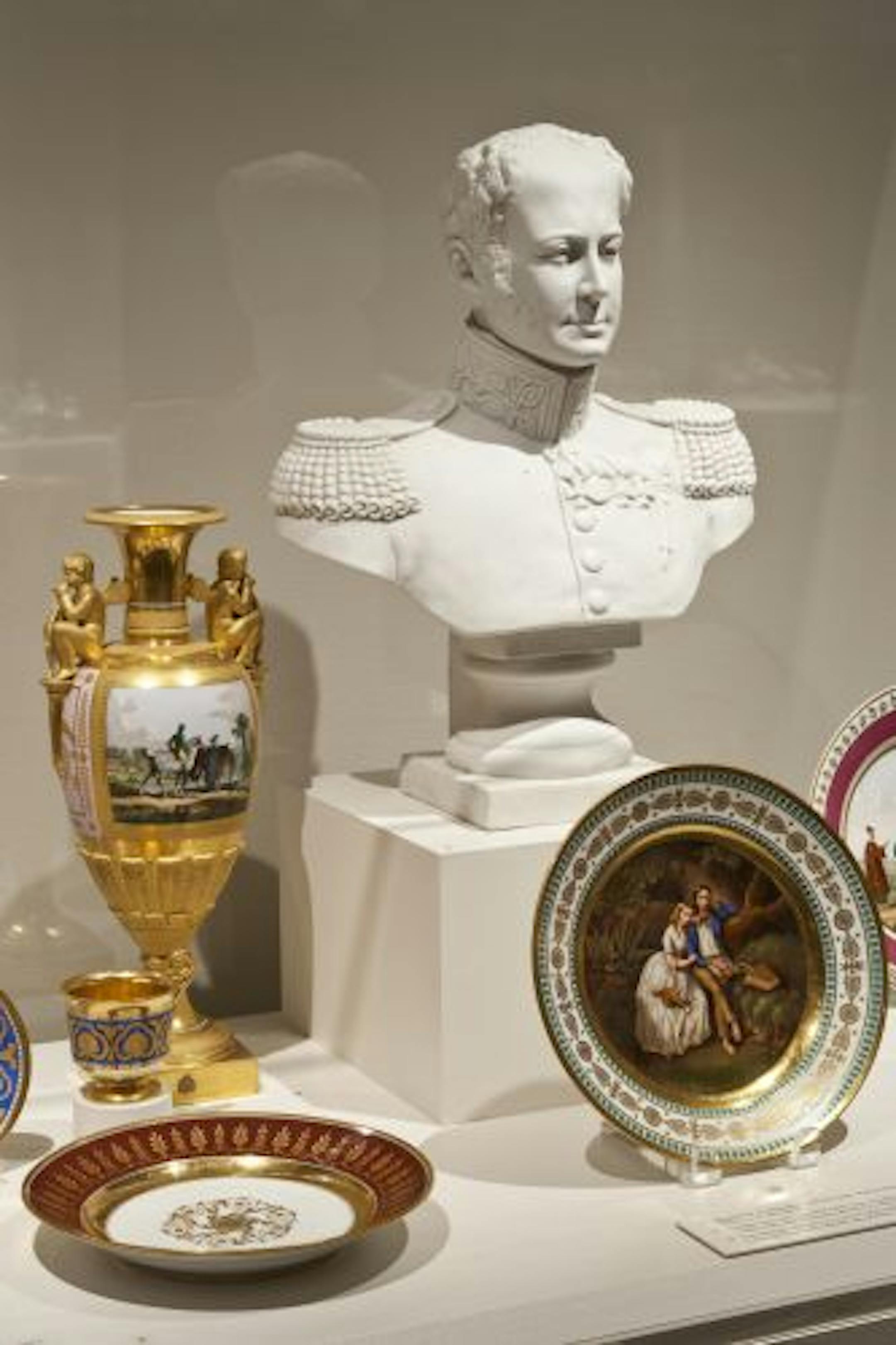
In an exceptionally beautiful installation, the show unfolds chronologically, punctuated by handsome banners that summarize the reigns of eight tsars and divide the gallery into intimate alcoves filled with cases of porcelain from their eras. Original menus from the coronation dinners of Alexander III (1883) and Nicholas II (1896), plus a menu for a 1913 dinner marking the 300th anniversary of the House of Romanov, introduce the exhibit on a sumptuously festive and poignant note. Only four years after Nicholas and his guests sipped Victoria punch and dined on turtle soup and saddle of wild goat at that anniversary dinner, the tsar and his family were slaughtered in a cellar and their bodies dumped into hasty graves in a nearby forest.
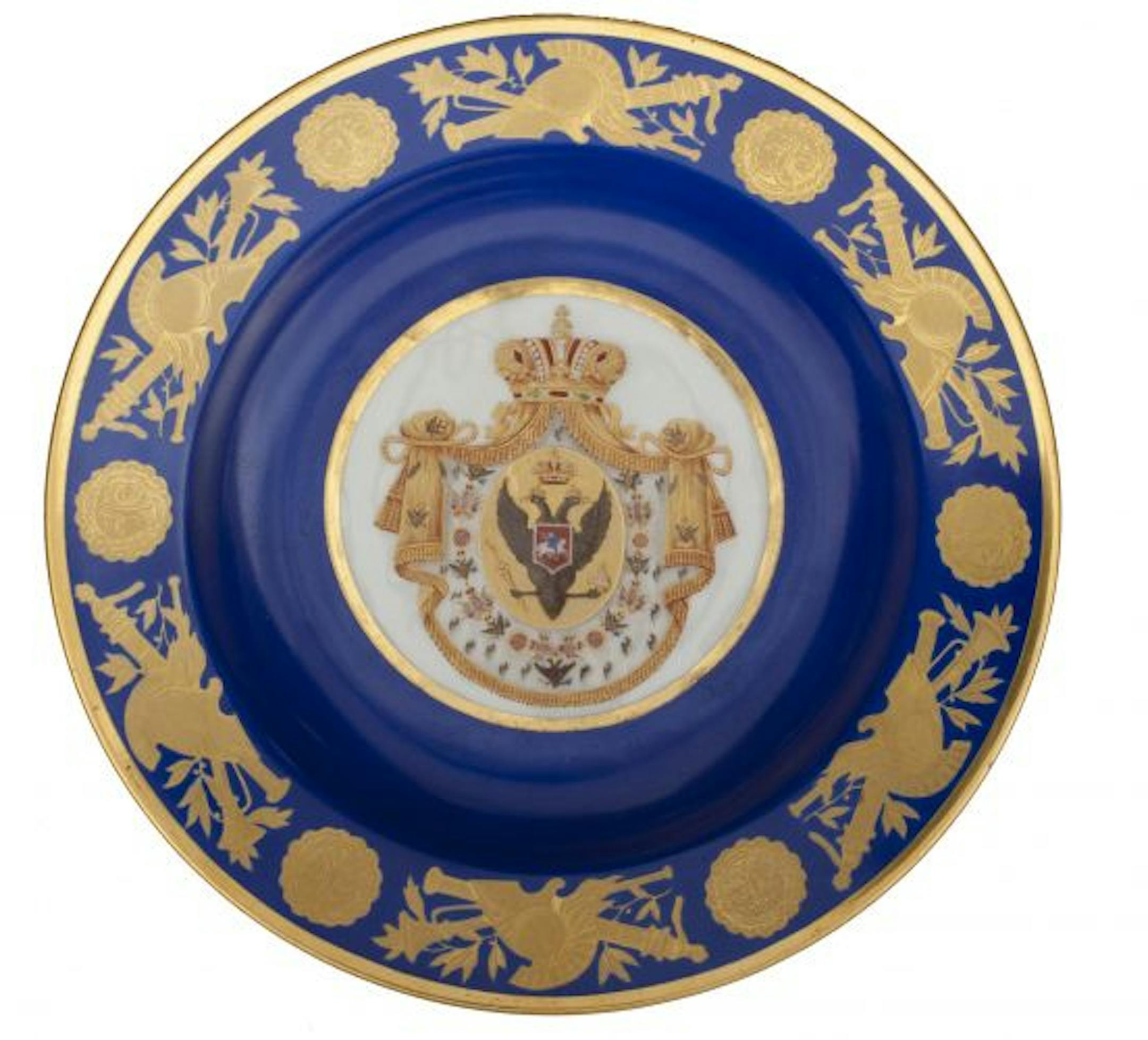
Products of the Imperial Porcelain Factory offer an index of ever-changing taste. The earliest pieces have light, floral decorations or hand-painted scenes of Rome and other European sites. Catherine the Great (1762-96), who seized power by deposing her husband in a coup, gave her supporters bowls decorated with imperial emblems. Catherine herself appears in an almost life-size bust, sporting a crown of laurel leaves.
Her son and successor, Paul I, was a nasty autocrat who ruled only five years before he was murdered in his bedroom by a group of nobles. Still, he managed to marry off several of his daughters into European courts and provide pretty porcelain dowries for each. His son Alexander I fared better, reigning a quarter-century during which the Russians vanquished Napoleon and introduced native motifs -- Russian scenes and people -- on neoclassical china.
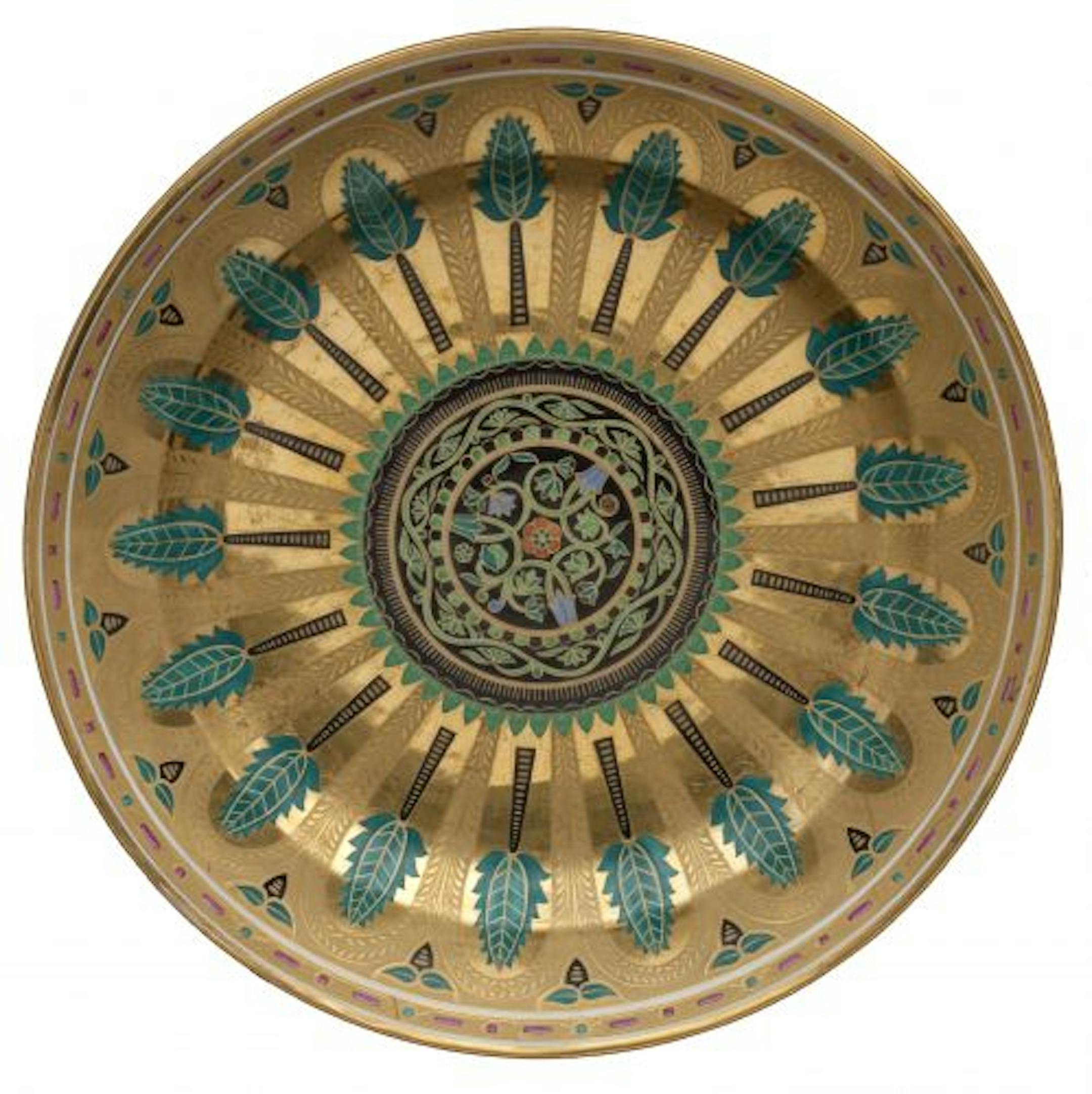
Patriotic themes continued under Nicholas I (1825-55), who revived historical styles to reinforce his governing motto, "Orthodoxy, Autocracy and Nation." No shirker in the china department, he commissioned the show's most lavish and distinctively Russian porcelain, the "Kremlin Service" -- 4,000 gold-encrusted plates and bowls whose ornate designs echo ancient Byzantine motifs.