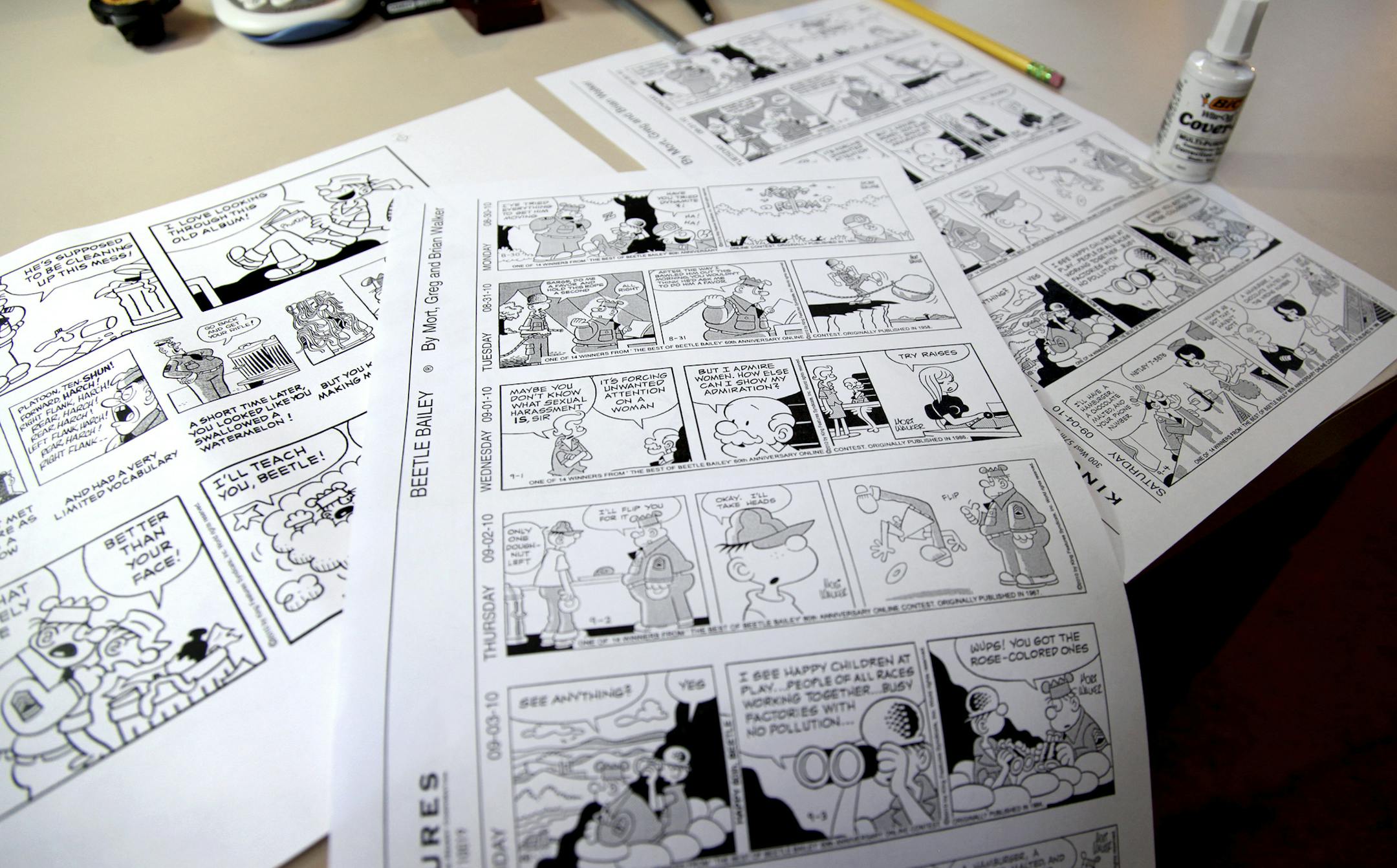
Mort Walker, whose "Beetle Bailey" comic strip followed the exploits of a lazy G.I. and his inept cohorts at the dysfunctional Camp Swampy, and whose dedication to his art form led him to found the first museum devoted to the history of cartooning, died Saturday at his home in Stamford, Conn. He was 94.
In contrast with the work-shirking soldier he immortalized, Walker was a man of considerable drive and ambition. He drew his daily comic strip for 68 years, longer than any other U.S. artist in the history of the medium.
Debuting in 1950, "Beetle Bailey" was distributed by King Features Syndicate and eventually reached 200 million readers in 1,800 newspapers in more than 50 countries. Beetle and company appeared in comic books, TV cartoons, games and toys and were also featured in a musical with the book by Walker, as well as on a U.S. postal stamp in 2010.
"Beetle Bailey" was among the first cartoons to mark a shift in the funny pages from the serial strips of the previous decade to the graphically simpler gag-a-day model that predominates today.
Beetle's cast includes the title character, a lanky goof-off whose eyes are always covered by the visor of his hat or helmet; his rotund nemesis, Sgt. Snorkel, a violent but sentimental man who frequently beat Beetle to a pulp of squiggly lines; the ineffectual Gen. Halftrack, who ran Camp Swampy (a place the Pentagon had lost track of); Halftrack's voluptuous secretary, Miss Buxley; Cookie, the chef and purveyor of inedible meatballs; and the bumpkin Pvt. Zero.
The characters never saw battle, and weapons and uniforms were not updated. Walker said the military setting was simply a convenient stand-in for the pecking order of which everyone is a part.
Comics historian R.C. Harvey wrote that the strip "gives expression to our resentment by ridiculing traditional authority figures and by demonstrating, with Beetle, how to survive through the diligent application of sheer lethargy and studied indifference."
Starting in 1954, Walker wrote another hit cartoon, the widely syndicated family strip "Hi and Lois," originally illustrated by Dik Browne (later the creator of "Hägar the Horrible"). Walker said he wanted to depict a loving family "together against the world … instead of against each other."