

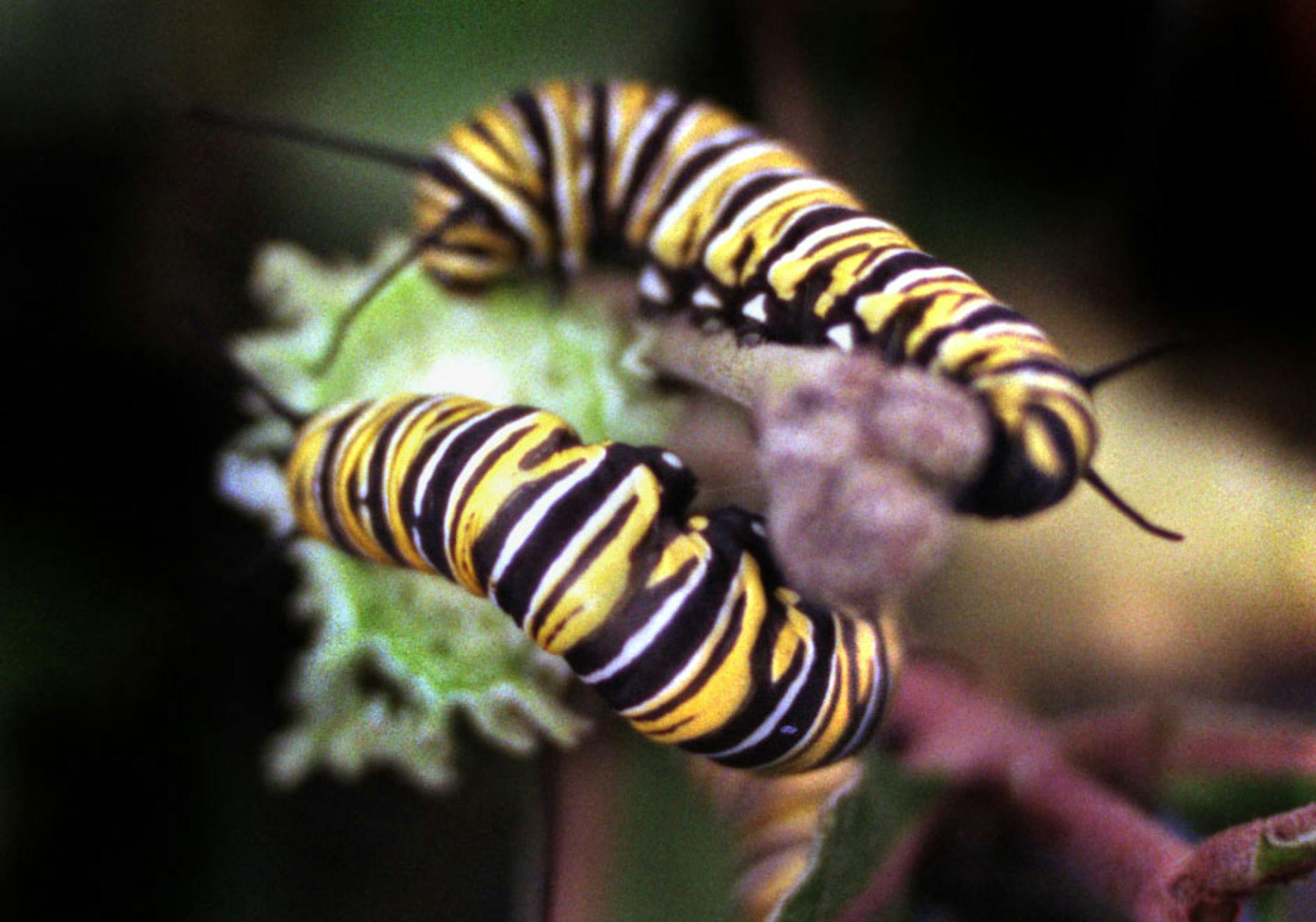
BUTTERFLIES IN DANGER
Monarch's woes linked to milkweed
The more you know about monarch butterflies, the more extraordinary they seem. Their life cycle — the adaptive web of behaviors they have evolved — is almost unbelievably complex. They migrate en masse (this month, as a rule) from all across the Midwest and Northeast to just a few high-altitude sites in Mexico, where they winter, sheltering in profusion beneath a canopy of fir trees, from whose trunks they draw the residual heat they need to stay alive. Winter past, they migrate thousands of miles northward, where they lay their eggs on milkweed plants, the only plant a monarch caterpillar can eat.
The complexity of their life cycle is mirrored by the complexity of the threats they face. For the past 15 years, scientists have been watching monarch numbers plummet, as much as 81 percent between 1999 and 2010.
A few weeks ago, one of the scientists devoted to studying monarchs, Ernest Williams at Hamilton College, summarized for me the threats that have been reported in recent studies.
Nearly every link in the monarchs' chain of being, he said, is at risk. Illegal logging in Mexico has reduced their winter habitat — an already vanishingly small area, which is itself being altered by the warming climate. Ecotourists who come to witness the congregation of so many butterflies disturb the creatures they have come to see. But perhaps most damaging is the demise of milkweed.
Monarchs have the misfortune to rely exclusively on a plant that farmers all across the Midwest and Northeast consider a weed. There is a direct parallel between the demise of milkweeds and the steady drop in monarch numbers.
To anyone who has grown up in the Midwest, the result seems very strange. After decades of trying to eradicate milkweed, gardeners are being encouraged to plant it in their gardens, and townships and counties are being asked to let it thrive in the roadside ditches. What looks like agricultural success, purging bean and cornfields of milkweed (among other weeds), turns out to be butterfly disaster. This is the great puzzle of species conservation — it has to be effective at nearly every stage of a species' life cycle. And this, too, is the dilemma of human behavior. We live in a world of unintended consequences of our own making, which can never be easily undone.


