New Vikings QB Carson Wentz will need more help than J.J. McCarthy got vs. Falcons

A look at the film from Sunday’s loss shows that J.J. McCarthy’s second NFL start was undercut by poor blocking, bad timing and a curious lack of quicker pass plays.

The Minnesota Star Tribune
September 17, 2025 at 1:00PM
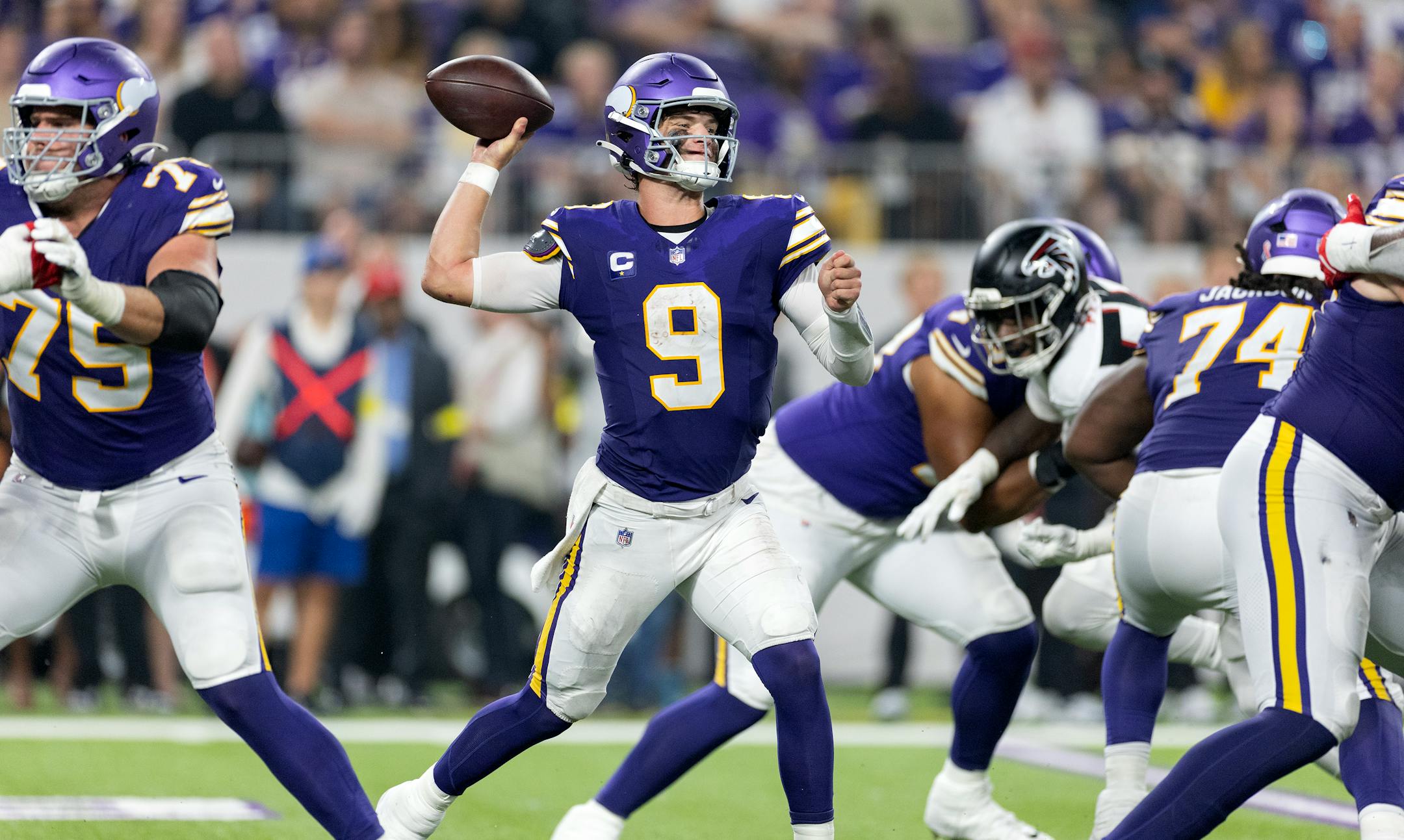
Film from the Falcons loss shows mistakes made by the rookie left guard, the team captain right tackle and quarterback J.J. McCarthy. (Carlos Gonzalez/The Minnesota Star Tribune)

If new Vikings quarterback Carson Wentz is going to have more success than injured quarterback J.J. McCarthy, Wentz will need more help than what McCarthy was given in Sunday night’s loss to the Falcons.

That means better blocking from offensive linemen, tight ends and receivers.

That means quicker developing pass plays if that blocking is not reliable.

Coordinator Wes Phillips told reporters on Tuesday that too often somebody wasn’t doing their job within the relatively few plays — just 46 — generated on offense. He pointed to a couple examples like the 19-yard throw to receiver Adam Thielen and the 17-yard throw to receiver Jalen Nailor when everyone, including McCarthy, was on point.

“The more of that we can get,” Phillips said, “I think you’ll start to see our offense grow more and more. There is an aspect as well of us learning not only J.J.’s strengths, Carson Wentz coming in, our offensive line — what schemes they are really taking to.”

Ready, set, go? Coaches haven’t had long to learn about Wentz, the 10th-year veteran on his sixth NFL team. He’s been with the Vikings for three weeks. But what’s clear is he isn’t walking into a finely-tuned machine. Film from the Falcons loss shows mistakes made by everyone from the rookie left guard to the team captain right tackle.
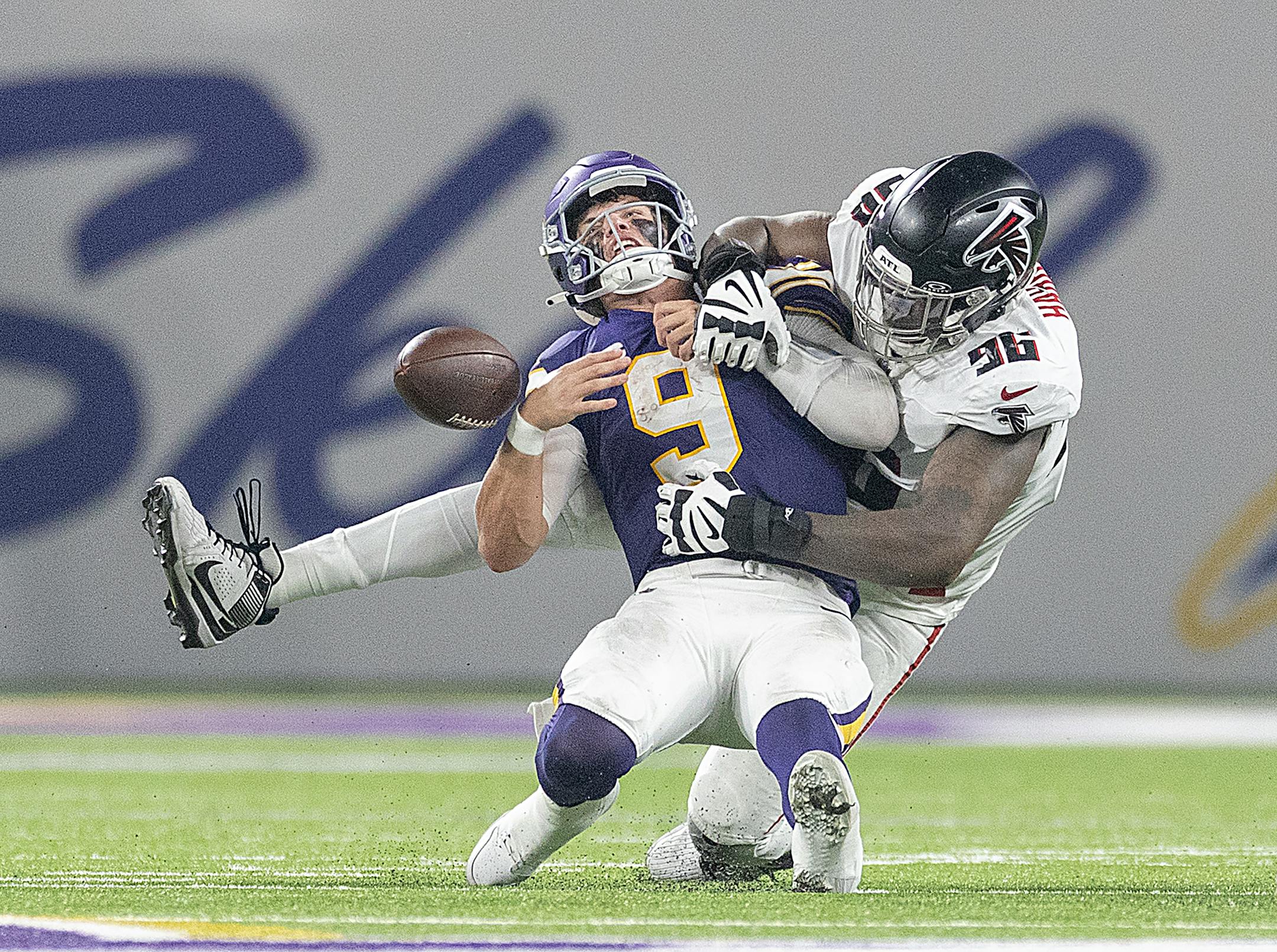
Vikings coaches didn't point fingers at who was responsible for this strip sack of J.J. McCarthy (9) by Falcons defensive end Zach Harrison (96). (Elizabeth Flores/The Minnesota Star Tribune)

Pass protection not ‘on same page’

The Atlanta Falcons can’t produce a 53.3% pressure rate, the franchise’s best pass-rushing game in seven years, without unforced errors by the Vikings.

Coaches didn’t point fingers at who, exactly, was at fault for the strip sack in the fourth quarter. But right tackle Brian O’Neill appears to leave an unblocked edge rusher off his side, leading to the sack. Phillips alluded to not everyone having the protection call that is supposed to be communicated before the snap by the center, who at the time was backup Michael Jurgens, and McCarthy.

ADVERTISEMENT

“That’s a play where we should have that defensive end blocked,” Phillips said, “and we just have to be on the same page across the board.”

The Falcons sacked McCarthy six times. Two came via unblocked defenders.

O’Neill also does not appear to be on the same page in this video below. You’ll see the offensive line slide right, except O’Neill’s first step is to his left. This pinches right guard Will Fries and leaves an unblocked edge rusher off the right side. Running back Jordan Mason is presumably supposed to cross McCarthy’s face and pick up the edge rusher on the left side. Mason stops and neither edge rusher gets blocked.

The Vikings’ O-line also struggled to pick up the Falcons’ defensive line movement. Atlanta wasn’t simply rushing straight ahead. They ran many twists, also called “stunts” or “games,” that Vikings’ interior blockers didn’t always pass off to each other.

On the opening third-and-7, when McCarthy scrambled for 6 yards, a Falcons twist generated quick pressure past center Ryan Kelly and Fries — a duo that has played many games together going back to Indianapolis.

“They showed the twists up front that we were prepared for,” said Jurgens, who played 24 snaps (51%) after Kelly exited with a concussion. “We’ve seen twists a million times from every defense, so we have to be ready for that.”

On a third-and-2 in the first half, McCarthy was sacked again.

The Falcons were aggressive defensively. They played more “base,” or standard run-stopping personnel, against the Vikings’ three-receiver groupings that are meant to get defenses into lighter formations with more defensive backs.

But even when the Falcons matched lightweight-for-lightweight personnel, like on this third-and-2 below, the Vikings couldn’t block. The Falcons show six defenders at the line and send a five-man blitz. Tight end T.J. Hockenson and Mason seal the left edge, leaving two rushers for left tackle Justin Skule and rookie left guard Donovan Jackson. Watch as Jackson (74) misses a looping Falcons edge rusher James Pearce Jr. (27) from his outside.

McCarthy’s poor vision, timing

Plenty of issues surrounded McCarthy, but the 22-year-old quarterback’s decision making and timing left plays on the field. Coaches are likely hoping Wentz can better play on schedule and find the one-on-one opportunities as he goes from options No. 1 to No. 2 to No. 3 in the progression.

Among the six sacks on McCarthy, there was at least one — on third-and-14 in the red zone after Skule was beaten for a different sack — that was solely on the quarterback.

In the video below, you’ll see McCarthy’s internal clock tick too quickly as he flees a clean pocket and leaves Nailor (1) with a void toward the left end zone. You’ve probably heard that McCarthy doesn’t often throw to his left, and he does not see this opportunity. He runs into a sack.

McCarthy wasn’t quick enough with his decision making or throws.

In the third quarter, McCarthy nearly threw another pick to Falcons cornerback Billy Bowman Jr. when he was a tick late on a pass to Hockenson.

The video below highlights the brief window to Hockenson (87), who gets open against Bowman (in zone coverage leverage with his back to the sideline). This is a fine read by McCarthy if the throw comes quick enough. There’s also more meat left on the bone as Nailor (1) nicely snaps off his deep route and has good leverage against the defender farther down the same side of the field.

Quicker throws coming from Wentz?

McCarthy’s average time to throw of 3.15 seconds is the second-longest in the league through two weeks, according NFL Next Gen Stats.

This is affected not only by slower decision making, but also longer-developing pass plays. McCarthy is averaging the second-most air yardage per attempt while getting very little from receivers after the catch.

So, where are the quick passes? The screens that we saw during training camp?

Phillips, the offensive coordinator, said coaches have talked about implementing more quick throws. But those plays are not as easy to execute as they sound.

“The one thing about quick game ... the defense has to cover for this long,” said Phillips, who snapped his fingers. “It doesn’t mean you don’t like quick game, but the throws have to be — footwork and timing are essential in the quick game world. Being able to take the right footwork, seeing the defense quickly. You have to start your arm almost before you see it.”

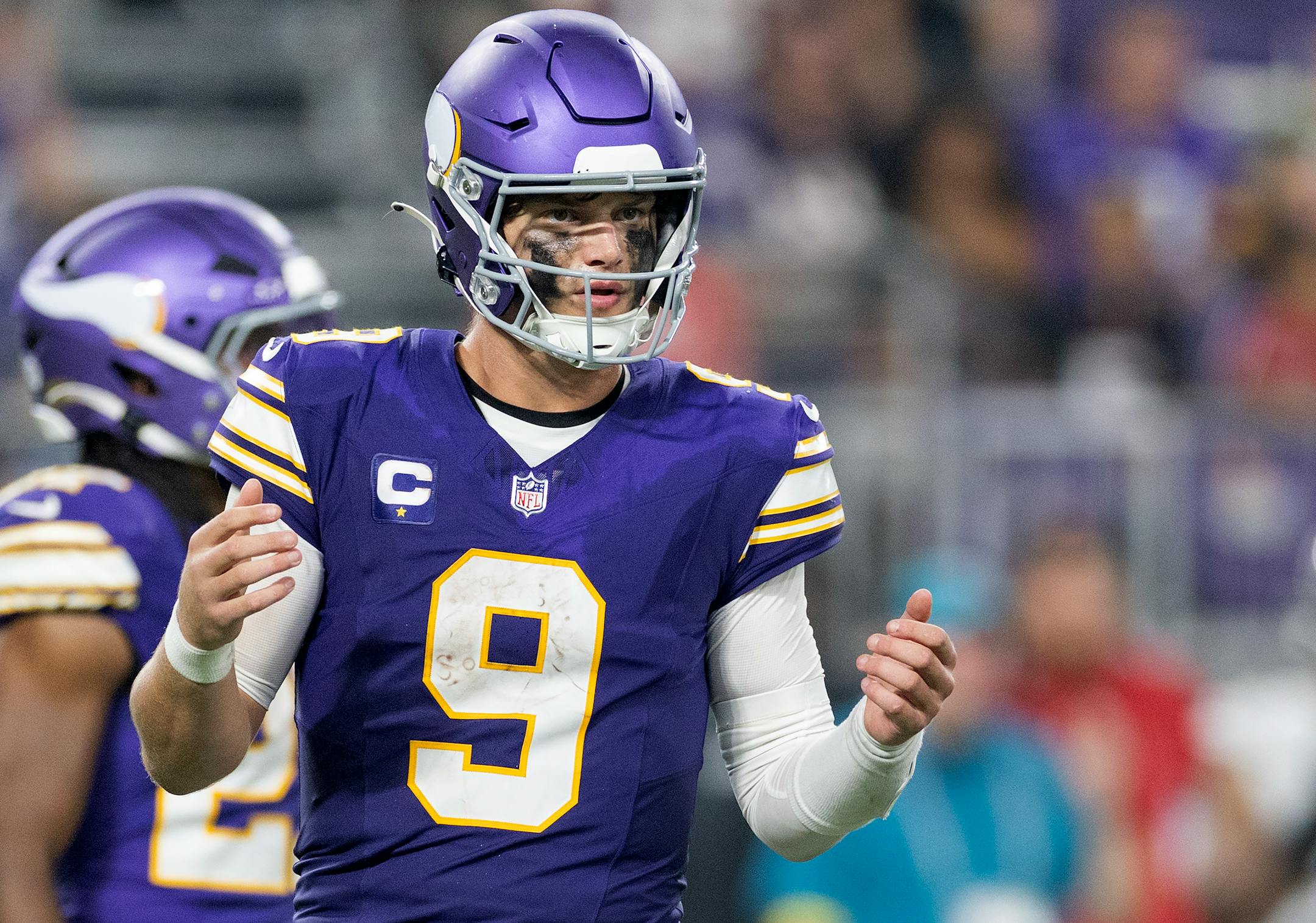
J.J. McCarthy's he 22-year-old quarterback’s decision making and timing left plays on the field. (Carlos Gonzalez/The Minnesota Star Tribune)

Does the precision of quick passes mean that’s more difficult on inexperienced quarterbacks like McCarthy?

“It’s based on the individual quarterback,” Phillips said. “Some guys love quick game and some guys don’t. ... J.J. is up for any plays scheme-wise. ... There’s some guys that have always run a lot of quick game, liked quick game. ... Fast-release guys that just want to get the ball out of their hand quickly. We got to find ways to put the ball in the hands of our playmakers, first and foremost, no matter how that is done.”

O’Connell called at least two screens vs. Atlanta. Both went nowhere.

“We don’t throw and catch one with a pretty significant chance for a gain on that play,” O’Connell said, “and then just have a mental error on another screen that ends up being a two-yard gain, when we should clearly have everybody kind of accounted for with a chance to have Jordan Mason in space with a lot of grass.”

Running back Aaron Jones dropped a screen that would’ve been a huge gain in the third quarter.

Earlier in the game, a missed block by receiver Tim Jones (14) — the “mental error” that O’Connell referenced — undercut a screen attempt to Mason. In the video below, you’ll see a slick design that uses Justin Jefferson (18) as a clear-out decoy. Jefferson’s pre-snap motion and sprint downfield serves to get the secondary on their heels before the underneath pass. This gets blocked nicely except for Tim Jones, a veteran special teamer who doesn’t play offense often.

Sign up for the free Access Vikings newsletter to get exclusive analysis in your inbox every Friday. Send us your Vikings questions at accessvikings@startribune.com.

about the writer

about the writer

Andrew Krammer

Reporter

Andrew Krammer covers the Vikings for the Minnesota Star Tribune, entering his sixth NFL season. From the Metrodome to U.S. Bank Stadium, he's reported on everything from Case Keenum's Minneapolis Miracle, the offensive line's kangaroo court to Adrian Peterson's suspension.

See Moreicon

More from Vikings

See More
card image
Elizabeth Flores/The Minnesota Star Tribune

Vikings receiver Justin Jefferson said this season is among the most difficult of his career, but he wouldn’t call it a waste of one of his prime years.

card image
card image