

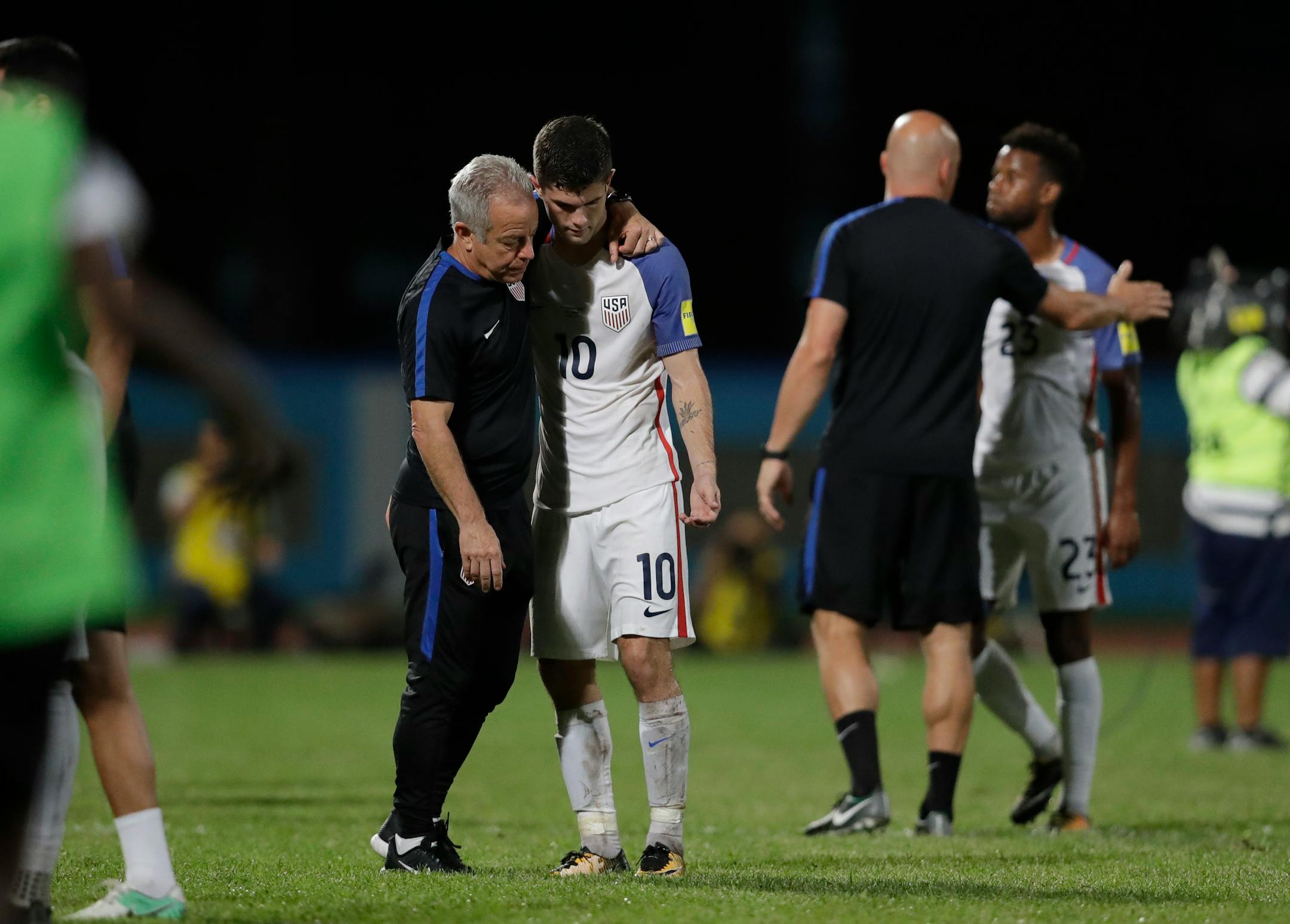
The U.S. national team's absence from the 2018 World Cup in Russia won't really strike home until June.
"Half of the population is just understanding, 'Wait, what, we're not even going to be in the World Cup that's nine months away?' " Minnesota United winger Ethan Finlay said Wednesday. "And it won't really hit the other half until they're not hearing about our team. And you'll have, I'm sure, plenty of people asking when Team USA plays after the opening ceremonies, and they'll be shocked to find out that they're not in it."
The U.S. failed to qualify for the World Cup for the first time since 1986 with Tuesday's 2-1 loss to Trinidad and Tobago (which United midfielder Kevin Molino represents, though he missed this match on a yellow card accumulation suspension). Qualifying for the World Cup is a two-year, 16-match process that saw the Americans change coaches back in November 2016.
Finlay, who played in one of the U.S.'s qualifiers in March of 2016, said it was "tough" to see the U.S. eliminated. Loons winger Miguel Ibarra, who played for the U.S. in 2014 and 2015, said he was "sad" and termed the U.S.'s absence from the global tournament "a big loss." United coach Adrian Heath, an England native, called it a "huge disappointment."
"My generation, this was our generation for the World Cup," Finlay said. "I'm not saying I was on the inside, that I was going to be there, but you never know, right?"
The U.S. finished third at the 1930 World Cup, but since then the best finish was 2002's quarterfinals appearance. Finlay said the U.S. measuring stick for most of his recent memory had been advancing out of the World Cup group stage.
"Now I look at it, and I say, 'Well, how far have we regressed then if we're not even making the World Cup?' " he said. "I don't want to say it's a catastrophic occurrence, but this is going to do one of two things, I think, for us: This is going to set us back significantly or we're going to have an incredible response, and we'll be back in a quarterfinal in four years."
Finlay put the onus on individual players, calling for all American soccer players, national team capped or not, to take responsibility to improve on a singular basis to better the collective.


