

Compared to its siblings, winter is Mother Nature's neglected child. Artistically speaking, that is.
Come the first warm spring day and the plein-air painters are out in force, propping up easels and splashing off impressions of dog walkers in motion, lilacs in bud and greening grass. Summer lures them to the lakes and fall to the fields.
Winter? Not so much. Who wants to crouch in a drift daubing freezing paint onto a stretch of cold canvas? Scrutinizing the few winter pictures in Groveland Gallery's "Scene in Minnesota" and "Fred Anderson: New Work," one reason is obvious. They look so cold and crisp. Though snow figures prominently in them, white is in surprisingly short supply. Often the tonal range runs from blue to lilac and back again. Chilly colors all.
And yet there's something invigorating about the effort to capture winter in paint.
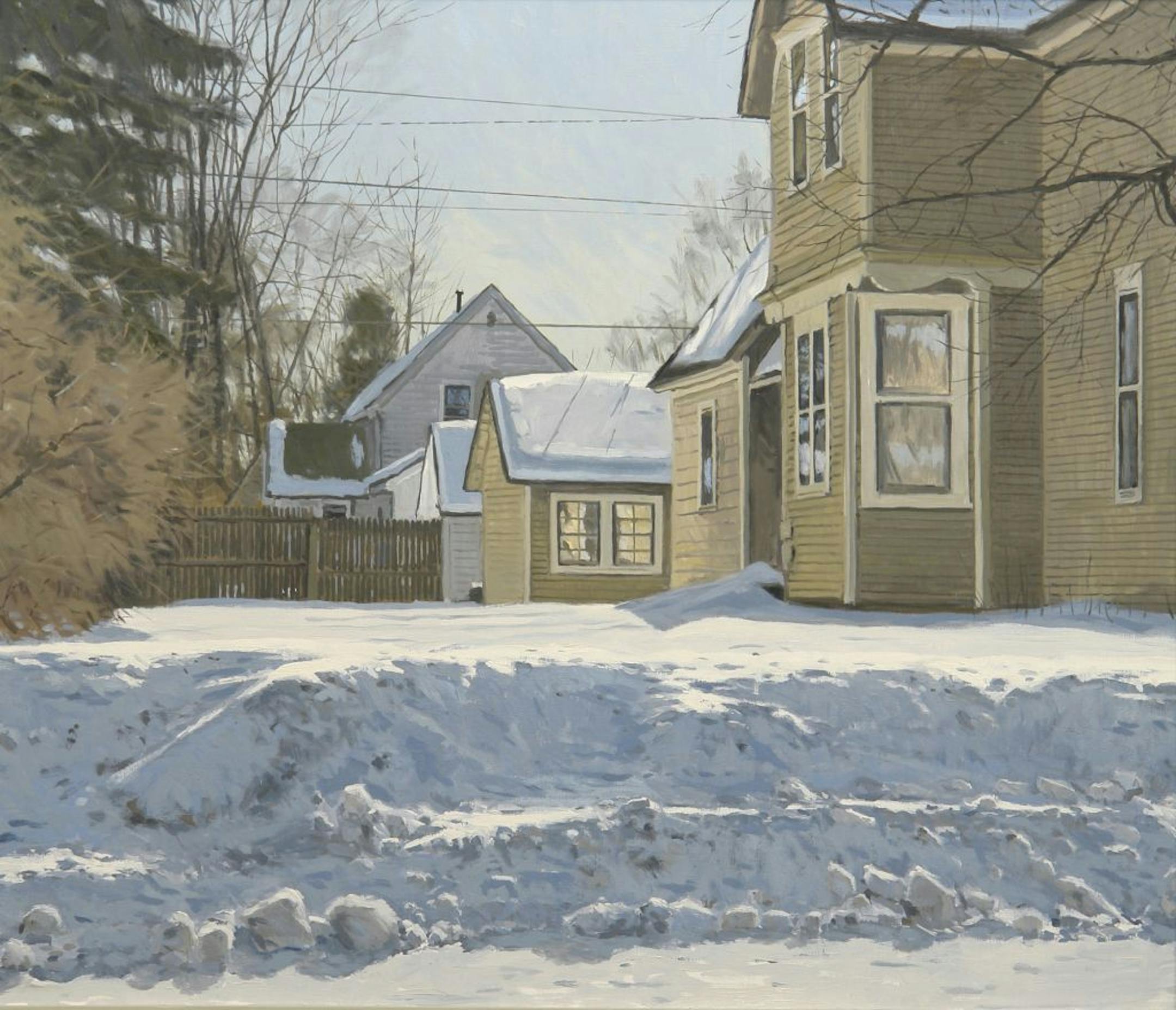
Take Anderson's "House on Second Ave," an image of a modest back yard on a sunny midwinter day. The lower two-fifths of the picture is all snow, starting from the bottom with an irregular, crunchy, hard-packed ribbon of freshly plowed driveway. Imaginative types can almost hear it squeak as they walk in the breath-catching air.
Above that there's a wide band of rutted, icy clots and ragged ridges tinged with violet, lavender and gray, with a few sketchy lines of creamy white where the sun hits them. The band is punctuated by those irksome knobs of dirty ice that street plows spit out when they accidentally block driveways just after hardworking homeowners have finished clearing them so they can drag out the recycle bins in the 6 a.m. darkness.
Atop that is a ribbon of paint that signals the glory of a Minnesota winter. As Anderson renders it, a meringue of snow spreads across the neighbor's yard, cozying up to the neat tan house that fills the upper-right corner of the painting, its windows beaming with lemony reflections of sunlight. Snow-covered roofs and walls of neighboring houses are laid out in little wedges -- triangles, parallelograms, rectangles of taupe, gray, and bruised white. And on the left, scratchy conifer boughs, bare twigs and a soft burst of tan shrubbery enclose the yard.
To the Minnesota mind, the picture reads immediately as a familiar, homey place on a sunny, 15-degree February morning. To the artist's eye and hand, the scene is an analytical challenge demanding utmost concentration. Translating a crackling crisp moment into paint requires a keen mastery of color theory, geometry, composition and painterly bravado. More than just a backyard scene, Anderson's "House on Second Ave" is a sparkling little sonata in pigment.


