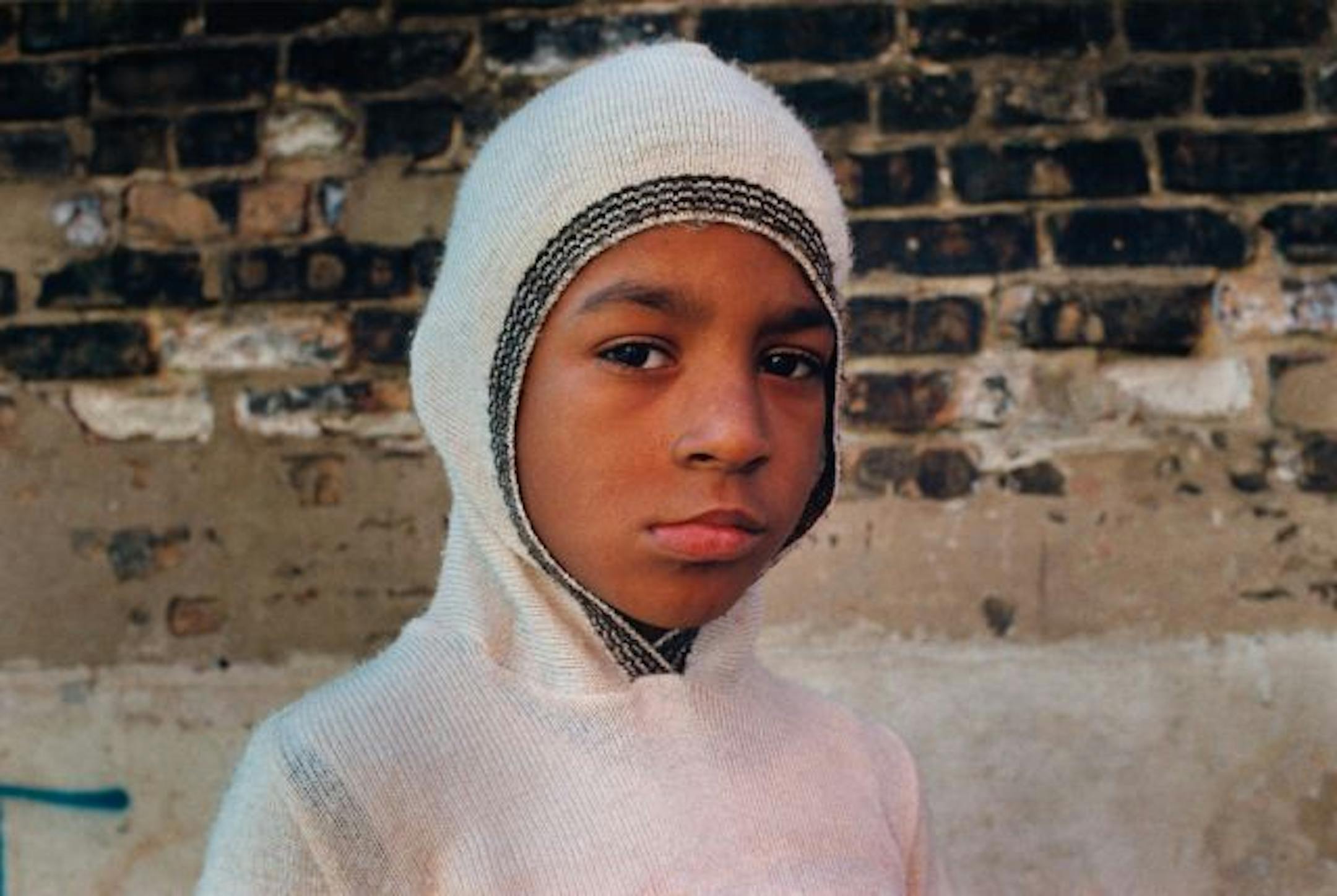
A world of trouble awaits in Robert Bergman's "Portraits: 1986-1995" at the Minneapolis Institute of Arts through Aug. 22. In 30 large, intensely colored, sometimes garish images, the photographer presents a rogues gallery of society's losers -- men, women and a few children whose worn faces, wary glances, glazed eyes and joyless mouths testify to lifetimes of abuse, neglect, homelessness, rejection, hunger and most likely addiction to drink, drugs, despair.
Bergman, a New Orleans native who now divides his time between Minneapolis and New York City, offers no commentary on his subjects. No dates, names, places or titles explain them, no footnotes contextualize their grim realities. Instead viewers are left to spin their own narratives about these solitary sad sacks and the kind of society -- our own, as it happens -- that enables such destitution.
Beyond the shabbiness of their attire, Bergman's subjects have visible pain as a common denominator: A gaunt woman with pinched lips glances fearfully away, her russet hair highlit with red and purple light and her freckled face washed with greenish pallor. A man with pinched brows cocks his head and retreats into reverie, while a woman in a silvery jacket trembles with suppressed tears. A bony blue-eyed girl looks like an untamed Irish waif and her counterpart -- a brown-haired boy of about 8 -- seems so neglected as to be unreachable. Most hauntingly, a wild scarecrow of a man with decaying teeth stands in raking light before a chain-link fence, his clear hazel eyes open but disengaged, as if seeing nothing.
In virtually every case, Bergman moves in low and close for a head shot, generally framing his subjects against a wall or panel of color. They rarely return his gaze, but instead glance away or down. Even if they look into the camera's lens, their eyes turn inward so they do not appear to see, only to be seen. A few, like a shriveled man clutching a thick religious tract, stare back at the camera but with a thin-lipped distrust that speaks to years of marginalization. The one woman who almost smiles has fresh cigarette burns on her cheek and forehead. Self-mutilation or the mark of another hand? Who knows?
Contrived grit
All this gritty reality has, of course, an air of unreality about it, enshrined as it is in a museum gallery. Curator David Little has grouped and lit the pictures sensitively so that each has a modicum of dignity. And Bergman's inkjet prints are ripe with painterly color: A glowing gold background makes a bitter black man look like a medieval saint, while a shifty man stroking a feather seems pinned to a bright blue wall by a slice of red in his black jacket.
For all their contemporaniety, Bergman's characters seem less a record of modern life than archetypes of suffering. They are intensely physical, but also strangely dematerialized, like a galaxy of Catholic saints chosen to represent the miseries and mysteries to which the human condition is prey. With their stagey poses and visibly tortured souls, they read as characters in a modern morality play. Pathos aside, the figures are often repellent because the photographer has made them so with his juiced color, harsh light, and unrelenting narrative.
Bergman's studied silence invites viewers to question his motives and goals. Is he simply a bleeding-heart dishing up a platter of guilt in response to the societal failures these lives imply? Or is he a voyeur using his camera as passport to another psychological country? Was he a fellow traveler in degradation who has now cleaned up his act and turned amanuensis for his fellow outcasts? Or, as seems more likely, is he sanctifying others' destitution to bootstrap himself into the company of Lewis Wickes Hine, Walker Evans, Robert Frank and other great photo documentarians of the past century?