

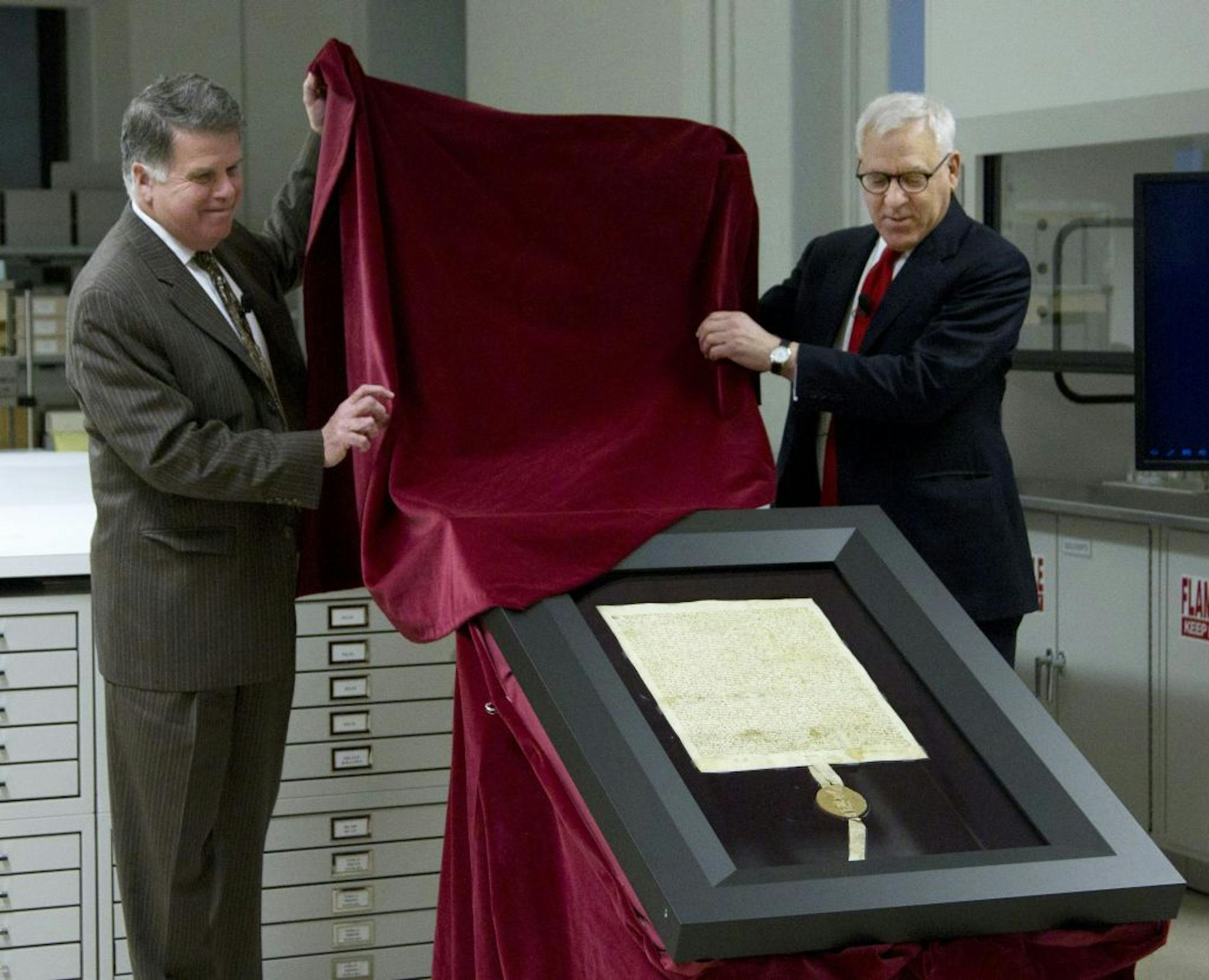
To most Americans, England's Magna Carta, or "Great Charter," is a dead-tree document from the 13th century. Written in medieval Latin and dealing with arguments between long-dead kings and their nobles, the document is impenetrable.
But the National Archives in Washington, D.C., has brought the Magna Carta into the 21st century with a new interactive exhibit.
Why should Americans care about this charter?
Read up on the founding fathers and the American Revolution.
"If you read the early writings of Hamilton, Jefferson and Adams, and Madison, many times they say, it's because of the Magna Carta that we're doing this [rebelling against England]," said David M. Rubenstein, who lent the document to the National Archives. He is the co-founder and managing director of the Carlyle Group, a global asset management firm.
The Magna Carta was born out of dispute. In 1215, the English nobility at odds with King John (known to many as the Prince John of the Robin Hood legends) had him sign the Magna Carta, which limited the powers of the monarchy.
The document included "the right to habeas corpus, that punishment was proportionate to the crime involved, [and] no taxation without representation," said Rubinstein. On display is the charter of 1297 signed by Edward I, John's grandson, which is viewed as a foundation for English law.
The new display case is found in the west Rotunda gallery of the National Archives (www.archives.gov). The Magna Carta is flanked by two interactive computer terminals where, by touching a screen, visitors can read the document in English, discover how it applies to American legal history, and see who has cited the importance of the document.


