

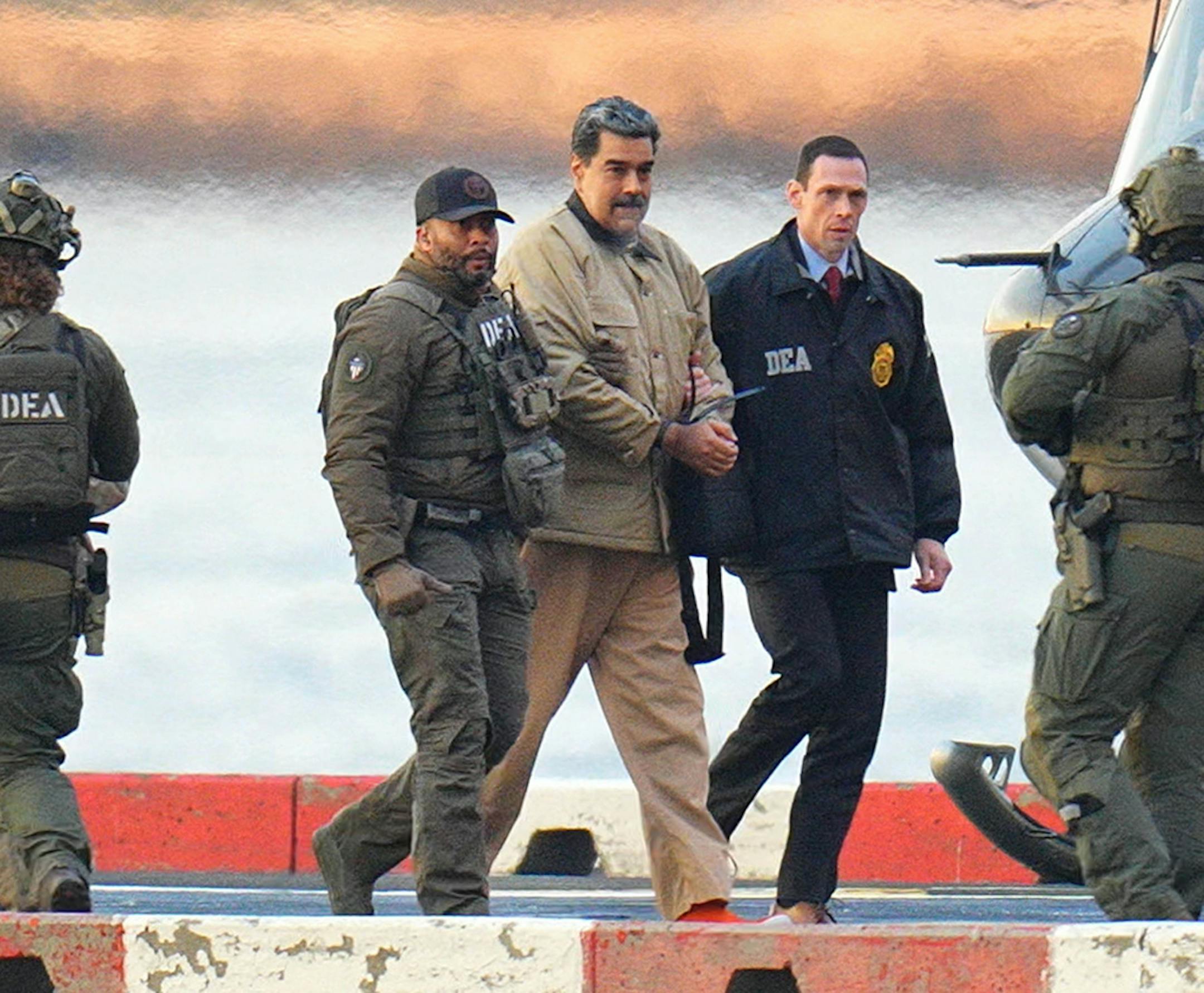
NEW YORK — A defiant Nicolás Maduro declared himself "the president of my country'' as he protested his capture and pleaded not guilty Monday to federal drug trafficking charges that the Trump administration used to justify removing him from power in Venezuela.
''I was captured,'' Maduro said in Spanish as translated by a courtroom interpreter before being cut off by the judge. Asked later for his plea to the charges, he stated: "I am innocent. I am not guilty. I am a decent man, the constitutional president of my country.''
Maduro's court appearance in Manhattan, his first since he and his wife, Cilia Flores, were seized from their Caracas home Saturday in a stunning middle-of-the-night military operation, kicked off the U.S. government's most consequential prosecution in decades of a foreign head of state. She also pleaded not guilty.
The criminal case is unfolding against a broader diplomatic backdrop of an audacious U.S.-engineered regime change that President Donald Trump has said will enable his administration to ''run'' the South American country.
Maduro, 63, was brought to court under heavy security early Monday — flown by helicopter to Manhattan from Brooklyn, where he is jailed, and then driven to the courthouse in an armored vehicle. He and Flores were led into court just before noon. Both were in leg shackles and jail-issued garb, and both put on headsets to hear the English-language proceeding as it was translated into Spanish.
As Maduro left the courtroom, a man in the audience denounced him as an ''illegitimate'' president.
A legal fight begins
As a criminal defendant in the U.S. legal system, Maduro will have the same rights as any other person charged with a crime in the country — including the right to jury trial. But, given the circumstances of his arrest and the geopolitical stakes at play, he'll also be nearly — but not quite — unique.
