

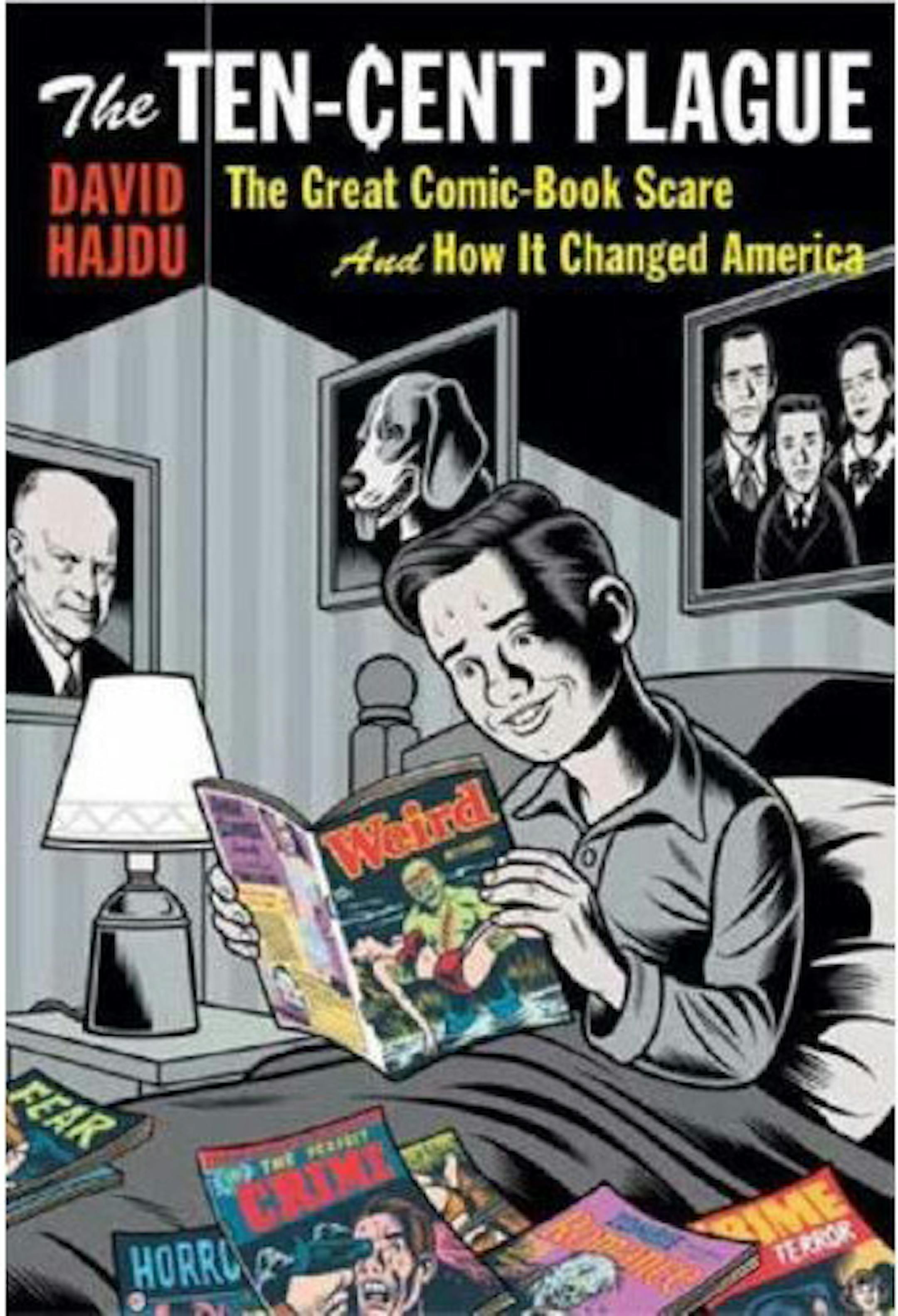
One way of looking at the history of American popular culture is to see it as episodic eruptions of condemnation of what young people, and others of limited sophistication, like to see, hear, read and do. Such an episode is described in "The Ten-Cent Plague," David Hajdu's splendid account of America's "comic-book scare" of the early 1950s. ¶ It is weird -- to use one of comic books' favorite words -- to read about events that one has experienced. I grew up on 10-cent comic books -- indeed, they set me on the path toward a hopeless love of all printed matter -- and Hajdu captures not only what I recall of my adolescent reaction to comics, but also my later understanding of what society did to them. Hajdu's book is dead-on. ¶ Hajdu ("Lush Life: A Biography of Billy Strayhorn" and "Positively 4th Street") has mined every sort of documentation to illumine the subject and the era, from the comics themselves to studies about them to interviews with surviving comics creators, and much more. Comic books grew in the 1930s out of comic strips, which had grown out of the turn-of-the-century color Sunday supplements (the "Yellow Kid" and the like), which were themselves condemned by those in cultural and legal authority. They in turn had been successors of dime novels -- likewise condemned in their time.
In the mid-1940s, between 80 million and 100 million copies were being issued each week. They spoke especially to young people who felt, as young people always have, like outsiders in a world run by and for adults -- even more so in that era before a youth culture as we know it today.
Consumed primarily by kids, comics were therefore looked down upon -- or, rather, overlooked altogether. As a business comics were not big, but they were extensive. By 1952, more than 20 publishers issued nearly 650 titles per month.
Based largely in New York, the business attracted workers who felt the more established forms of publishing and art closed to them. They were, in a word, outcasts: immigrants, women, Jews, Italians, blacks, Latinos, Asians -- outcasts creating a product for outsiders.
Hajdu's account of the creations and their creators -- notably such great cartoonists as Will Elder, Will Eisner, Jack Davis and Harvey Kurtzman -- is particularly engrossing. Equally so is his discussion of the successive waves of themes in comics: first crime and violence, then sex and romance, then horror and the macabre (at which Bill Gaines' EC Comics excelled).
An early and influential blast against comics came in 1940 from Sterling North, later a well-known children's author ("Rascal"), but then a book critic for the Chicago Daily News. In a review of children's books, North included a vilification of comic books, decrying their "poisonous mushroom growth." North's critique received national attention, and its disdain was echoed in criticisms throughout the decade.
The "scare" began around 1948. Accusations began to pile up, particularly that reading comics led to juvenile delinquency. There were church and community campaigns against comics, replete with book burnings, and more than 100 acts of legislation by state and municipal governments.
The self-appointed leader of this moralistic crusade was psychiatrist Dr. Fredric Wertham, whom Hajdu effectively discredits. He shows that as a work of scholarly research, Wertham's anti-comics tome, "Seduction of the Innocent," is a total zero. Yet many reviewers, including North, hailed the book.


