

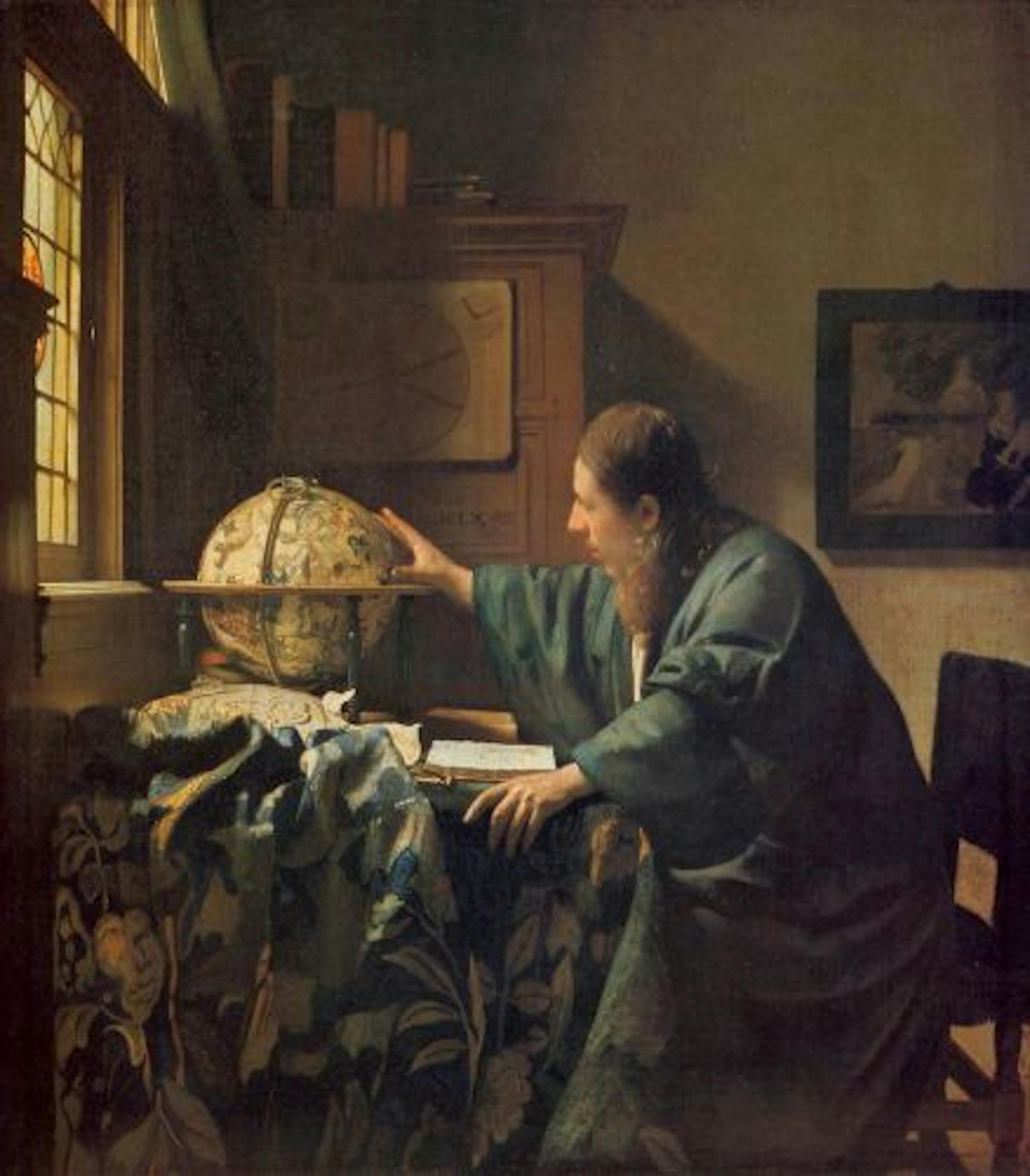
A failed painter who channeled his obsession with art into grandiose plans for a "Thousand Year Reich," Adolf Hitler ordered the pillaging of masterpieces from occupied Europe, then cherry-picked his favorites while paging through photo albums assembled by aides.
One work he long coveted was Johannes Vermeer's "The Astronomer." After the Nazis snatched it, their chief art confiscator, Alfred Rosenberg, sent a triumphant note to Hitler's closest aide to announce the news, which "will I believe bring him great joy," according to Hector Feliciano's 1995 book "The Lost Museum."
Hitler wanted the Vermeer to be the centerpiece of a museum he hoped to build in his hometown. Now it will be on view at Minneapolis Institute of Arts starting Thursday -- part of a blockbuster show from the Louvre that has brought the Dutch masterpiece to the United States for the first time.
"There are so few Vermeers and they're all great," said Patrick Noon, the Minneapolis museum's painting curator, who helped persuade the Louvre to lend "The Astronomer." Only about 35 paintings by Vermeer are known to exist, and the Louvre owns two.
A contemporary of Rembrandt, Vermeer (1632-75) was prized then, as now, for the rarity of his paintings and the almost hypnotic spell cast by their tranquil subjects and light-filled interiors. "The Astronomer" also appealed to Hitler's nationalistic ambitions, because it celebrated early "Germanic" scientific achievements, and it was originally paired with another Vermeer, "The Geographer," that had wound up in Germany.
Less than 20 inches tall, the 1668 work was to star in a new museum of traditional Germanic and Northern European art that the Führer planned for Linz, his Austrian hometown.
The painting was confiscated, along with more than 5,000 other artworks, from Jewish financier Edouard de Rothschild, whose family had owned it for half a century. Before that it had been in private hands in Amsterdam for two centuries.
The Vermeer was packed into crate H13 (H for Hitler), loaded onto a train and shipped from Paris to Germany on Feb. 3, 1941.


