

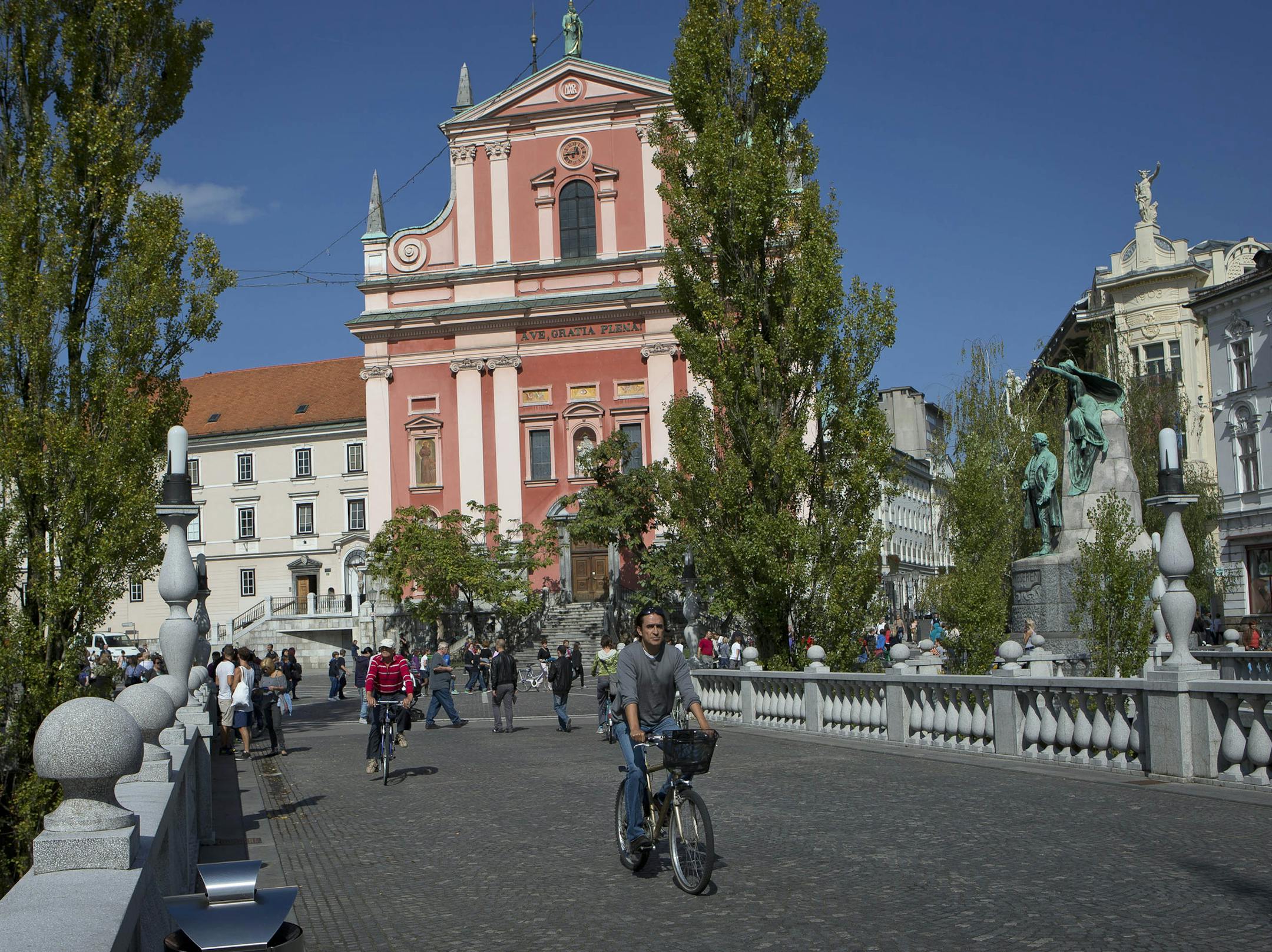
Have I stepped into a fairy tale? A mountaintop castle towers above winding cobblestone streets graced with splashing fountains, onion-domed churches and a tavern with a massive door flanked by flaming torches. From somewhere come strains of accordion music. Then a girl with purple hair whizzes by on a mountain bike and I am thrust back into the 21st century.
I cross the river on a footbridge, stopping to appreciate a street band playing Irish tunes, and then size up my choices for lunch: a French bistro, an Asian-fusion kitchen, a Mexican cantina, a kebab stand or a Viennese coffeehouse. At an outdoor cafe along the river, I order calamari and local white wine and wonder if Ljubljana is Europe's best-kept secret.
With 270,000 residents, Ljubljana (LOO-blee-ah-na) is the capital of Slovenia, a nation that has been independent for more than 20 years but is still confused with Slovakia (formerly half of Czechoslovakia), Slavonia (a region of Croatia) and Sylvania (the fictional country against which the Marx Brothers declared war in their 1933 movie "Duck Soup").
I wouldn't know about Slovenia either, except that as editor of the Utne Reader I followed the dissident movements that arose in Eastern Europe before the fall of the Berlin Wall in 1989. I learned then that Yugoslavia stood out in Eastern Europe for its relaxed version of communism, more tolerant of private enterprise, cultural expression and foreign travel. And that Slovenia, its northernmost republic, stood out in Yugoslavia.
When black-market blue jeans were selling for thousands of rubles in Moscow, Ljubljana residents were shopping in neighboring Italy and Austria. When dissidents from East Berlin, Budapest and sometimes Belgrade were being imprisoned, Ljubljana's artists, intellectuals and punk rockers spoke their minds with much less fear.
In 1991, Slovenia became the first of Yugoslavia's six republics to declare independence, and then won it in a 10-day skirmish that saw only 74 casualties and not a trace of ethnic cleansing. With just 2 million people in a country the size of New Jersey, many observers — including the U.S. State Department and some European Union officials — feared that Slovenia was too tiny to be a viable nation. It turns out they were wrong, as a quick glance at this thriving capital city shows.
At that time, Ljubljana symbolized to me what others of my generation were seeking in Prague: an exciting, exotic city emerging from the communist shadows with bright hopes and cheap rent. It beckoned as a cultural crossroads where Slavic soulfulness, German industriousness and Italian la dolce vita could happily coexist. I couldn't wait to see it.
But work and family delayed my journey to the point where I was no longer young by anyone's definition.


