

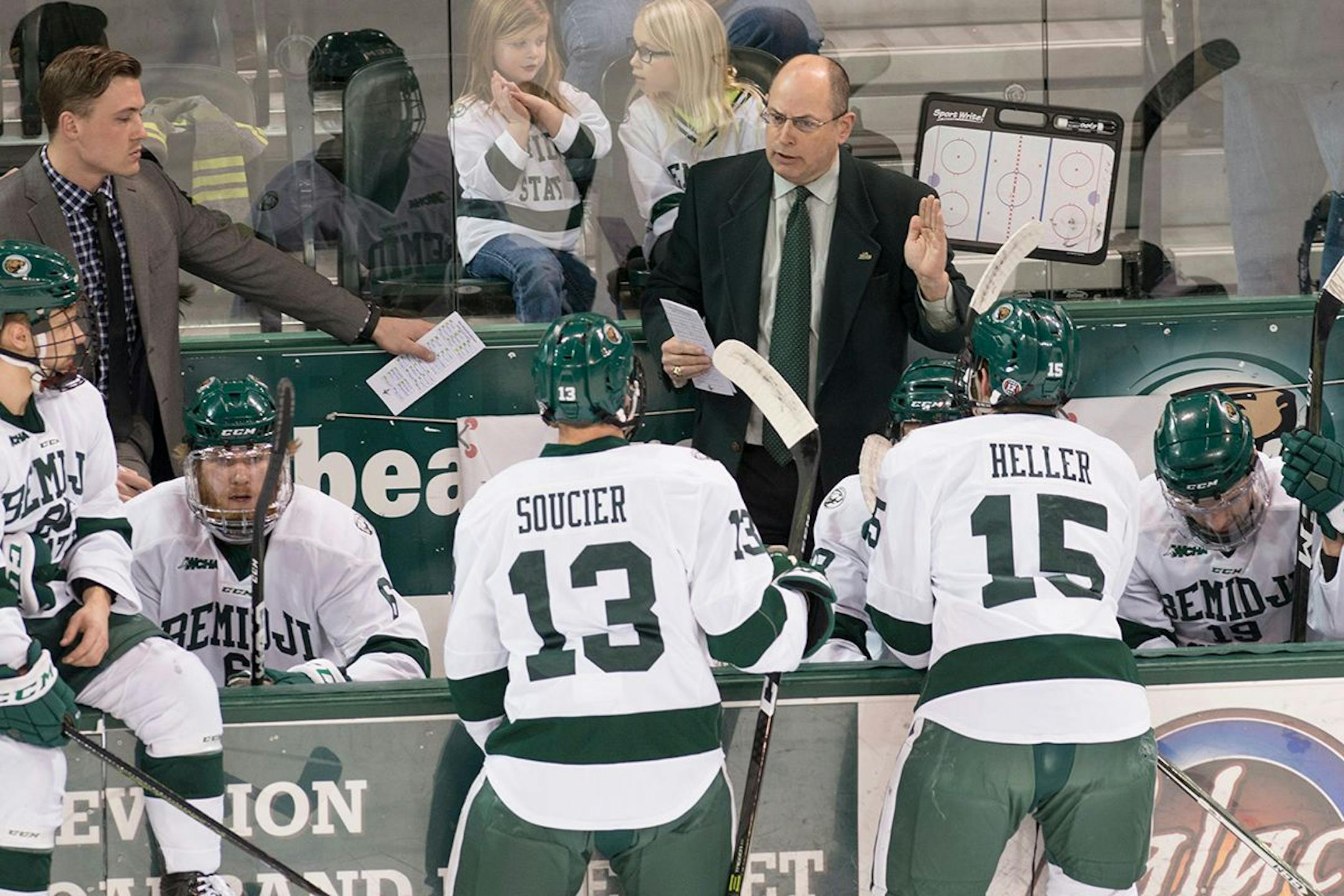
BEMIDJI, MINN. – "Details, fellas, details," Tom Serratore reminded his players during a skills development session in September. The drill hadn't gone quite perfectly, and the Bemidji State men's hockey coach wanted to let them know that the little things matter.
That teaching side of Serratore was on display during Puck Drop's Tour of Minnesota stop in Bemidji, and the coach who's entering his 19th season in charge of the Beavers has used that approach to build a program that's an under-the-radar contender.
The Beavers, then a member of the College Hockey America, reached the NCAA Frozen Four in 2009, upsetting Notre Dame and Cornell in regional play before falling to Miami (Ohio) in the national semifinals in Washington, D.C. When conference realignment began in the 2013-14 season, Bemidji State remained in a revamped WCHA, where the Beavers won the 2017 regular-season title. After a 15-17-6 record in 2018-19, the Beavers are expected to contend again, with WCHA coaches picking them to finish third.
"We like where we're at right now," said Serratore, whose Beavers open the season against regional rival St. Cloud State on Friday and Saturday at the Sanford Center. "We're really experienced up front; we had one of the youngest forward groups in the country last year. … Now, they're ready to step up. And we've got some experience in goal. The one area where we're young is the blue line, with six freshmen or sophomores."
Bemidji State isn't a flashy program, and it usually wins with tight defense and pressure on the puck, as evidenced by its strong penalty kill that has ranked as high as second and not lower than 11th nationally over the past four seasons. The Beavers' captain this season isn't a high-scoring forward, but gritty senior defenseman, Tommy Muck, who has no goals but 124 blocked shots in his career.
"He's got a lot of sandpaper to his game," Serratore said.
Serratore, a Coleraine, Minn., native, played for legendary coaches Don Brose at Mankato State (now Minnesota State Mankato) and Bob Peters at Bemidji State in the 1980s, and he's applied lessons he learned from them.
"A lot of it is the habits, the work ethic, the details, the culture," Serratore said. "With those coaches, it was so much about culture."


