
La Dolce Vespa

Navigating Italy's streets and sidewalks can be challenging, but nothing is as exhilarating as seeing its cities by scooter.

For the Minnesota Star Tribune
August 22, 2009 at 10:03PM
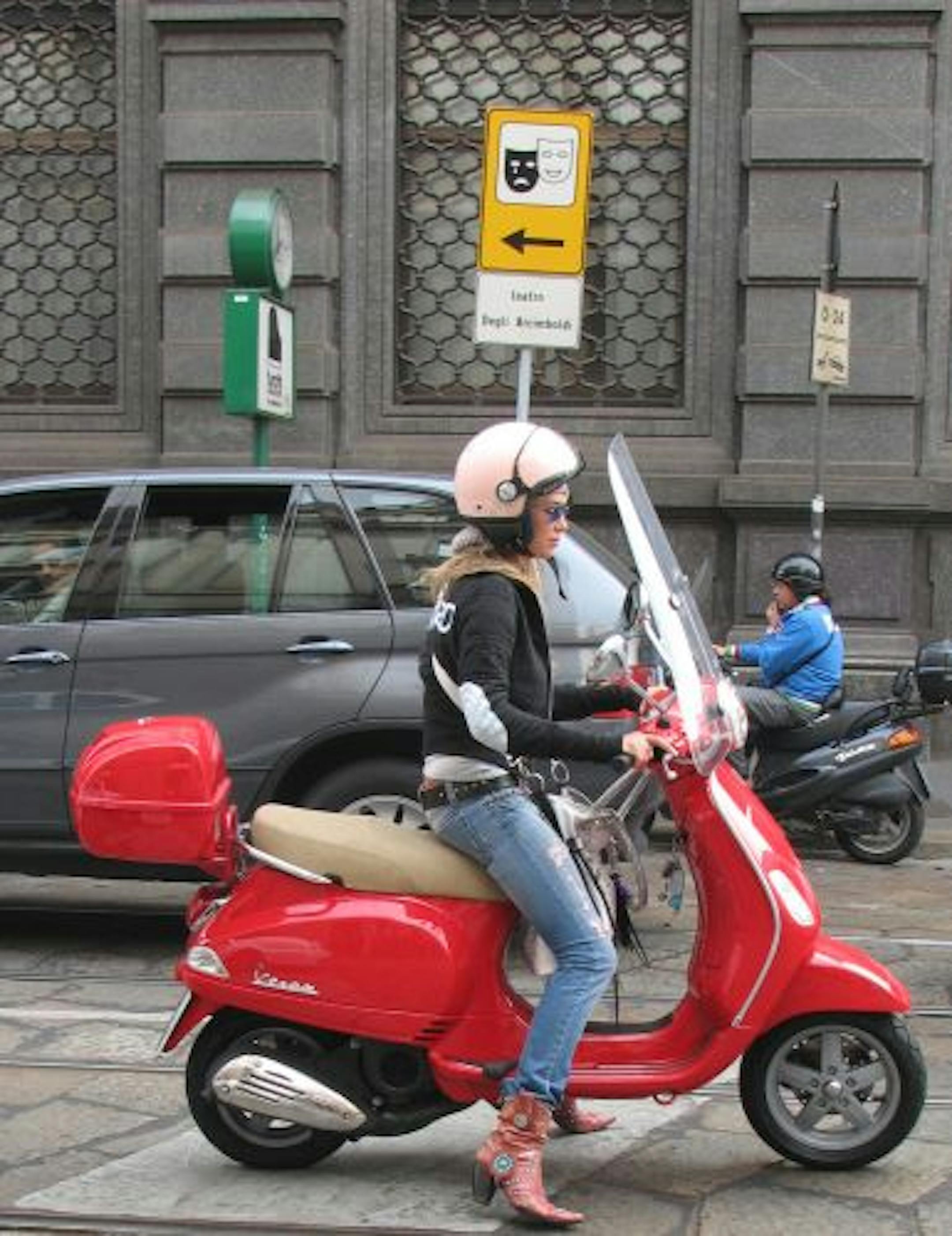
Scooters are a popular — and practical — transit option in the narrow streets of many Italian cities. Above, a young woman waits for the light to change in downtown Milan, near the famous Teatro alla Scala.
Scooters are a popular — and practical — transit option in the narrow streets of many Italian cities. Above, a young woman waits for the light to change in downtown Milan, near the famous Teatro alla Scala. (Special To The Star Tribune/The Minnesota Star Tribune)

When Audrey Hepburn hopped onto a Vespa with Gregory Peck in "Roman Holiday," she landed in the police station. Still, the image of the prim princess on a two-wheeled scooter, freed from society's restraints, etched itself in my mind. I, too, wanted to tool around the ancient streets on a Vespa, just like the snooping journalist Paparazzo did in "La Dolce Vita."

Before graduating to two wheels while visiting Rome, I had to find my way on two feet. I tried to cross the busy boulevard in front of the fascist-conceived Olympic Stadium, where preparations were underway for that night's soccer game of Roma vs. Milan with David Beckham.

"It's even safer to cross at the zebra stripes because if the drivers hit you, they pay double," I had been told by my friend Giovanni, but the traffic wasn't slowing down.

A Roman woman saw my fear of being flattened and advised me, "The only way to get across the street is to cross with arrogance. Act like you don't see the cars, and they will avoid you." We stepped into the traffic together, and the line of Fiats respectfully let us through.

As we ignored the impatient drivers, she talked politics: "In Italy we still have Berlusconi, but I'm very happy for your President Obama. We all need to get along, all races, all colors. Love your neighbor -- but I don't like the Milanesi! The people from Milano just work all the time and are impatient and pushy. They don't know how to have fun."

On the bus ... to the market

I soon advanced to taking the buses and trams, but the guidance of my Roman friend Giuseppe again rang through my ears: "Never pay on the bus; people will know you're a tourist." Still, I bought a ticket at a newsstand just in case I had to validate it on my way to the Porta Portese flea market in Trastevere, but I heeded Giuseppe's lesson that "you only have to pay at the end of the month. The ticket controllers will block both doors, so you are trapped. That's why you wait by the machine to validate your ticket, and then punch it if you see the ticket controllers jump on."

The tram left me near the sprawling Sunday morning flea market, where vendors hawked everything from moth-eaten Mussolini paraphernalia to odd-sized patent leather shoes. A merchant selling Rolex watches dipped them in tumblers of water to demonstrate that they're authentic waterproof originals, despite the "Made in China" inscribed on the back. She was bored and monotonously drummed up business by chanting, "We've gone crazy! Look, we're giving everything away."

I opted for a stand selling knockoff soccer jerseys that easily cost $150 for the real thing. With huge sales at every stand, I hoped for a deal when I held up an extra small soccer shirt of a Milanese team for my 5-year-old son. The seller squinted his eyes and looked me up and down: No discount for me.

Two wheels in the Eternal City

While the Colosseum may be the symbol of Rome, the scooter has become a symbol of Italy -- along with pizza, pasta and the Leaning Tower. The designer of the original Vespa, Corradino d'Ascanio, boasted in the 1950s that "the Vespa will always look like it does. Even when it is atomic-powered and riding on the moon."

A friend lent me her scooter to relive Gregory Peck and Audrey Hepburn's famous voyage, but the cars nearly clipped me, allowing about an inch of space on either side of the handlebars. I was shaking in fear by the time I stopped at the Pantheon and put the scooter on its kickstand.

I copied how other scooterists drove along the busy road next to the Tiber River. They lined up at the stoplight as if it were a race. When the light from the other direction turned yellow, they gunned it, hoping no stray driver from the other direction would run a red. Soon the cars passed the putt-putts and lined up at the next stoplight. The scooters filtered through the waiting cars and set up on the starting line for the whole process to begin again.

Thinking I could fit in with the best of them, I wove through the cars and immediately bashed an old Lancia's side mirror. The driver honked and yelled at me as I struggled to stop my scooter. I had shattered his mirror, but he was so surprised that I actually pulled over to apologize and assess the damage that he just laughed. "Buon soggiorno a Roma!" he wished me and drove off.

I was more careful, but soon learned the law of the streets.

Eric Dregni is an assistant professor of English at Concordia University and the author of "In Cod We Trust" and the forthcoming "Never Trust a Thin Cook and Other Lessons From Italy's Culinary Capital," due out this fall from the University of Minnesota Press.

about the writer

about the writer

ERIC DREGNI

More from Minnesota Star Tribune

See More
card image
J. SCOTT APPLEWHITE, ASSOCIATED PRESS/The Minnesota Star Tribune

The "winners" have all been Turkeys, no matter the honor's name.

In this photo taken Monday, March 6, 2017, in San Francisco, released confidential files by The University of California of a sexual misconduct case, like this one against UC Santa Cruz Latin Studies professor Hector Perla is shown. Perla was accused of raping a student during a wine-tasting outing in June 2015. Some of the files are so heavily redacted that on many pages no words are visible. Perla is one of 113 UC employees found to have violated the system's sexual misconduct policies in rece