
Knobs show Ohio's natural history

Rock formations called knobs, known as buttes out West, are the highlight of an Ohio nature preserve.

February 18, 2012 at 6:39PM
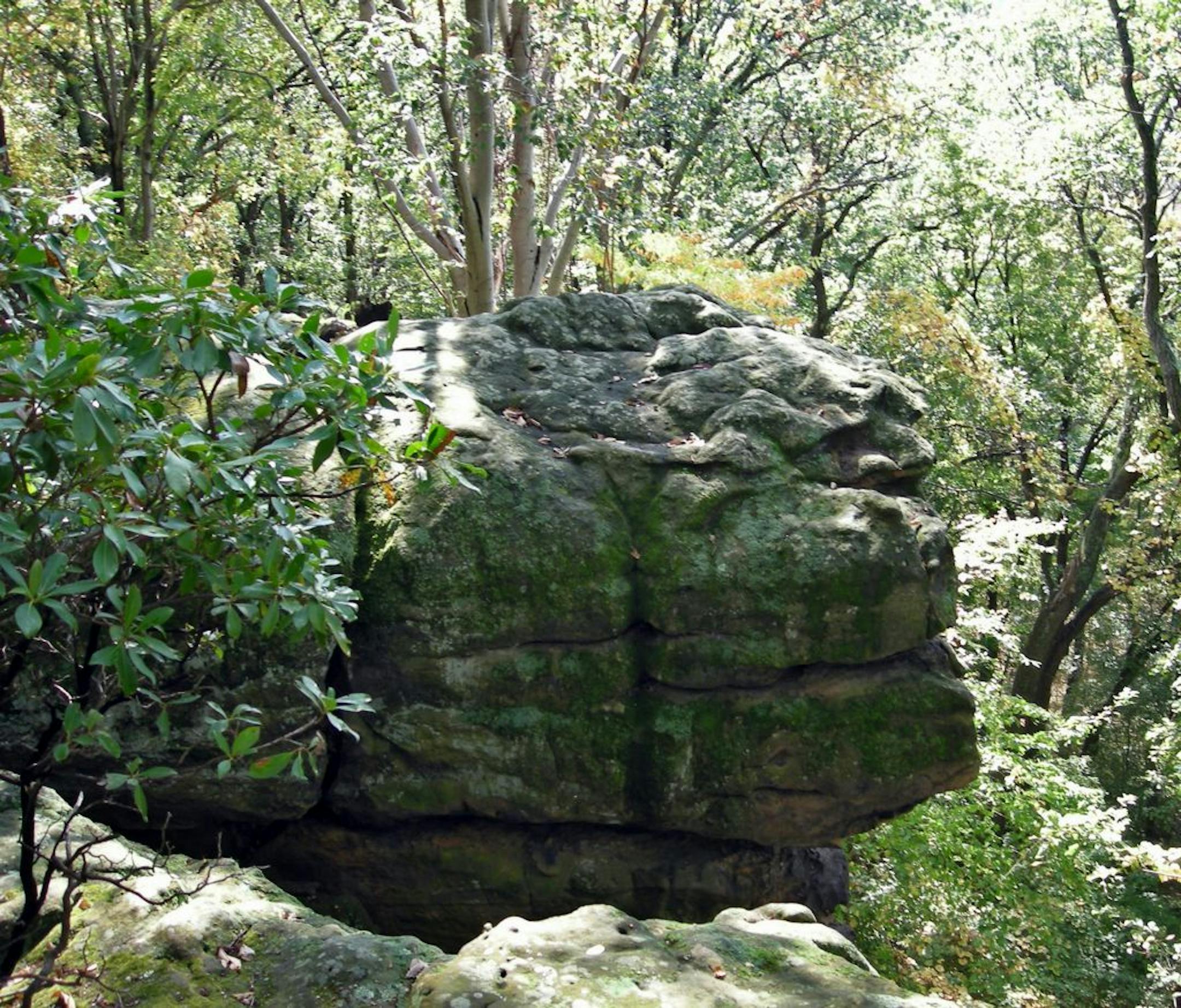
Rocky cliffs of erosion-resistant sandstone dominate at Shallenberger State Nature Preserve outside Lancaster, Ohio.
Rocky cliffs of erosion-resistant sandstone dominate at Shallenberger State Nature Preserve outside Lancaster, Ohio. (Mct/The Minnesota Star Tribune)

The Knobs stand out, in more ways than one.

The lumpy, flat-topped formations southwest of Lancaster, Ohio, mark the edge of the Appalachian Plateau. They rise 250 feet above the surrounding farmland and offer views to the Hocking Hills to the south and to the lowland plain of central Ohio to the north.

In the West, they would be called buttes. But the tree-covered formations were called the Knobs by early settlers: Beck's Knob, Allen's Knob, Claypool Knob and Ruble Knob.

The Shallenberger State Nature Preserve encompasses Allen Knob and Ruble Knob. Both are topped by erosion-resistant sandstone and feature steep sides and rocky outcroppings.

The 87-acre preserve lies west of Lancaster in Fairfield County's Hocking Township.

Trails lead from the parking lot and wind upward around the 80-foot-high walls of cap rock to the tree-covered tops.

The forest at the bottom is a rich and robust mix of oaks, maples, beech, cherry, walnut, hickory, ash and elm. Blueberries and ferns thrive on the forest floor. Spring wildflowers are abundant.

The last mile-thick glacier pushed into the knobs 12,000 years ago, but never topped them. It brought rich topsoil where the mixed forest now thrives at the bottom of the knobs.

At the top, the trees appear smaller, scraggly and poor because the soil is thin and dry. The dominant tree atop the knobs is the chestnut oak. The unglaciated knob tops offer sanctuary for the dry oak forest of the South, a bit of Appalachian habitat that developed there.

Mountain laurel also thrives atop the knobs, especially on their southern and western slopes. They are at their colorful best from late May to mid-July.

The rock gets its orange tint from the iron oxide that cemented the sand 325 million years ago when the sediments formed at the bottom of a shallow inland sea.

The land uplifted and the tough sandstone formed rocky knobs, gorges, cascades, caves, rock bridges and outcroppings across southern Ohio. Hocking Hills State Park near Logan is one example.

Allen Knob towers 240 feet above the countryside. Adjoining Ruble Knob is lower. A small stream flows north and separates the two knobs. The best viewing, of course, is when the leaves are off the trees from late fall through early spring.

You can also get a dose of Ohio history in downtown Lancaster. That's where you will find the Sherman House in Lancaster's National Register of Historic Places district.

The house at 137 E. Main St. is Ohio's only memorial to Civil War Gen. William Tecumseh Sherman. Sherman was born and spent his childhood there.

The original portion of the frame house was built in 1811 and expanded in 1816 by Charles Sherman, a lawyer who moved to Lancaster from Connecticut. The Sherman family occupied the house until 1844.

IF YOU GO

For information on visiting, go to www.shermanhouse.org/index.htm.

about the writer

about the writer

BOB DOWNING, Akron Beacon Journal

More from Minnesota Star Tribune

See More
card image
J. SCOTT APPLEWHITE, ASSOCIATED PRESS/The Minnesota Star Tribune

The "winners" have all been Turkeys, no matter the honor's name.

In this photo taken Monday, March 6, 2017, in San Francisco, released confidential files by The University of California of a sexual misconduct case, like this one against UC Santa Cruz Latin Studies professor Hector Perla is shown. Perla was accused of raping a student during a wine-tasting outing in June 2015. Some of the files are so heavily redacted that on many pages no words are visible. Perla is one of 113 UC employees found to have violated the system's sexual misconduct policies in rece