

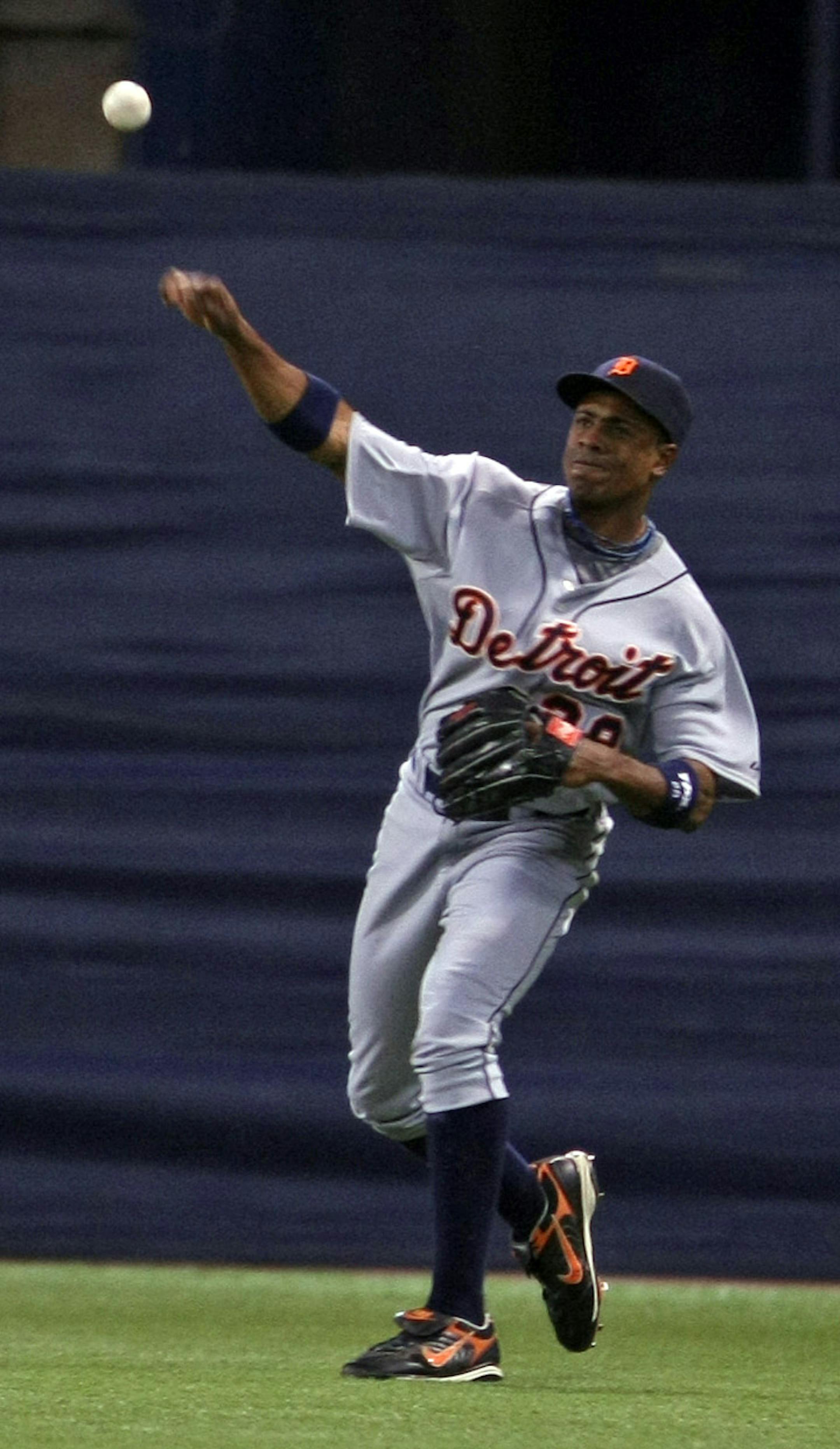
The guy who makes the Detroit Tigers go is not signed to a $153 million contract (Miguel Cabrera), isn't closing in on 500 home runs (Gary Sheffield), isn't playing his third position in six months (Carlos Guillen), isn't a formerly Pudgy future Hall of Famer who's shrinking faster than the American dollar (Ivan Rodriguez).
The guy who makes the Tigers go is one of the first players you'd send to a foreign country to promote baseball (he went to Africa last winter to do so), one of the first players you'd want in your clubhouse (he's got two college degrees and signs enough autographs for the whole team) and the first player Detroit sends to the plate every night.
Curtis Granderson, the Tigers leadoff hitter and center fielder, is coming off one of the most remarkable seasons in baseball history, so it shouldn't be surprising that the end of the Tigers' early-season swoon dovetailed with his return from the disabled list.
Detroit is 6-4 since Granderson's return from a broken hand, having gone 8-13 without him. After going 2-for-4 with a homer that accounted for the Tigers' lone run in Saturday night's 4-1 loss to the Twins, he is hitting .297 with four homers, three doubles, a triple and seven RBI in 10 games, having drawn eight walks and compiled a slugging percentage of .757.
Ten games is a small sample size; the 2007 season was not. Granderson hit .302 with 23 homers, 74 RBI and a league-leading 23 triples, becoming the second player in big-league history to have at least 30 doubles, 20 triples, 20 homers and 20 steals in a season, a feat that was matched later in the year by Philadelphia's Jimmy Rollins.
That season led Tigers General Manager Dave Dombrowski to make Granderson the first player in Detroit he has signed to a long-term contract extension before he was eligible for arbitration. Granderson signed a five-year, $30.25 million contract in February, perhaps signalling the time to move out of his parents' house. "I'm looking," he said.
His parents were teachers. Granderson attended Illinois-Chicago and decided he wanted to be a Division I basketball player. "It took me all the way to my sophomore year of college to realize I was a better baseball player than basketball player," Granderson said.
The epiphany? "A broken thumb in fall practice my sophomore year, in baseball," Granderson said. "That was when I was ready to start basketball practice. We were running a pickoff play to second base. I was the baserunner. I dove in, the shortstop fell on me, and when I went to get up he went to push up off of me and fell on my thumb.


