
Israel’s last living hostages describe trauma of Hamas captivity

Israeli hospitals are treating the former captives, freed this week as part of the ceasefire deal, according to protocols honed over two years of hostage releases.

The Washington Post
October 17, 2025 at 6:08PM
Israeli flags are reflected on the window of a vehicle as freed Israeli hostage Omri Miran, left, is welcomed home at Kibbutz Kramim, Israel, Friday, Oct. 17, 2025. (Ohad Zwigenberg/The Associated Press)

TEL AVIV — Every night, over two anguished years, Omri Miran’s wife and two young girls gazed at the moon as the children said goodnight to their father, a 48-year-old Israeli hostage held by Hamas in Gaza.

Since the Hamas assault on southern Israel in October 2023, Miran had been shackled in a cage, shuffled between subterranean tunnels and aboveground buildings, and — although sporadically allowed to listen to Arab media — repeatedly denied information about the fate of his family. Only after about five months of captivity was he was transferred to a “relatively normal guard who told him that his family is alive,” said Boaz Miran, Omri’s brother, speaking by phone from Ichilov hospital in Tel Aviv, where he and the family have camped out since Omri’s release on Monday.

“Now, the goal is to strengthen his connection again with his girls,” said Boaz. He added that Miran’s youngest daughter Alma, who was 6 months old when her father was abducted from their home in Kibbutz Nahal Oz, did not initially recognize him.

Since Hamas released the last 20 living Israeli hostages on Monday and the Israeli military began pulling back in the Gaza Strip, the former captives and their families are finally beginning a process of healing.

“This is the first breath after nearly two years of suffocation,” Iair Horn said in a news conference on Tuesday. Horn had been abducted with his brother Eitan from Kibbutz Nir Oz, near the Gaza border, and then released during a ceasefire earlier this year, but his brother had remained behind until this week.

“Now, we can recover together,” their mother, Ruth Strum, told the Washington Post at Ichilov hospital, where Eitan was being treated.
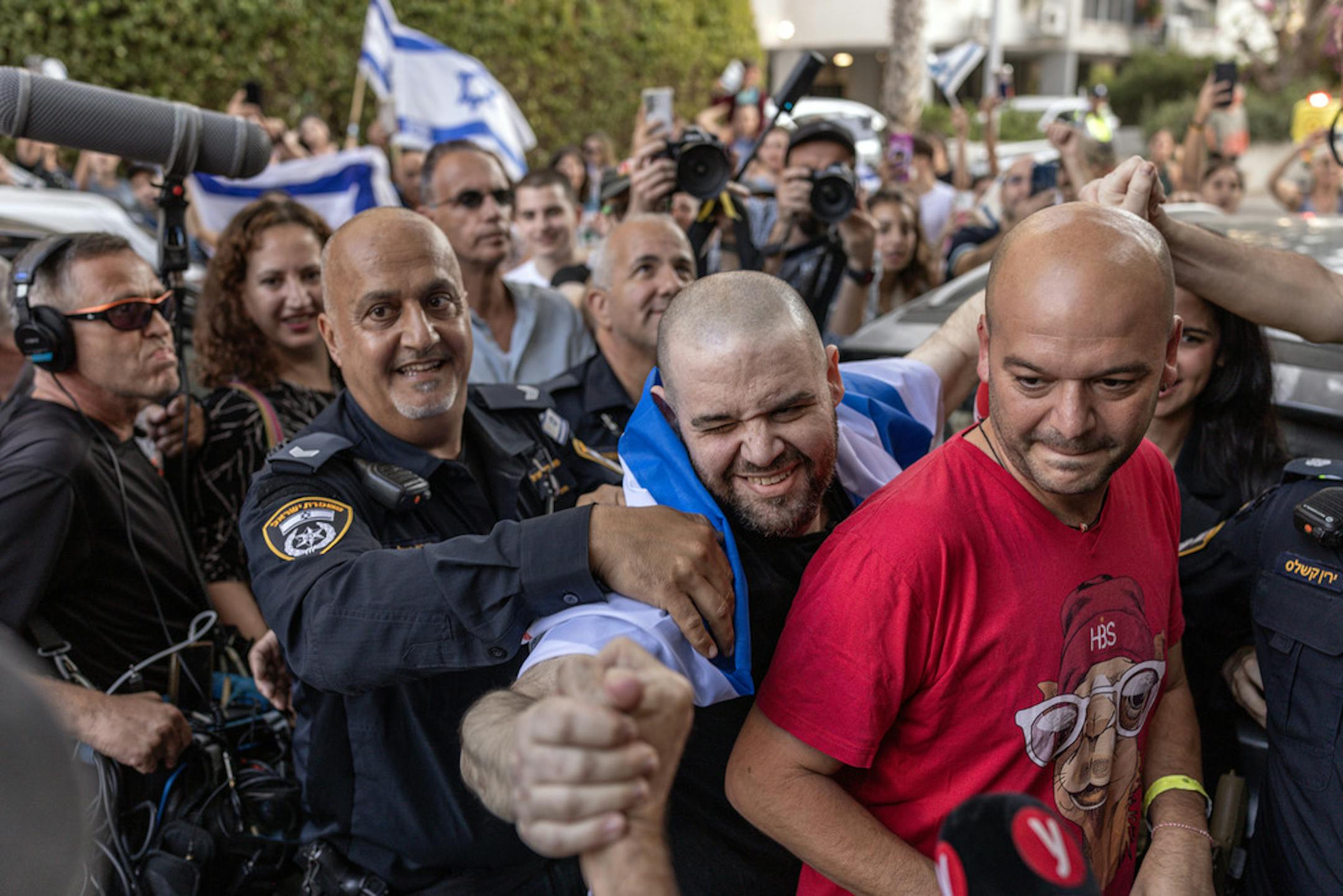
Eitan Horn, center, is welcomed home in Kfar Saba, Israel, on Thursday, Oct. 16, 2025, after being held captive in Gaza for two years. (AVISHAG SHAAR-YASHUV/The New York Times)

Israel’s hostage crisis gripped the nation for more than two years, and for many Israelis became a symbol of their government’s failure to thwart Hamas’s Oct. 7 assault and then negotiate a deal to secure the release of the hostages. A vast majority of Israelis wanted Prime Minister Benjamin Netanyahu to put top priority on returning the hostages and ending the war, public opinion polls repeatedly showed. Millions wore yellow ribbon pins in solidarity.

On Monday, hundreds of thousands of Israelis gathered in “Hostages Square” in central Tel Aviv — which regularly hosted protests calling for the hostages’ return — amid crying and cheering as the first images of the hostage releases were broadcast live.

In addition to the living hostages, Hamas has released the remains of nine of the 28 deceased hostages. It says it has yet to locate the 19 others amid the rubble and the unexploded ordnance that litter the Gaza Strip since the war. Hamas’s unwillingness or inability to do so underscores how precarious the ceasefire agreement may be. For its part, Israel on Monday released 2,000 Palestinian detainees and prisoners, including 250 serving long sentences.

The Israeli hostages are readjusting to their new reality, and some have sent initial videos thanking friends and fellow Israelis for their support.

“I saw you all downstairs, through the van — insanity,” 32-year-old Avinatan Or, a former hostage, said in a video addressed to his friends, which was recorded at Rabin Medical Center in Petah Tikva, where he was receiving treatment. “I am exhausted, but we will meet soon and fill in all the gaps.”

Or was held in total isolation in a tunnel for his entire captivity, his father, Yaron, said in an interview Wednesday with Kan radio, Israel’s public news broadcaster. Or was violently beaten and chained to a cage for more than a year after trying to escape.

“He was locked in a cage the width of a mattress and 1.8 meters tall,” said Yaron. “Around him, there were guards whose relatives were killed by the [Israeli military] bombings. And I think that it’s a miracle that they didn’t harm him.”

Hamas’s live stream of Or’s abduction two years ago, showing a swarm of militants pushing Or toward Gaza as another mob bundled his girlfriend, Noa Argamani, onto a motorcycle as she screamed “Don’t kill me!” provided some of the most iconic images of that traumatic day.

When Or and Argamani reunited on Monday, Or learned that Argamani had been rescued in a special operations mission in June 2024, along with three other hostages. He had almost no access to information, and Hamas refused to supply his family with signs of life, Argamani said in an Instagram post on Wednesday.

“Two years have passed since terrorists separated me from Avinatan in front of the eyes of the entire world … but both of us, against all odds, are back home and reunited!” Argamani wrote, alongside a photo of the two embracing in the Israeli military helicopter transporting them to the hospital.

Israel’s hospitals are treating the former captives according to protocols that have been honed over two years of hostage releases. Measures include preparing for the potential of refeeding syndrome, which can develop if food is introduced too quickly after periods of starvation. This risk seems particularly high given the testimony of previously freed hostages that their captors fed them excessively in the days before their release, said Sigal Frishman, head of the nutrition and diet unit at Rabin Medical Center, which is caring for five of the 20 released hostages.

Medical teams also appreciate how important the presence of family and friends and signs of comfort are to the former hostages’ recovery. Video of Guy Gilboa Dalal, 22, gorging on his family’s homemade sweets as he was driven to a hospital quickly went viral. Alon Ohel, a 24-year-old musician who survived in the tunnels with a head injury and a shrapnel wound in his right eye, sat down to play a piano set up in his hospital room, his mother, Idit, said in a statement on Thursday.

“After more than 700 days in the silence of the tunnels — his melody finally echoed once again and it filled all of our hearts,” said Idit. She added that alongside the joy of her son’s return is the continued grief over those who did not survive captivity and whose whereabouts remain unknown.

“This week was a true moment of grace,” she said. But “even in these days of joy, we do not forget … our brothers and sisters for whom the hostage return agreement came too late.”

about the writer

about the writer

Shira Rubin, Lior Soroka

The Washington Post

More from World

See More

British Prime Minister Keir Starmer refused to say Wednesday whether he would urge U.S. President Donald Trump to drop his threat to sue the BBC for $1 billion over the broadcaster's edit of a speech he made after losing the 2020 presidential election.