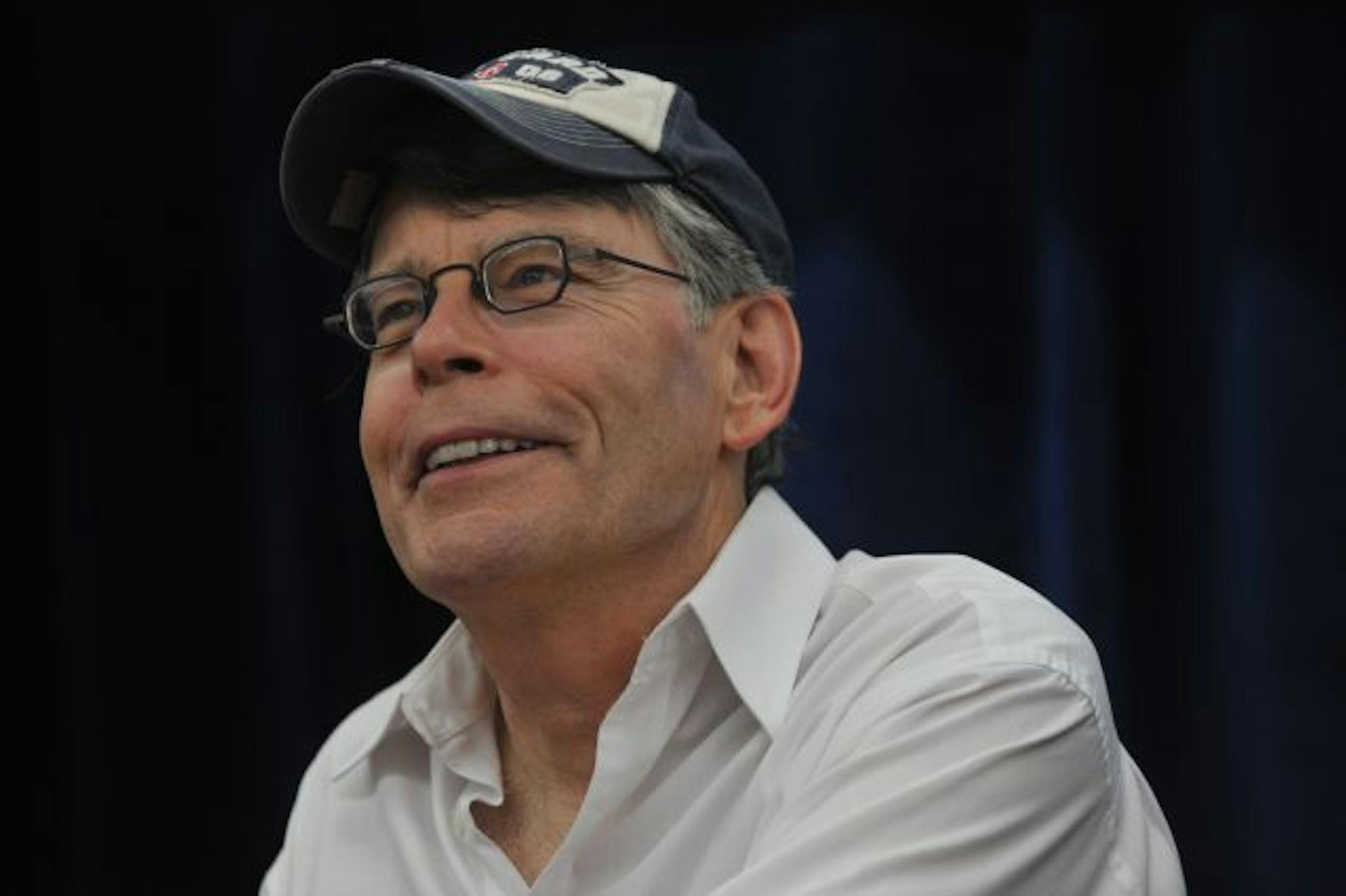
"You know, I'm a lazy son of a gun."
So says Stephen King: a man who just published a story in the New Yorker and a review of the Raymond Carver biography in the New York Review of Books. He also has a piece in the horror mag Fangoria and a poem in the current issue of Playboy. Anything else? "Under the Dome," his 51st novel, all 1,072 pages, dropped last week. He just finished a five-part graphic novel for DC comics, as well. In his spare time, perhaps between putting away the breakfast dishes and waiting for the computer to boot up, he wrote a musical with John Mellencamp.
Lazy?
We'll get to that. Let's get the obvious stuff out of the way first. No, he's not spooky. Anyone who expects a creepy guy with a ghoulish laugh probably thinks Vincent Price sat around the house in a black cape, casting spells. Stephen King is an affable, funny, gracious, effortlessly conversational fellow. He could be a guy you worked with in a college restaurant who'd dropped out but knew lots of stuff and had some interesting ideas.
A normal fellow -- except for the part about being one of the most successful authors in human history, the American answer to Dickens.
His latest, "Under the Dome," might be described as "The Stand Under Glass." It has the epic length and apocalyptic character of his eschatological pandemic classic, but instead of a cross-country tale of harrowing collapse, the story unfolds under a clear dome that seals off a small town in Maine (just north of Castle Rock, for all you Constant Readers). It can't be breached. There's no explanation. How things fall apart, how ordinary folk react to extraordinary, inexplicable circumstances -- these are timeless King themes. So perhaps it's apt that they come together in a book he's been working on for longer than half of his fans have been alive.
"I started it in 1976, got about 75 pages into it -- and then I saw what the scope of the thing was going to be, how many technological issues it raised, and I buckled. I'm not a sci-fi writer; I don't know a lot about technology, so I thought I'd try again, set it in an apartment building, and then I wouldn't have to deal with what the weather would be like under a dome. But I didn't like any of the characters, so I put it away."
When he returned to the book years later, he had help with issues most of us don't confront in our jobs: the proper way to amputate a leg, meteorology in closed systems and the consumption rate of LP gas, which matters a lot when you're cut off from civilization, all you have is propane, and most of it's been diverted by the bad guys. But King had the same question as the readers: What caused a typical American town to be cut off from the world on an ordinary October day?