
Infestation is driving us all a little buggy

Japanese beetles are here. There isn't an "easy solution," but try these tactics.

July 17, 2012 at 8:32PM
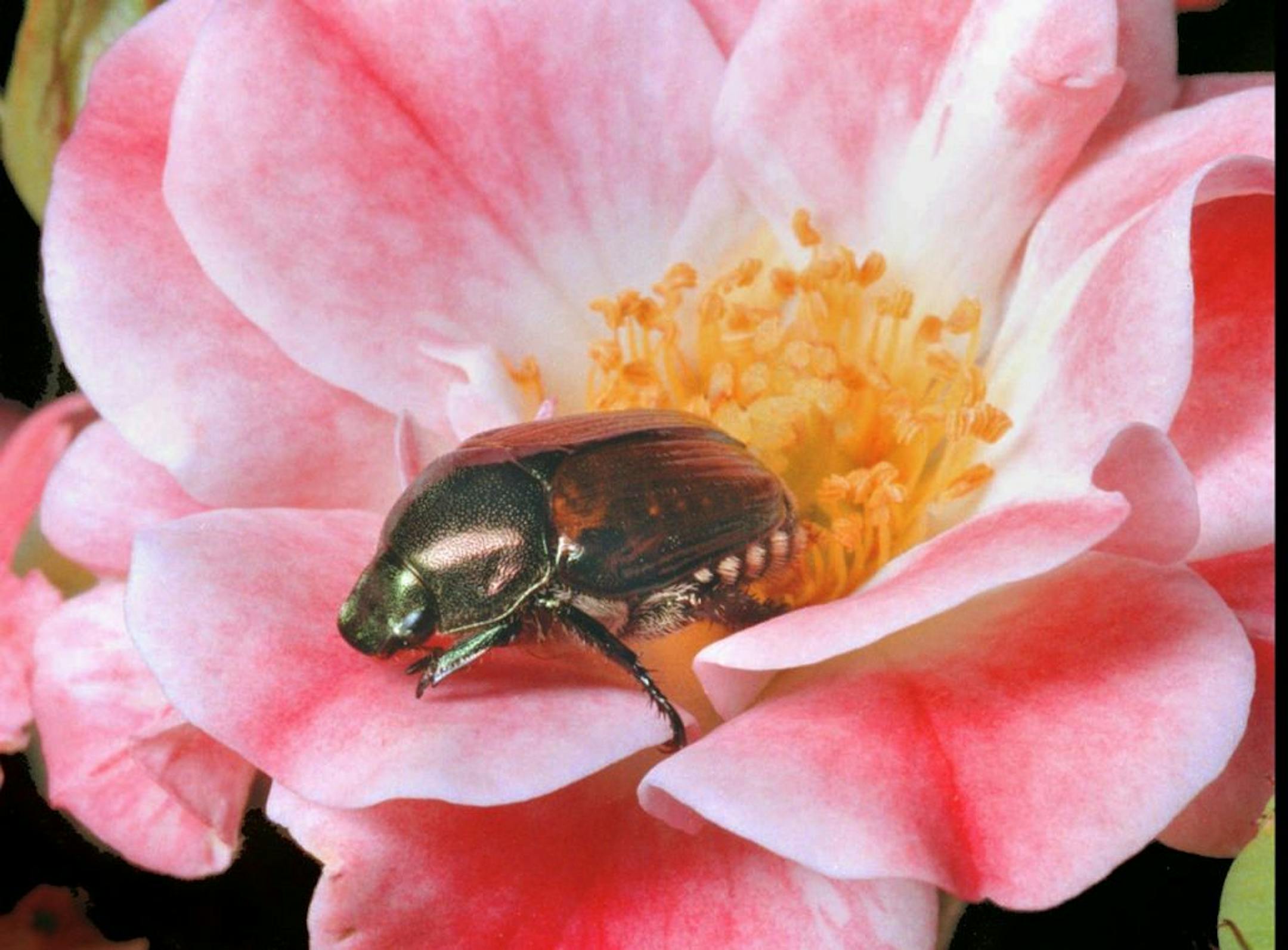
A Japanese beetle crawls on a small rose. Last year's wet weather provided excellent breeding conditions, and the insect is being seen feeding on backyard flora in above-average numbers across Maryland according to horticulture experts.
A Japanese beetle crawls on a small rose. (Dml - Associated Press/The Minnesota Star Tribune)

Paige Pelini, co-owner of Mother Earth Gardens in Minneapolis, calls it "the morning beetle pick." She starts her day with a cup of coffee in one hand and a bucket of water in the other, knocking voracious Japanese beetles off plants to halt the munching that turns healthy leaves into veined skeletons.

Last year was the first Pelini battled a massive invasion of the bronze-winged beetles. "Before that it was just a smattering," she said. But this year has been even worse. "They're thick. It's not been pretty."

Japanese beetles feed on many plants this time of year, but some of their favorite noshes include grapevines, roses, lindens and apple trees. While the beetles are bugging some local gardeners more than ever, the pests' presence is similar to last year, according to Jeff Hahn, entomologist at the University of Minnesota. "The last five or six years, we've seen a gradual increase in their numbers as they gradually expand their territory."

But the adult beetles appear to have emerged earlier than usual, thanks to the mild early spring.

"I started getting reports in mid-May; usually it's a July 1 insect," Hahn said. The good news is that the beetles' wave of destruction is short-lived. "The numbers are heavy for six to eight weeks, then start to decline. It wouldn't surprise me if they taper off in early August."

If you don't want to wait that long, there are things you can do to banish beetles. "There's not an easy solution, but there are a lot of tactics," Hahn said.

You can do what Pelini does: pluck the bugs off plants and drop them into a bucket of soapy water. "Make sure they fall into it," Hahn said. "They like to drop and play dead, but they'll just come back." The best time to do it is in the morning when the beetles are less active, he said.

Another nonchemical remedy is to cover plants with netting or cheesecloth while the beetles are at their peak, Hahn suggested.

When handpicking and wrapping are not practical, he suggests a low-impact botanical insecticide such as Neem products. Stronger insecticides should be used with caution because many also are toxic to bees, Hahn said. (For more information about specific insecticides and their use to control Japanese beetles and their larvae, visit www.extension.umn.edu).

Pelini also recommends applying beneficial nematodes to attack beetles at the larvae stage. "We advise customers to control them by breaking the life cycle in more than one place," she said.

And brace yourself for seeing other out-of-the-ordinary pests. "It's a wacky bug year," said Pelini. "I'm seeing bugs I've never even seen before."

Hahn said that so far he isn't seeing an unusual number of species, although certain ones seem to be generating more calls. "We're in the midst of a lot of earwigs," he said. "They're getting indoors and causing damage in gardens." He's also hearing from complaints about tortoise beetles, which feed on sweet potatoes and other plants. "They're always here but not commonly seen as pests," he said. "I suspect they might be more prevalent."

Variegated cutworms also are making their presence felt, he said, with gardeners reporting them feeding on a wide variety of plants. "That's not something we normally see. I've had reports up to Grand Marais -- that's unusual."

Kim Palmer • 612-673-4784

about the writer

about the writer

Kim Palmer

Reporter, Editor

Kim Palmer is editor/reporter for the Homes section of the Star Tribune. Previous coverage areas include city government, real estate and arts and entertainment 

See Moreicon

More from Minnesota Star Tribune

See More
card image
J. SCOTT APPLEWHITE, ASSOCIATED PRESS/The Minnesota Star Tribune

The "winners" have all been Turkeys, no matter the honor's name.

In this photo taken Monday, March 6, 2017, in San Francisco, released confidential files by The University of California of a sexual misconduct case, like this one against UC Santa Cruz Latin Studies professor Hector Perla is shown. Perla was accused of raping a student during a wine-tasting outing in June 2015. Some of the files are so heavily redacted that on many pages no words are visible. Perla is one of 113 UC employees found to have violated the system's sexual misconduct policies in rece