

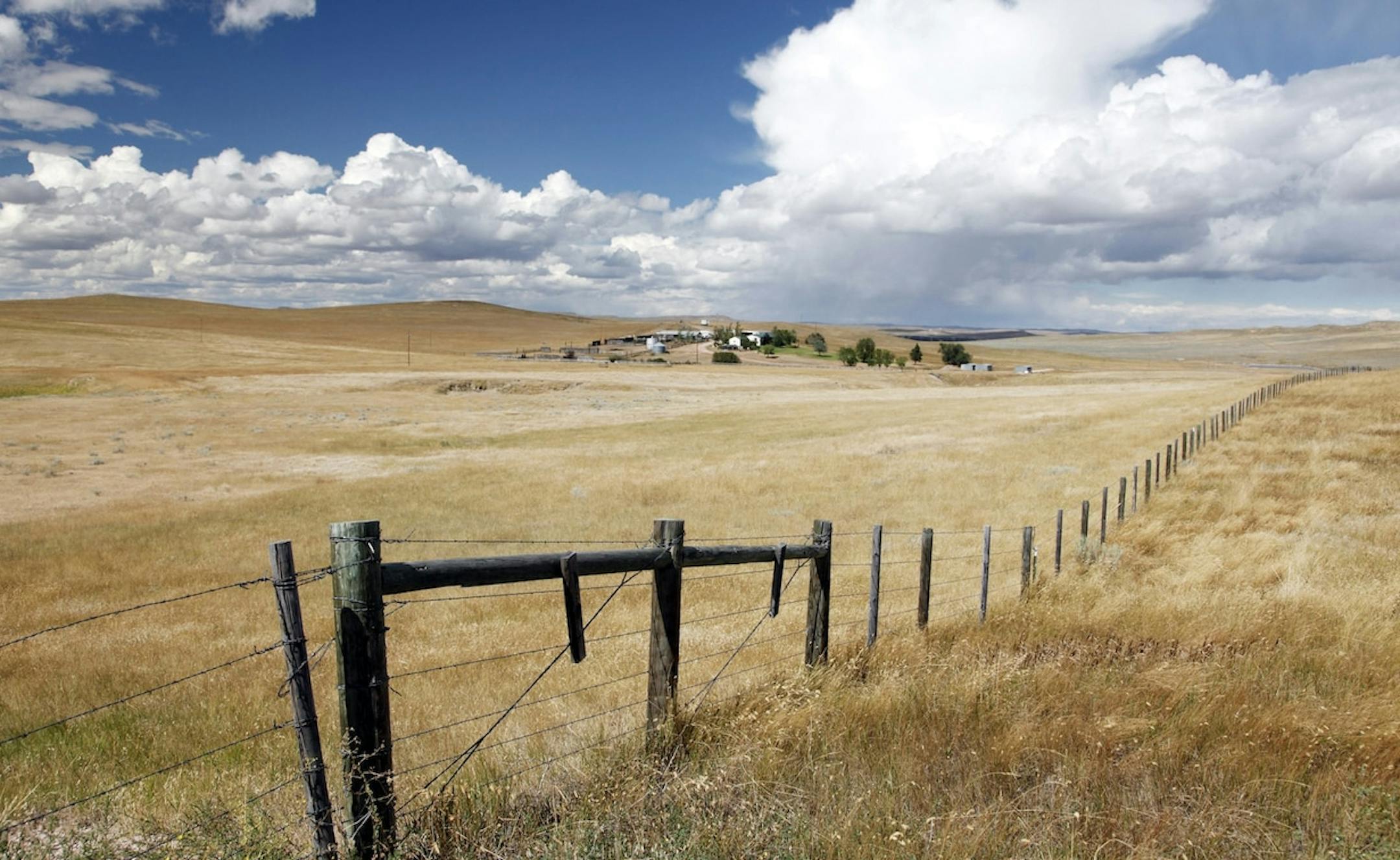
On a warm July morning, roughly two dozen volunteers gathered at a ranch outside Cody, Wyo., carrying wire cutters, gloves, buckets, and bottles of water. The goal was to take down several miles of barbed wire that had not been used to fence livestock for many years — and were now a useless and even dangerous blemish on the landscape.
West of Cody, on the road to Yellowstone National Park, the North Fork of the Shoshone River winds through the Absaroka Mountains, a landscape of extinct volcanoes that once towered thousands of feet higher. Strange formations of eroded volcanic rock, known as hoodoos, cap the hillsides. If you're lucky, you might see a flock of bighorn sheep scampering beneath these ancient deposits. But that's much less likely than it would have been a century or two ago, when settlers first began developing — and fencing — the landscape.
Scientists conservatively estimate that more than 600,000 miles of fences crisscross the American West, and that's without counting property fencing in cities and suburbs. In just one Wyoming county, researchers mapped roughly 4,500 miles of fences — longer than the U.S. border with Mexico. The Absarokas and other western landscapes may look wide open and sprawling, particularly to road-trippers from more paved-over parts of the country, but in fact they are sliced up by miles and miles of barbed wire, put there to keep livestock in (or out), to mark boundaries between public and private lands, or to keep animals away from roads.
In some cases, the fences are simply remnants, erected decades ago and no longer serving any purpose. In others, they were constructed with little thought about their impact on other species. But land managers and conservation groups in the United States are increasingly aware of how fences can harm wild animals, and they are beginning to push for fence removal or replacement as a solution that many otherwise-at-odds constituents can get behind.
"Everyone can agree on this," says Tony Mong, a wildlife biologist with the Wyoming Game and Fish Department. Mong is chair of the Absaroka Fence Initiative, a local organization that organized the fence takedown outside Cody.
Deer, interrupted
Fences can spell disaster for wildlife that need to migrate seasonally or simply move around for their basic needs. Mule deer can get their legs caught as they try to jump over fencing and can die there. Pronghorn antelopes, which tend to scramble under fences, can get stuck or scraped on the bottom wire, leading to death or to cuts and scars that never heal and are prone to infection.
One study looked at pronghorn in the northern sagebrush steppe in Montana, Alberta, and Saskatchewan — where the study area contained enough fence to wrap around the planet eight times — and found, not surprisingly, that pronghorn chose paths that crossed less fencing. That means there is actually less habitat available to them than it might seem just from the vastness of the landscape
No matter where you are in the western U.S., says Wenjing Xu, a graduate student at University of California, Berkeley, on average you are likely less than 2 miles from a fence.

