

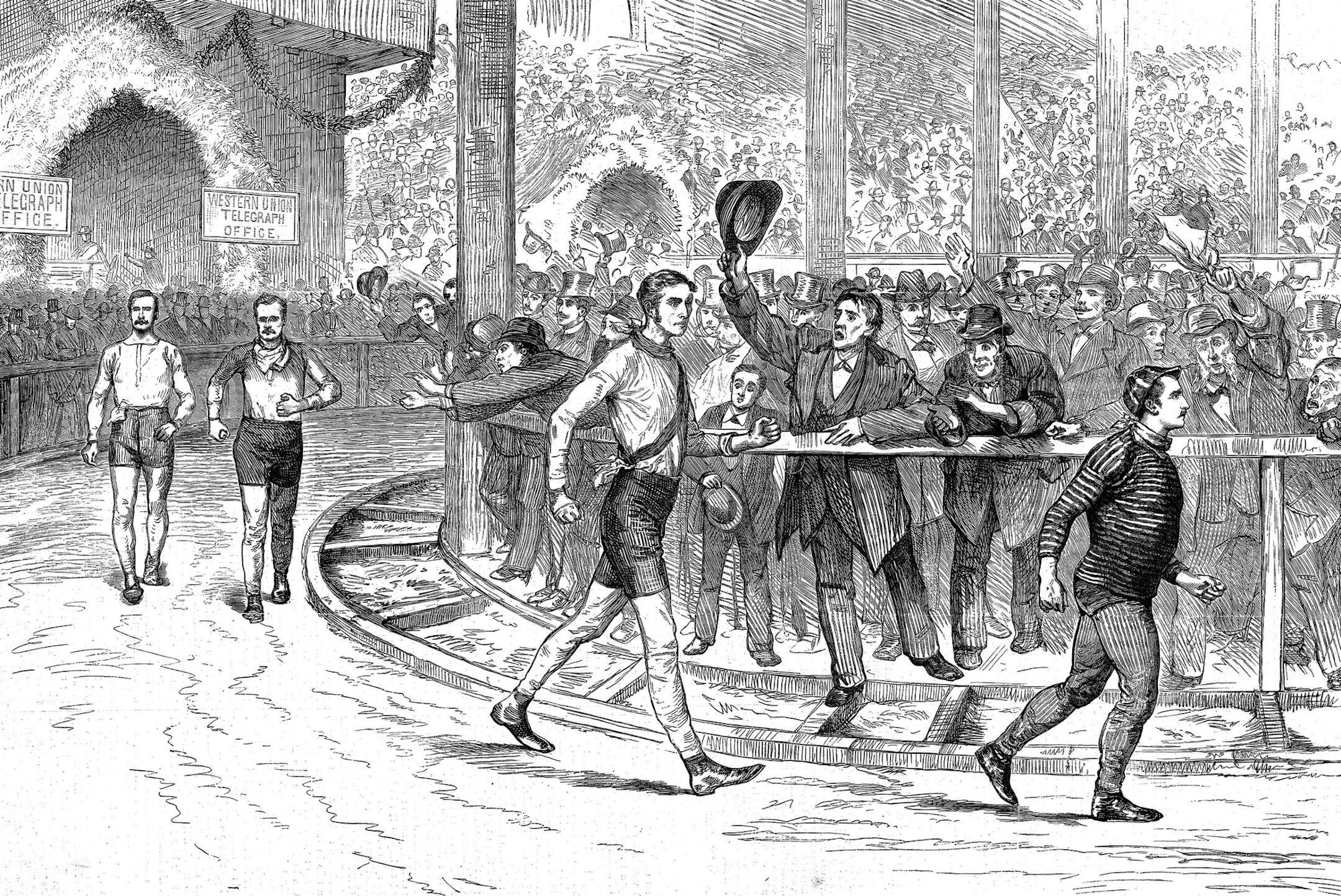
"Grand Female Walking Match," announced the 1889 ad for Kernan's theater in the Washington Star. "Six days, 12 hours daily. From 12 noon to 12 midnight. Admission to all 25 cts."
It may sound as boring as a congressional committee meeting, but in the late 1880s, people were entranced by a series of "pedestrian tournaments." In other words, walking marathons.
At the original Madison Square Garden in New York, endurance walking matches were wildly popular beginning in the late 1870s. Crowds of 10,000 or more regularly packed the rickety arena to watch men and women circle a one-sixth-mile track for days at a time. For a while, pedestrianism, as it came to be known, was the most popular spectator sport in the United States.
The races in Washington, D.C., were the brainchild of James Lawrence Kernan, a Confederate soldier who became an entertainment mogul after the Civil War. Kernan's was one of the capital's best theaters, boasting a sliding roof, but it was a fraction the size of the Garden, with a capacity of just 2,500, so Kernan was forced to improvise. He removed the seats from the main floor and laid a 6-foot-wide sawdust track 156 feet around.
It took 34 laps to complete a mile. The competitor who covered the most miles won.
The Grand Female Walking Match commenced at noon on Monday, May 27, 1889. A "dozen short-skirted, strong-limbed maidens" toed the starting line, the Star reported. The women's skirts exposed their "sturdy calves" clad in tights. "Most of them were young," the Star's correspondent wrote of the entrants, "and all of them were not ugly."
With the starter's command of "Let her go!" the women set off as a packed house roared. The favorite was Sarah Tobias, a phy ed teacher from New York City who affected a superior, aristocratic air. On the night before the race, a Washington Post reporter asked if she expected to win.
"I shall do my best, and will probably be somewhere near the head when the walk ceases next Saturday night," she answered.


