

In a haiku, the still-revered 16th-century master of the Japanese tea ceremony, Sen no Rikyu, wrote:
Sometimes a person may feel embarrassed to ask questions.
That embarrassment should be set aside and questions asked.
Well, let it be known, the artists in "This Here Now: Nature and Human Consciousness" do not feel embarrassed. In fact, Guido Alvarez, Christine Baeumler, Jil Evans, Jill Ewald and Chris Larson ask the really big questions without blushing -- such as: What is "nature," "human consciousness" and "meaning"? -- and transform their responses into mixed-media installations, each taking a unique aesthetic approach.
However, their conclusions are not self-evident. How could they be? Such answers do not come easily, nor are they for the intellectually faint of heart. As Wayne Roosa, an art historian at Bethel University in Arden Hills, writes in the exhibition essay, "the artworks explore the relations between nature, experience, symbolic systems of knowledge and human consciousness, asking how we navigate and mediate these different states as liminal beings." Liminal? That's us. As conscious human beings we are liminal; we can exist in transitional states, or on both sides of a boundary, "between states of nature and states of mind."
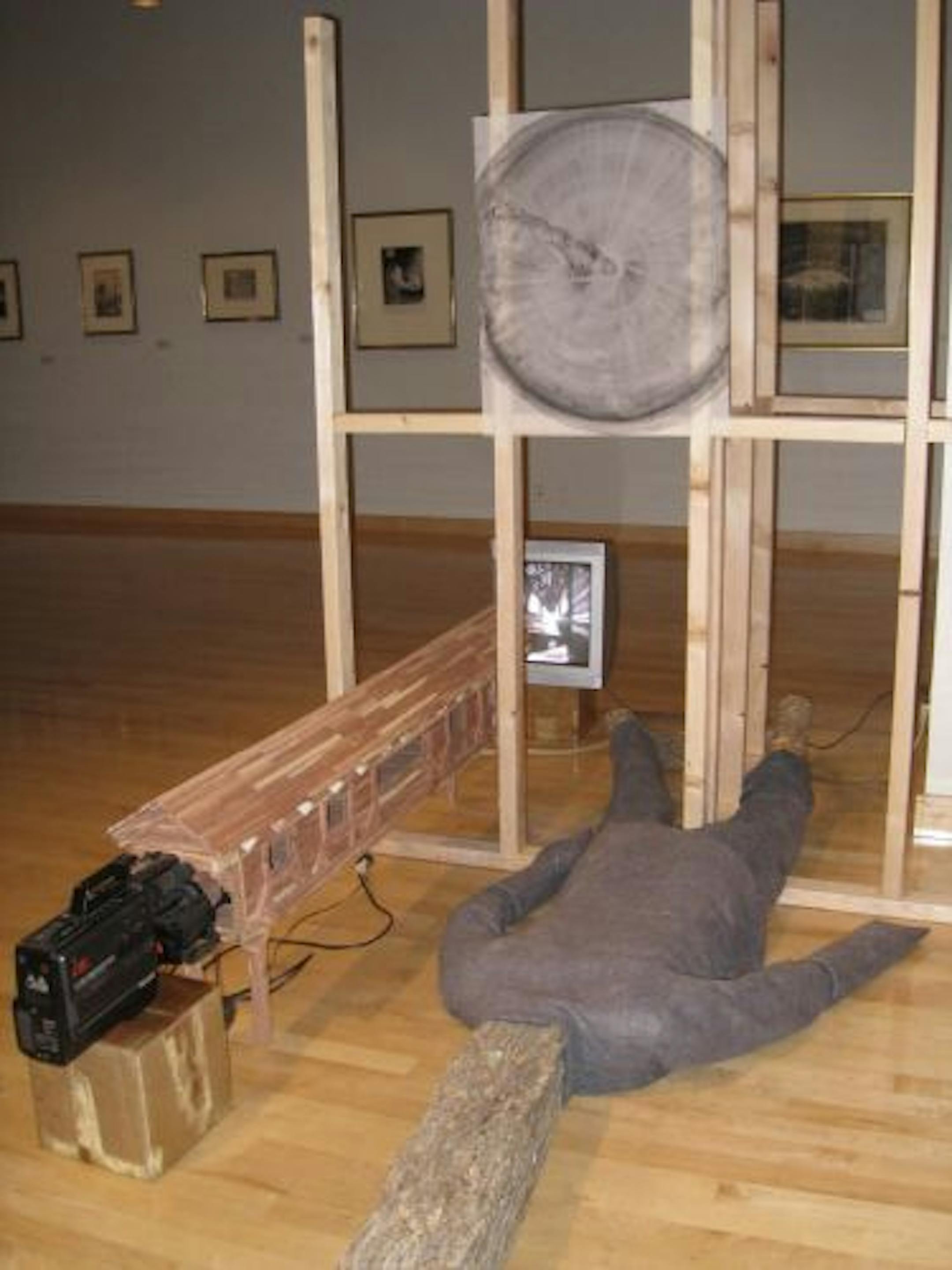
The installations are provocative and, given the artists' quest of the abstract, each is unexpectedly resolved as a visual work of art. Combining variously found objects, painting, sculpture and photography, the one element shared by all five installations is the integration of technology. Video, both archived and live streaming, audio and animation undergird their investigations, and inject this centuries-old philosophical dialogue with street cred of the present.
In Alvarez's "Temporal Flow" -- a small mountain of more than a dozen monitors, cameras and screens, an aquarium and a vase of dried flowers -- a salamander is the protagonist, existing digitally in video loops of the past and as a living creature in a video streaming live from a remote location. The creature is simultaneously present and absent.
In "Darwin's Table and South American Miscellaneous," Baeumler evokes a natural history museum diorama, where the real experience of seeing animals and exotic places has been replaced by video loops under glass bell jars and photographs of taxidermied animals.


