

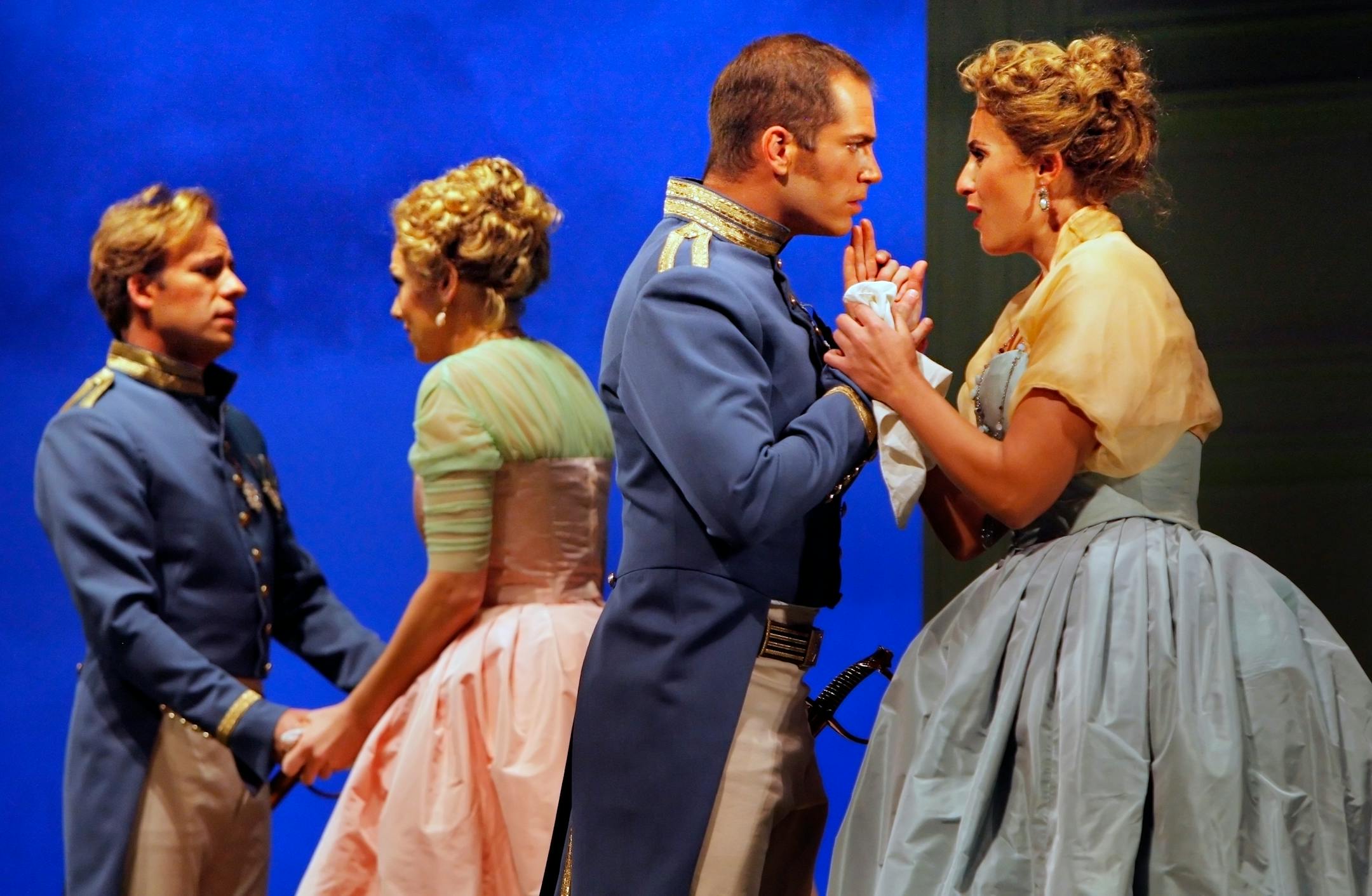
The action of Mozart's "Così fan tutte" ("All Women Are Like That"), which launched Minnesota Opera's new season Saturday at the Ordway, is easily told. Two young soldiers bet a cynical "philosopher" that their fiancées, two sisters, are incapable of infidelity. They're proven wrong through an elaborate scheme, contrived by the old cynic, in which each of the young men, disguised, woos the other's lover. Eventually the disguises are dropped; the women are mortified, the men enraged. But the unrepentant philosopher proclaims the ending a happy one, and all sing reason's praises.
It sounds like formulaic farce, and at first it's just that. But the depth and sublimity of Mozart's music transform this brittle folderol, which some critics find unworthy of the composer, into an emotion-charged probe of the human (not just the feminine) heart. What begins as a game becomes, in Act 2, an agonizing reality in which characters and spectators are uncontrollably caught up. And if the ending is ambiguous, this much is clear: in "Così," passion trumps reason. Humankind is like that, as Mozart well knew.
Director Peter Rothstein shapes the production, the company's first "Cosi" in 20 years, with a sage hand. Breathing life into his characters, he adroitly manages the work's progression from slapstick to seriousness. Making imaginative use of Alexander Dodge's elegant, flexible set, he's especially attentive to the machinations of Don Alfonso, the philosopher, whose watchful presence drives the drama. And with the meteorological event that he conjures at the very end of the opera, Rothstein adds an ironic twist that Mozart and librettist Lorenzo da Ponte would have savored.
A superb, youthful cast, North Americans all, makes light of the work's vocal challenges. Jacquelyn Wagner, her soprano as agile as it is lustrous, excels as Fiordiligi. Her account of "Per pietà," one of Mozart's greatest arias, is riveting; her bearing, almost regal, makes her ultimate capitulation all the more touching. Jennifer Holloway is a warm, fetching Dorabella; her voice blends exquisitely with Wagner's. The men -- John Tessier's glowing Ferrando, Matthew Worth's vibrant Guglielmo, Daniel Mobbs' egoistic yet enigmatic Alfonso -- are similarly strong. And Angela Mortellaro, one of the company's accomplished resident artists, makes a saucy, hammy Despina.
Conductor Christopher Franklin melds romantic expressivity with elements of period style. Orchestral ensemble is tight, even in the breathless finale of Act 1. The horns deserve a solo bow.
Rothstein's earth-air-fire-water symbolism feels a bit studied, and his AstroTurf floor gets old. But quibbles aside, this "Così" is a vividly theatrical, sumptuously sung realization of an elusive masterpiece.
Larry Fuchsberg writes frequently about music.


