

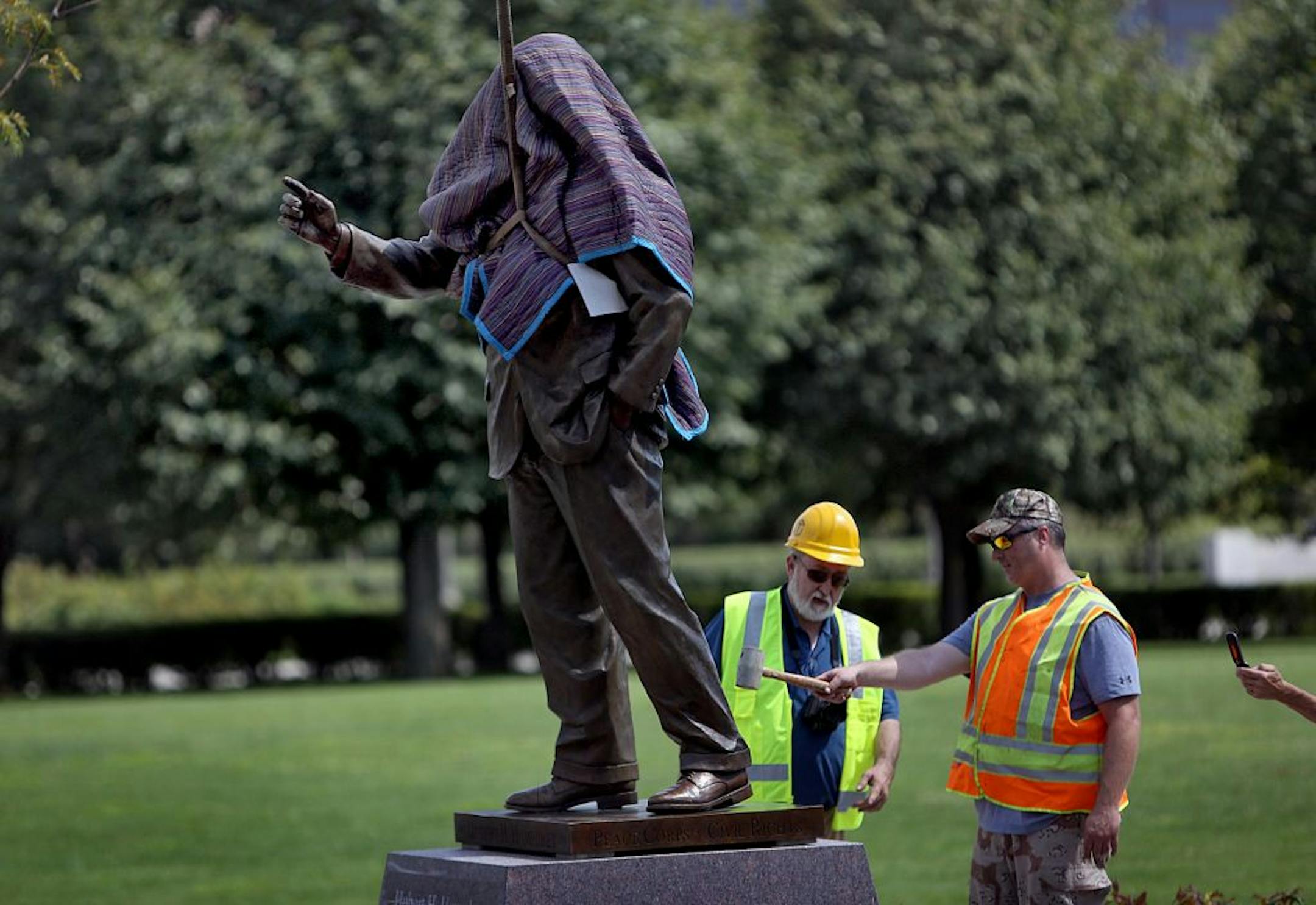
Hubert Humphrey wasn't always a Happy Warrior in Washington, several of his former staffers said Saturday. But he was persistent, hard-working, thoughtful, instinctively inclusive, and a friend even of his political rivals.
Those were some of the traits that elevated the late Minnesota senator and vice president to the top eschelon of American lawmakers of the 20th century. His prodigious productivity and the enduring nature of his achievements -- particularly of the landmark Civil Rights Act of 1964 -- make Humphrey well worth examining today, when few Americans use words like "productive" and "effective" to describe their government.
A number of former Humphrey hands from around the country are in the Twin Cities this weekend to help dedicate a statue and memorial to their old boss on the State Capitol grounds. Several of them gathered before a luncheon at the Humphrey School of Public Affairs to swap stories in response to my question: What made Humphrey effective?
"His persistence, for one thing," allowed John Stewart, Humphrey's top domestic policy aide from 1962 to 1968. He introduced a batch of civil rights bills in the Senate every year for 15 years before the 1964 breakthrough arrived. None of them went anywhere for a decade, Stewart said, but Humphrey kept at it.
When the moment came for the big 1964 bill's floor debate, Humphrey assigned one Democratic and one Republican supporter of the bill to be co-captains of each of the bill's 10 subsections. He didn't care who got credit as long as the bill became law, Stewart said.
Humphrey's prodigious work ethic was another key to his achievements, added Norm Sherman, his press secretary from 1963 to 1976. "I once asked Humphrey how he accomplished all he did. He said, 'I work an extra four to six hours a day. The other senators all go home early.'"
Many nights, Humphrey was the last to leave the Senate office. He wasn't above tidying up others' desks as he went out -- and woe be unto the staff member who left visible an unanswered letter from a constituent bearing a postmark several days earlier. "We had to hide unanswered mail," said Jane Low, who handled Humphrey's legislative mail from 1961-64. The office rule: A reply was to be sent to every received letter within three days.
Humphrey expected a lot of his staff, which the parsimonious son of a South Dakota druggist kept unusually small. But he was there for his staff too. When Low was married shortly after the death of her father, Humphrey offered to give her away at her wedding. When his African-American chauffeur's wife died, Humphrey spoke at her funeral -- a rare move in segregated 1950s Washington.


