

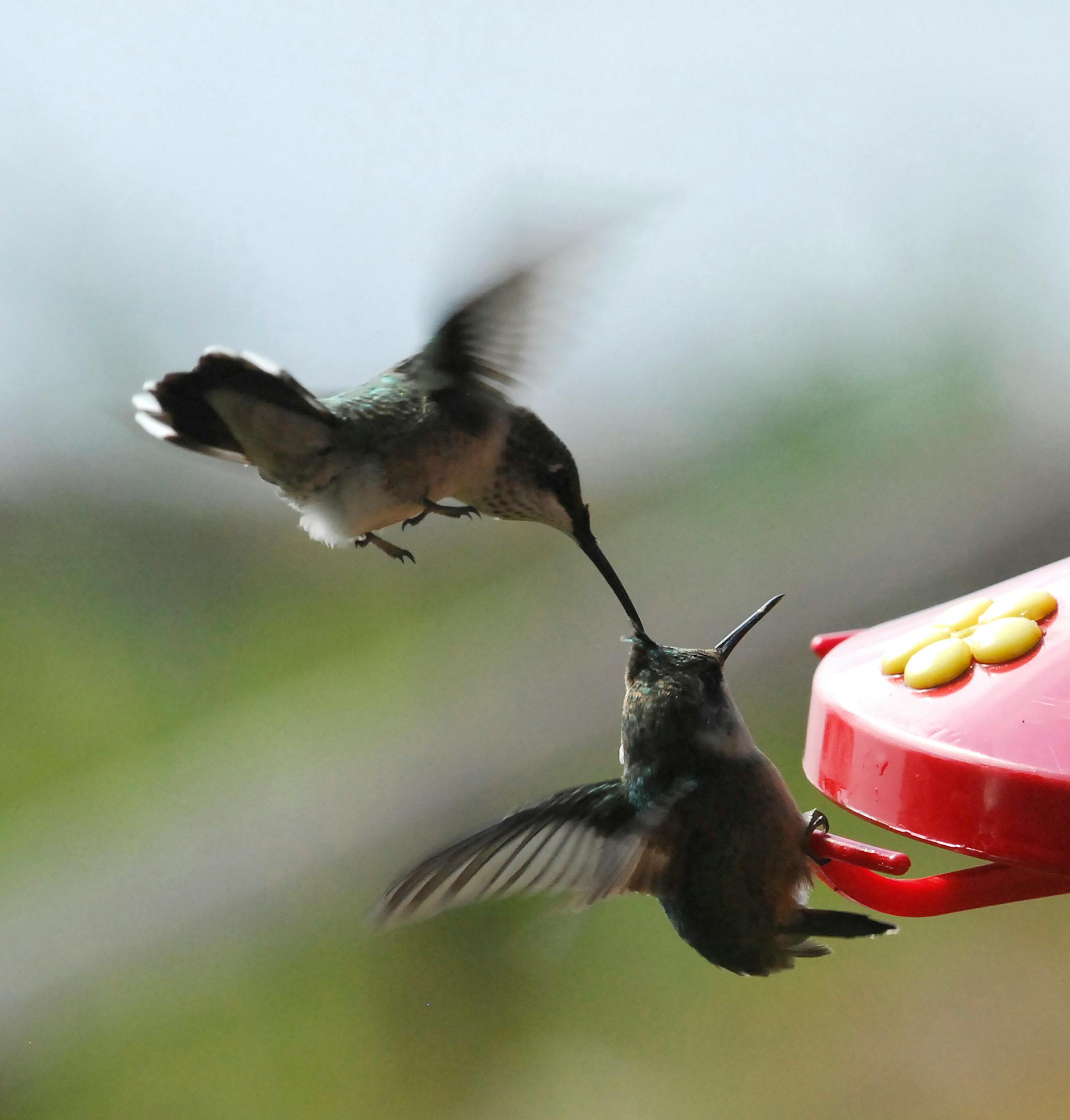
"Hummingbirds live most of their lives within hours of starvation."
That's what Sheri Williamson told me. She's the author of "A Field Guide to Hummingbirds of North America," one of the Peterson field guide series.
I e-mailed her earlier this fall after I witnessed a hummingbird brawl.
The fight took place at a hummingbird feeder, a place where you often see hummers confronting one another for feeding rights. But what I saw didn't seem like a run-of-the-mill territory dispute. One ruby-throated hummingbird attacked another so viciously I thought one bird was going to be killed.
E-mailing with Williamson made me feel a bit better.
"As savage as this no-holds-barred brawling seems, fatalities are extremely rare," she wrote.
She should know. She's been banding hummingbirds at the Southeastern Arizona Bird Observatory in Bisbee (www.sabo.org) for 18 years. Among the more than 5,000 hummers she's banded, she's seen hundreds with patches of missing or regrowing feathers, but fewer than 10 with injuries that looked like stab wounds.
According to Williamson, bill breakage is a more common injury than stab wounds, which she said "suggests that use of the bill as a stabbing weapon would put the stabber at almost as much risk of serious injury as the stabbee."


