

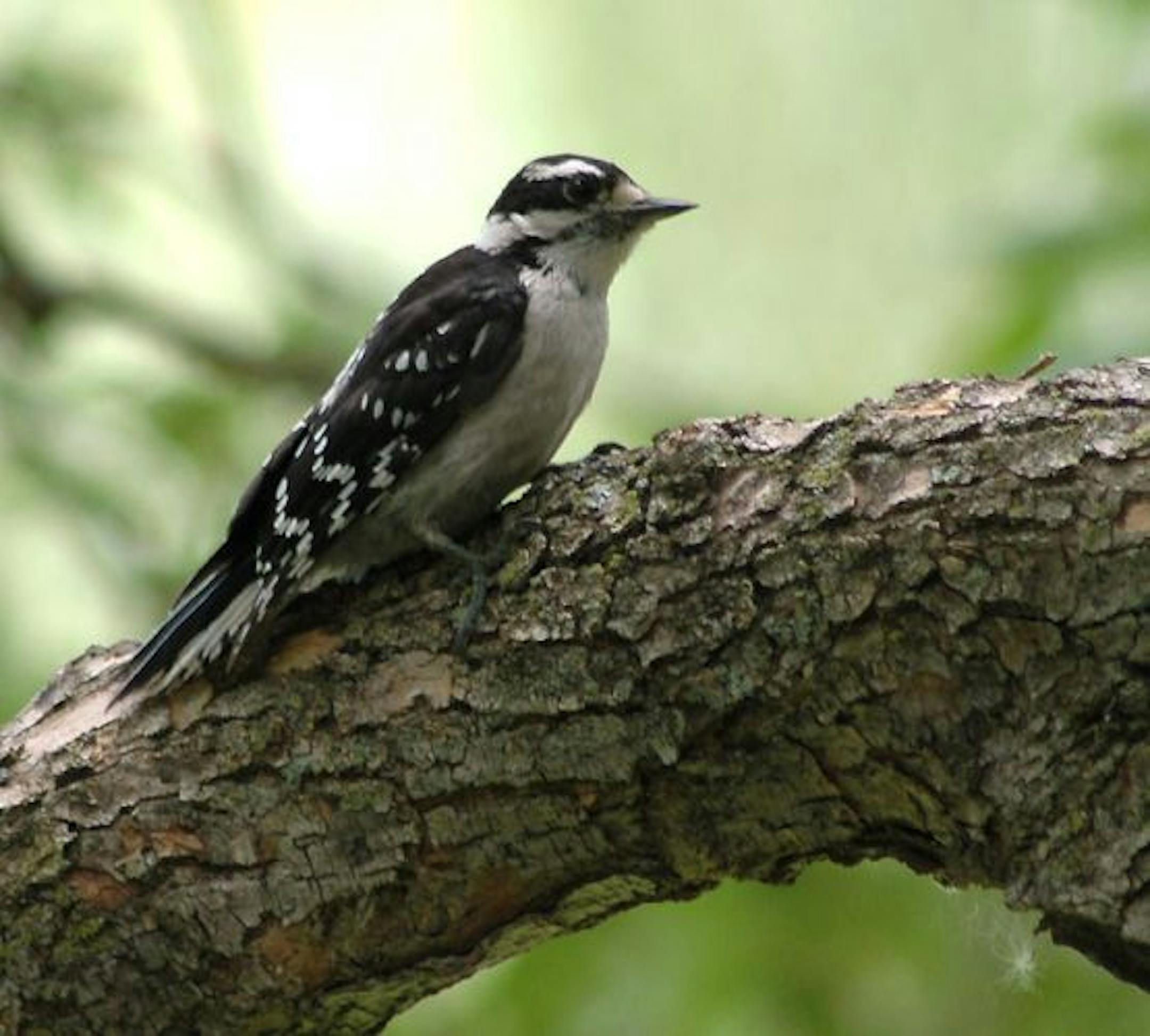
Q We have a family of downy woodpeckers coming to our peanut feeder. The two youngsters are males. Is that unusual?
A You've noticed a peculiarity in the downy woodpecker world.
When you see a red patch on back of the head of an adult downy, you can be sure it's a male. But a red spot on a young bird's head isn't so definitive. Both males and females can have a red spot atop their heads for a month or so after leaving the nest. This may help adult birds recognize them as youngsters needing a meal. The red topknot molts away within weeks, then males acquire the red nape spot and females sport their all black-and-white look.
Name that bird Q Some bird built a nest on a porch overhang at our cabin. The babies are being fed by the parents, which are fairly nondescript birds. Can you help us identify what kind of birds they are?
A Yes. There are only a few species of birds that regularly build their nests on shelf-like structures. One is the easily recognized American robin. The other is the Eastern phoebe, a brownish-gray bird with a pale underside. Phoebes frequently build nests on eaves, rafters and porch overhangs in cities and at cabins. Phoebes also are known for being insect-catchers.
Protecting bluebirds Q I finally got bluebirds to nest in one of the bluebird boxes mounted on my property. But then I found the nest destroyed and only a few blue feathers on the ground. I suspect a raccoon ate them. What can I do to prevent this from happening again?
A Mount the nest box on a pole and be sure to add some predator guards. Try mounting PVC piping over the pole and adding a 5-inch roof overhang to deter raccoons and cats. To learn how to make predator guards, go to the North American Bluebird Society's site at www.nabluebird society.org. Click on "Bluebird facts," then on "Nestbox plans."
Val Cunningham, a St. Paul nature writer, bird surveyor and Audubon field trip leader, can be reached at valwrites@comcast.net.


