
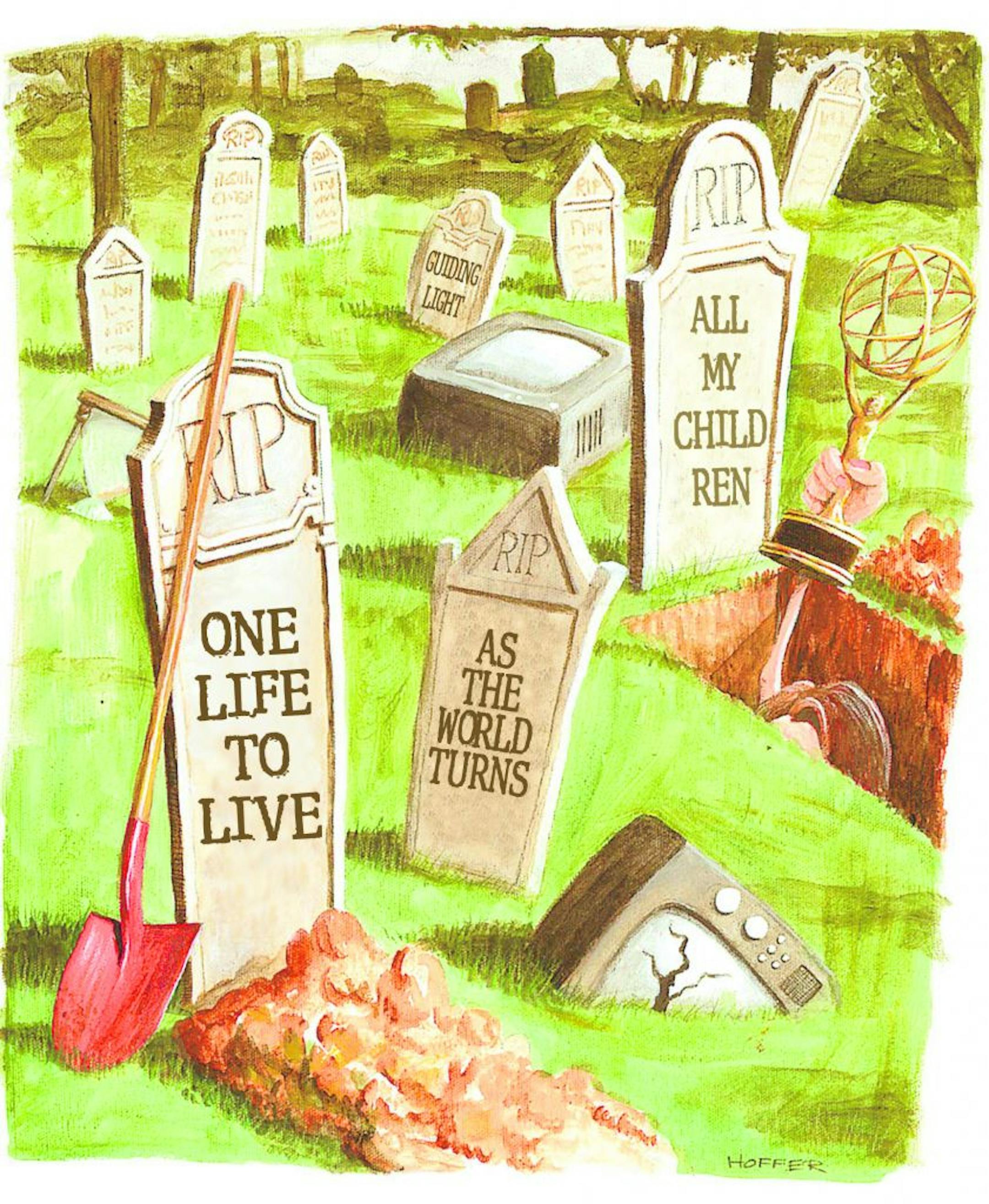
How many lives do soap operas have to live?

With "All My Children" and "One Life to Live" on the chopping block, one soaps fan dissects the rapid decline of a cherished genre.

For the Minnesota Star Tribune
September 22, 2011 at 3:48AM
300 dpi 3 col x 7 in / 146x178 mm / 497x605 pixels Mark Hoffer color illustration of a cemetery with TVs and gravestones of famous soap opera stars: Susan Lucci, Hope Brady and Reva Shayne; Susan Lucci reaches out of the grave with her Emmy Award in her hand. Fort Worth Star-Telegram 2002 With BC- TV-DYINGSOAPS:FT, Fort Worth Star-Telegram by Miki Turner <p>
KEYWORDS: dyingsoaps soap opera television illustration dyings soaps daytime soap tv television graveyard cemetery tombstone emmy shovel ha
300 dpi 3 col x 7 in / 146x178 mm / 497x605 pixels Mark Hoffer color illustration of a cemetery with TVs and gravestones of famous soap opera stars: Susan Lucci, Hope Brady and Reva Shayne; Susan Lucci reaches out of the grave with her Emmy Award in her hand. Fort Worth Star-Telegram 2002 With BC- TV-DYINGSOAPS:FT, Fort Worth Star-Telegram by Miki Turner KEYWORDS: dyingsoaps soap opera television illustration dyings soaps daytime soap tv television graveyard cemetery tombstone emmy shovel halloween serial moribundo cementerio sepulcral sepultura tumba sepulcro pala ilustracion grabado contributed ft hoffer turner 2002 (MCT/The Minnesota Star Tribune)

To watchers of daytime television, Friday's final episode of "All My Children" cannot come as much of a shock. As one who has watched for more than 35 years, I am saddened by the sitcom's demise, but not surprised. It's been a war of attrition from the days when there were more than a dozen daily soap operas to the day when, after "One Life to Live" bows out in January, there will be only four.

The traditional wisdom is that soaps are dying because housewives are no longer at home in the afternoon to watch. But ABC created the cable channel SOAPnet to allow evening viewing of its shows. The ratings were so anemic that ABC announced a change in format for the channel (to Disney Kids), even before canceling the soaps.

Brian Frons, president of ABC Daytime, described the replacing of the soaps with talk shows as "taking a bold step to expand our business because viewers are looking for different types of programming these days."

The ratings seem to bear that out. Over the past 10 years, audiences for "All My Children" and "One Life to Live" have declined by 60 percent. For the week of Aug. 15, the two shows each averaged just over 2 million viewers.

Carolyn Hinsey, columnist for "Soap Opera Digest" and author of "Afternoon Delight: Why Soaps Still Matter," said the decline is due in part to just that kind of attitude from network executives. "If ABC promoted 'All My Children' with half the vigor that it's now promoting 'The Chew' [its replacement], the ratings might be different. It's been decades since a soap got that kind of daytime and prime-time spots," she said.

But this perspective misses a true cultural shift. Traditional soaps are simply giving way to the soaps of the new millennium: unscripted "reality" shows like "The Real Housewives" or "Jersey Shore" or "Teen Mom." These shows scratch the same itch.

Take "The Real Housewives of New Jersey." This season alone, we've seen sibling rivalry erupt into violence at a christening, a mother throw her brat of a daughter out of the house, and at-least-weekly catfights. In a ratings comparison, this season they have been averaging 3.3 million viewers.

But Hinsey points out that the genres are qualitatively different. "There are no heroes in reality TV. The worst behavior gets the most screen time. I don't favor a genre where bad behavior gets rewarded."

Energy crisis at soaps?
At the same time, the over-the-top family melodrama regularly showcased on "The Real Housewives" used to be the bread and butter of traditional soaps. But those soaps seem to have run out of ideas. How many times can you deal with the appearance of an identical twin, or the switching of paternity tests? Been there, done that.

Just in case I was guilty of over-romanticizing the past, I watched classic episodes from the 1980s and '90s on YouTube. There was an energy and intensity to those shows that is lacking now. Nothing today comes close to the grand performance of Beverley McKinsey as the viperish millionairess Alexandra Spaulding on "Guiding Light."

But as budgets have been steadily slashed, there has been an inevitable reduction in rehearsal time. That has to affect the eventual product.

It's clear that the writing and acting on soaps is more "realistic" now, as if creators were embarrassed by all the credulity-stretching story lines of yore. But I'm not sure that's progress. It's just that quality that appealed to diehard fans. The changes have eroded the base without really attracting new audiences.

And things have become so much more timid. In the 1970s, "All My Children" dramatized Erica Kane having TV's first legal abortion, and "One Life to Live" revealed a long-running "white" character to be black and passing. Neither plot line would be possible in today's environment. Last year, "One Life" established a committed gay couple, only to write them off the show at the first signs of controversy.

It's a painful irony that both "All My Children" and "One Life to Live" have been at their best in the months since their cancellation. If they had been as bold in the years before, they may not have lost audiences and been canceled in the first place.

This may bode well for the future of the two soaps, as ABC has licensed them to Prospect Park, a production company that plans to deliver the shows via the Internet. So these cancellations may not so much represent the twilight of soaps as a genre as the continuing dramas stubbornly continuing.

about the writer

about the writer

WILLIAM RANDALL BEARD

More from Minnesota Star Tribune

See More
card image
J. SCOTT APPLEWHITE, ASSOCIATED PRESS/The Minnesota Star Tribune

The "winners" have all been Turkeys, no matter the honor's name.

In this photo taken Monday, March 6, 2017, in San Francisco, released confidential files by The University of California of a sexual misconduct case, like this one against UC Santa Cruz Latin Studies professor Hector Perla is shown. Perla was accused of raping a student during a wine-tasting outing in June 2015. Some of the files are so heavily redacted that on many pages no words are visible. Perla is one of 113 UC employees found to have violated the system's sexual misconduct policies in rece