

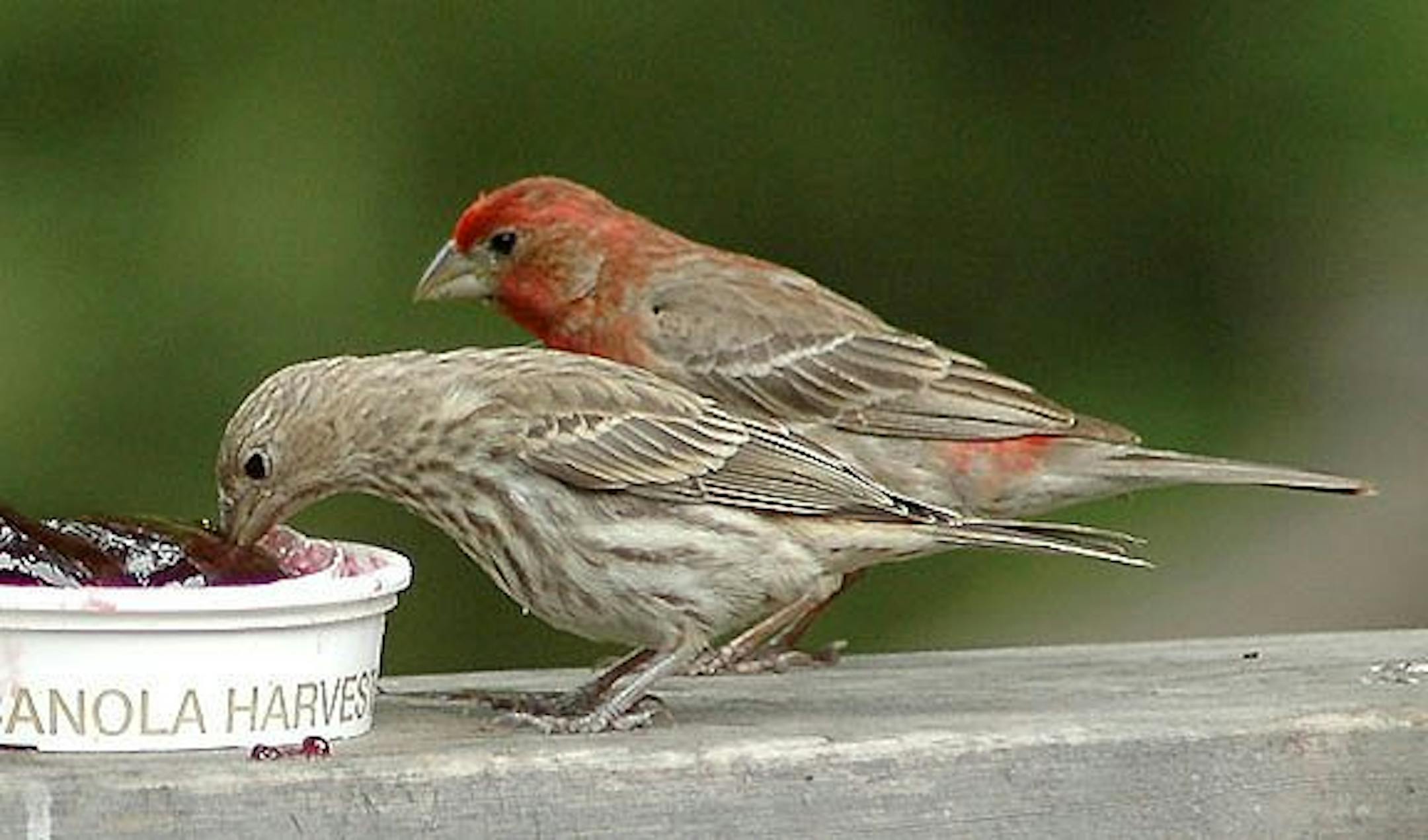
That reddish finch at your feeders is an amazing bird, capable of great feats of resilience in the face of some very hard times. Consider its recent history: Its ancestors were netted for years along the West Coast and sold, illegally, as caged birds, valued for their year-round singing. Transported, again illegally, to the East by pet dealers, some dozens were released around New York in the 1940s to avoid federal investigators.
Although thousands of miles from familiar habitat and facing cold winters, the birds did just fine. They not only survived, but thrived and soon had spread from the East Coast all the way to the Mississippi River, with a population in the millions.
They came to our state late in the game, but were firmly established by the 1990s. What had been a Western bird now owned the East, as well. At its peak, in the mid-1990s, the house finch population was estimated as being in the hundreds of millions.
The Cornell Lab of Ornithology calls the spread of the house finch "one of the most notable ornithological events of the 20th century in North America." No other bird has colonized such a wide area in so short a time in such huge numbers. These are social birds that congregate in large flocks, doubtless a factor in their survival.
Like all birds whose populations undergo major increases, this is a very adaptable species. House finches prefer to live near humans in parks, on farms, and in urban and suburban areas. They're big fans of bird feeders, especially those filled with black oil sunflower or safflower seeds.
Not aliens
Unlike introduced species such as the starling and house sparrow, the house finch is not an alien -- it's an out of place bird. Its recent history makes for an amazing saga and new chapters are still being written.
Several readers who have feeders have reported seeing house finches with swollen, crusty eyes. This is a symptom of a bacterial disease that infects the finches, causing conjunctivitis. It's often fatal, because blind birds can't see to escape predators or find food. Conjunctivitis swept through the house finch population, beginning in the mid-1990s -- just as their population was exploding, so was the disease. Some estimate that half of the house finch population disappeared by the year 2000. The disease seems to have leveled off but apparently will always be present at low levels. (See sidebar.)


