
St. Paul’s historic Justus Ramsey House is under reconstruction

Three years after the old stone structure was removed from West Seventh, preservationists are piecing it back together.

The Minnesota Star Tribune
January 15, 2026 at 12:00PM
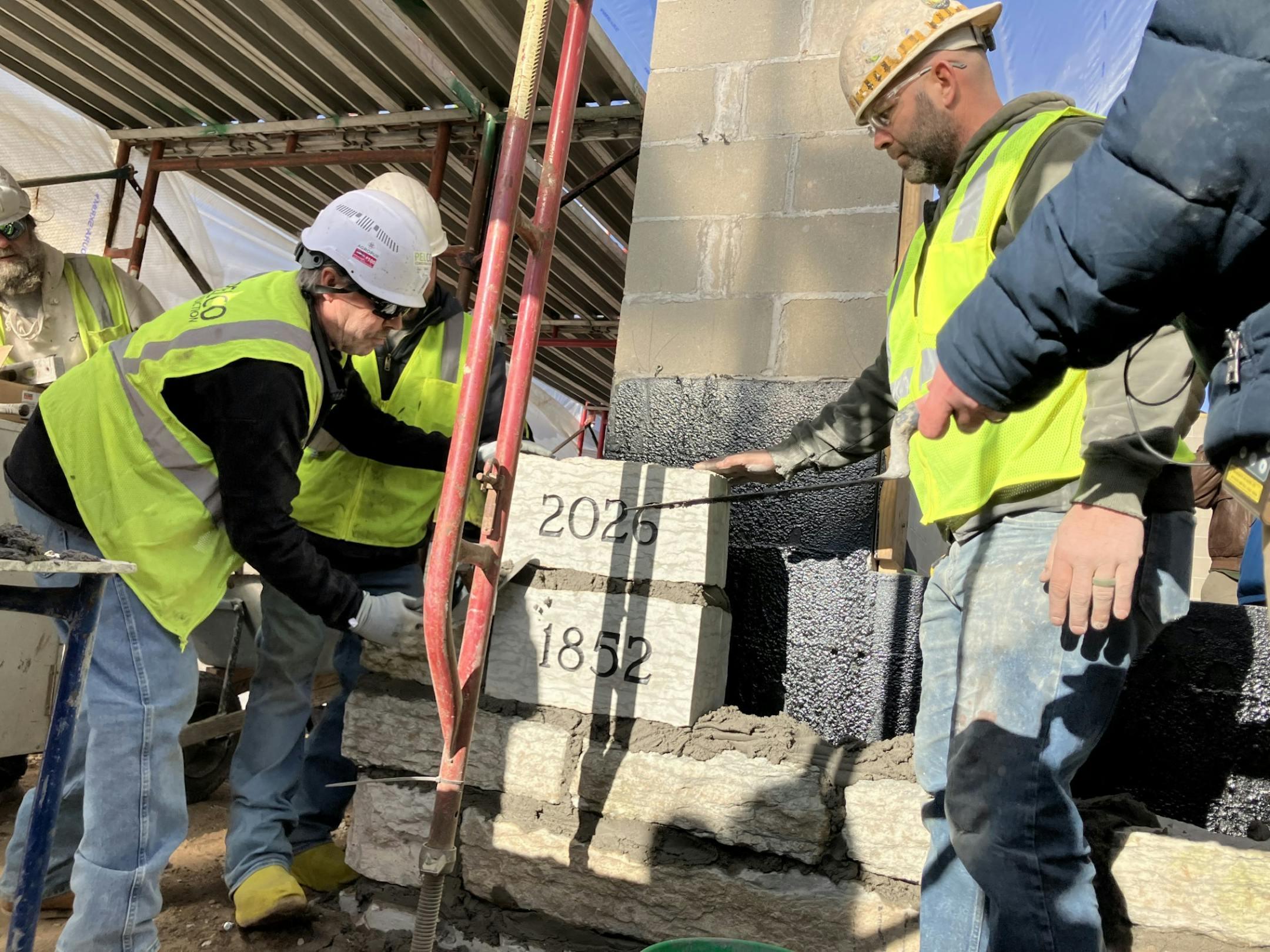
Three construction workers in white hard hats, neon yellow vests and blue jeans stack two limestone blocks and apply mortar. The blocks are engraved with the years 1852 and 2026.
Don Peltier, left, and Jon Dummer place cornerstones marking the Justus Ramsey House's original year of construction and the year of its reconstruction at the Minnesota Transportation Museum. (Josie Albertson-Grove)

The oldest surviving limestone house in St. Paul is being rebuilt at a new address and with a new purpose, the culmination of a yearslong preservation campaign.

On Wednesday, sheltered from the harsh cold and wind in a greenhouse of clear plastic tarps, workers laid two cornerstones — 1852 and 2026— to commemorate the construction and reconstruction dates of the Justus Ramsey House.

The tiny stone cottage is being put back together at the Minnesota Transportation Museum in St. Paul, but not quite as it was. A skeleton of modern concrete blocks will support the structure. Some pieces were missing after decades of deterioration and a wall collapse in 2022, so the reassembled house includes other limestone blocks that were a close match for the salvaged pieces.

But the house will come back together.

“This project gives us the opportunity to share not only railroad history, but life stories of St. Paul residents who called this very house home while working on these very railroads more than 100 years ago,” said Josh Hoaby, the museum’s executive director.

The new location is just the latest phase for a house that predates the city’s incorporation and was home to generations of St. Paulites.

City grew up around the small Justus House

The tiny stone cottage on W. 7th Street was built in 1852 for Justus C. Ramsey, brother of Alexander Ramsey, the first governor of the Minnesota Territory. Justus Ramsey and others owned the property jointly from 1849 to 1852. The first known resident was Robert A. Smith in 1853. Smith went on to become St. Paul’s longest-serving mayor.

The building later became an anchor for St. Paul’s early Black community, as a home to railroad porters and shopkeepers.

As St. Paul expanded from a small town to a city and the house’s environs sprouted businesses and eventually a hockey arena, it became a barbershop and a string of other businesses, shrinking in prominence as the neighborhood grew around it.

By the year 2000, the Justus Ramsey House was consigned to the corner of a restaurant patio. In 2022, the owner of that restaurant, Burger Moe’s, applied to demolish the structure, citing damage and danger after a wall collapsed.

Preservationists rallied against the demolition, horrified at the thought of losing one of the few buildings that remained from St. Paul’s earliest days.

In January 2023, a group opposed to demolition held an all-night vigil outside the house to fend off a demolition crew, and the next morning persuaded a judge to sign an order to stop the house from being torn down.

Eventually, the property owner and the preservationists found a city-brokered compromise: The house would be un-built, stone by stone, and stored in a warehouse until they could find it a permanent home and scrape together enough money to rebuild it.

Not enough money to fully rebuild

So far, the preservation effort has raised $500,000, including a $300,000 grant from the Minnesota Legacy Amendment fund and $34,000 in city funding.

Hoaby said that has been enough money to rebuild the exterior of the house and put a roof on it — just enough to protect the structure from the elements.

The railroad museum is now working to raise another $250,000 to finish the interior. The house will sit just outside the museum’s roundhouse that holds the main exhibit of old railcars and memorabilia from the Great Northern Railway.

Karen Siebert, who is overseeing the reconstruction project for the museum, said the hope is for the house to hold an exhibit about the lives of the workers on the Great Northern Railway, particularly the Black porters who lived in the house from the 1890s through the 1930s.

about the writer

about the writer

Josie Albertson-Grove

Reporter

Josie Albertson-Grove covers politics and government for the Star Tribune.

See Moreicon

More from St. Paul

See More
Three construction workers in white hard hats, neon yellow vests and blue jeans stack two limestone blocks and apply mortar. The blocks are engraved with the years 1852 and 2026.
Josie Albertson-Grove

Three years after the old stone structure was removed from West Seventh, preservationists are piecing it back together.

card image
card image