
Herschel Walker trade is the ultimate Vikings 'what if'

Analysis Dallas turned its haul for the running back into three championships.

May 4, 2020 at 12:21AM
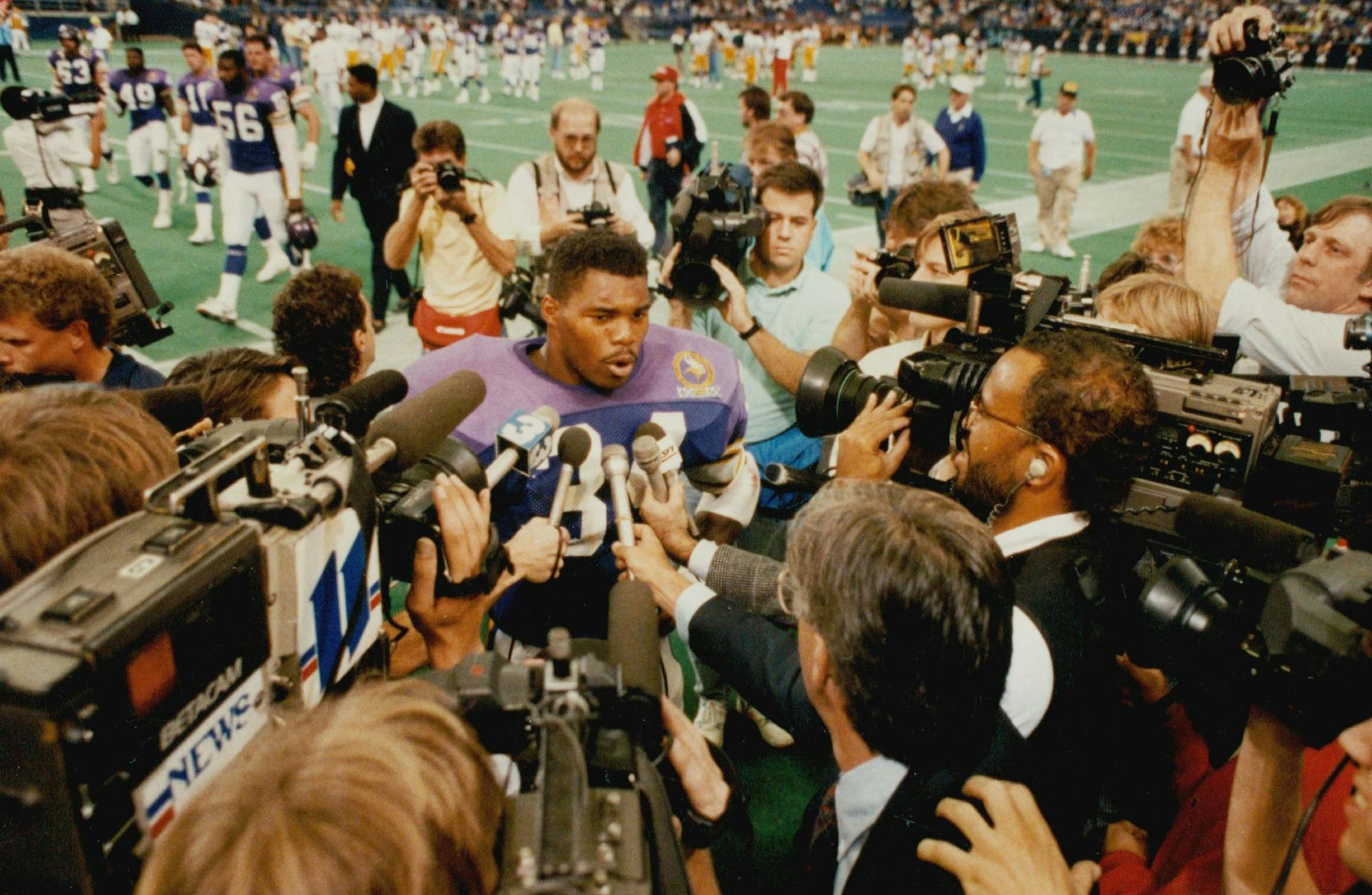
October 16, 1989 Reporters and photographers mobbed Herschel Walker after his highly successful debut as a Viking. He gained more total yards than the entire Green Bay offense. Brian Peterson, Minneapolis Star Tribune
Media members mobbed Herschel Walker after his impressive Vikings debut vs. the Packers on Oct. 15, 1989. That game also was the pinnacle of his 42-game Vikings career. (The Minnesota Star Tribune)

Vikings fans have never watched their team win a Super Bowl. But they are champions of playing the "what if?" game. So many moments in the franchise's history leave fans wondering how things might have been different, if only one thing had changed.

If Drew Pearson hadn't caught that Hail Mary; if Gary Anderson had made that kick; if they had scored points in the first half of just one Super Bowl. If, if, if.

As part of a series of stories examining some of the great "what if" moments in Minnesota sports history, we asked readers to submit their own big questions for investigation. Among the most consistent responses was some variation of the same question:

From Michael M.: What if Mike Lynn had not traded the future of the Vikings for Herschel Walker?

From Dennis B.: What if the Vikings had not traded for Herschel Walker (and kept all their draft picks)?

Joe F. had a bunch of ideas, including this: Of course the Herschel Walker trade.

Another Michael M.: What would have happened if the Vikings did not trade for Herschel Walker?

First, some history.

The Vikings went to the NFC Championship Game after the strike-interrupted 1987 season. In 1988 they went 11-5 and won a wild-card playoff game. In 1989, they were 3-2 in the middle of October when Lynn, the general manager, went all in.

Thinking the Vikings were a running back short of a Super Bowl team, Lynn made a deal with the Cowboys — who used interest from other teams, including the Browns, as leverage — for Walker.

This was the era of the workhorse running back dominating. Walker had carried 361 times for 1,514 yards in 1988, a healthy 4.2 yards per carry, and caught 53 passes for another 505 yards. Maybe it should have been a red flag that he was down to only 3.0 yards per carry through five games in 1989. Then again, the Cowboys were laughably bad — 0-5, en route to a 1-15 season.

So the swap was made Oct. 12, 1989 (more on the particulars in a moment). Fun fact: Walker's final game with Dallas was Oct. 8 against Green Bay. His Vikings debut, three days after the trade on Oct. 15, was against Green Bay.

Walker's first game with the Vikings was his best, by far. He lost his shoe! He ran for 148 yards! The Vikings cruised to a 26-14 victory. Super Bowl, baby.

But he never topped 100 yards again in 1989 or 1990. The Vikings made the playoffs at 10-6 but were waxed by the 49ers. Walker was an enigma. His production dipped, and then he had things figured out. He wasn't keeping his head up when he ran! Of course! Nope. They missed the playoffs in Walker's final two seasons, and Jerry Burns retired after the 1991 season.

A new sheriff (Dennis Green) came to town in 1992. And he didn't have a lot of young talent to work with. Because …

Ah, yes, the trade. Walker gained 2,264 rushing yards and 681 receiving yards in 42 games with the Vikings. That's decent production. But maybe it was not quite worth: three first-round picks, three second-round picks, a third-round pick and a sixth-round pick. And, um, four players.

Wow, just writing it out is painful.

The Vikings did get two third-round picks, a fifth-round pick and a 10th-round pick (hello, 1989!). But let's consult the handy draft pick value chart developed by — wait — Jimmy Johnson, the first-year Dallas coach in 1989 who cooked up the Walker trade. Yep, he knew exactly what he was doing.

This isn't an exact science since neither team knew exactly where in the draft each pick would land, but based on the value assigned to each draft slot in 2020 and only taking into account picks in the first three rounds, the Cowboys got:

800 points (first round, No. 21 overall, 1990)

430 points (second round, No. 47 overall, 1990)

1,250 points (first round, No. 11 overall, 1991)

530 points (second round, No. 37 overall, 1991)

1,150 points (first round, No. 13 overall, 1992)

500 points (second round, No. 40 overall, 1992)

235 points (third round, No. 71 overall, 1992)

Total: 4,895 points worth of draft capital

The Vikings got:

360 points (third round, No. 54 overall, 1990)

250 points (third round, No. 68 overall, 1991)

Total: 610 points worth of draft capital

Making matters worse: The Cowboys turned those picks into various swaps for other picks that netted them, among other drafted players: Hall of Fame running back Emmitt Smith, the NFL's career leading rusher; standout defensive tackle Russell Maryland; elite safety Darren Woodson; and solid cornerback Kevin Smith.

It's true the Vikings got Jake Reed with that third-round pick from Dallas in 1991, but those four Cowboys players became integral pieces of three Super Bowl champs (1992, '93 and '95).

The Vikings, as you might recall, did not win the Super Bowl during that time. They did not reach the Super Bowl. They have never won the Super Bowl. They have not made it to the Super Bowl since I was 2 months old (I am 43).

Would they have won it at some point in the late 1980s or 1990s if not for the Walker trade? That's the crux of this what-if, and the unsatisfying answer is that we will never know.

But there is this: Green took the Vikings to the playoffs in 1992, 1993, 1994, 1996, 1997, 1998, 1999 and 2000. At least in the earliest of those years, it would have been mighty nice to have a boatload of fresh talent, in the form of first- and second-round draft picks — three of each — to complement a roster that clearly had plenty of other talent.

Maybe if the Vikings had, say, drafted Emmitt Smith in 1990 instead of Dallas drafting him, the entire balance of that decade would have been different.

If anything, it makes you appreciate the job Green did in bolstering the roster and producing winning teams despite not having high-end talent from the three drafts immediately preceding the first game he coached with the Vikings.

It would have been fun to find out what might have happened if not for that fateful, colossal blunder of a trade 30 years ago.

about the writer

about the writer

Michael Rand

Columnist / Reporter

Michael Rand is the Minnesota Star Tribune's Digital Sports Senior Writer and host/creator of the Daily Delivery podcast. In 25 years covering Minnesota sports at the Minnesota Star Tribune, he has seen just about everything (except, of course, a Vikings Super Bowl).

See Moreicon

More from Minnesota Star Tribune

See More
card image
J. SCOTT APPLEWHITE, ASSOCIATED PRESS/The Minnesota Star Tribune

The "winners" have all been Turkeys, no matter the honor's name.

In this photo taken Monday, March 6, 2017, in San Francisco, released confidential files by The University of California of a sexual misconduct case, like this one against UC Santa Cruz Latin Studies professor Hector Perla is shown. Perla was accused of raping a student during a wine-tasting outing in June 2015. Some of the files are so heavily redacted that on many pages no words are visible. Perla is one of 113 UC employees found to have violated the system's sexual misconduct policies in rece