That artists of American Indian heritage defy stereotype should come as no surprise given the vast geographic territory and tribal diversity they represent. "Migrations: New Directions in Native American Art," a handsome sampler on view at the Hillstrom Museum of Art in St. Peter, Minn., wisely narrows the field, focusing on just six artists whose photos, lithographs and sculpture are as much personal expression as cultural statement.
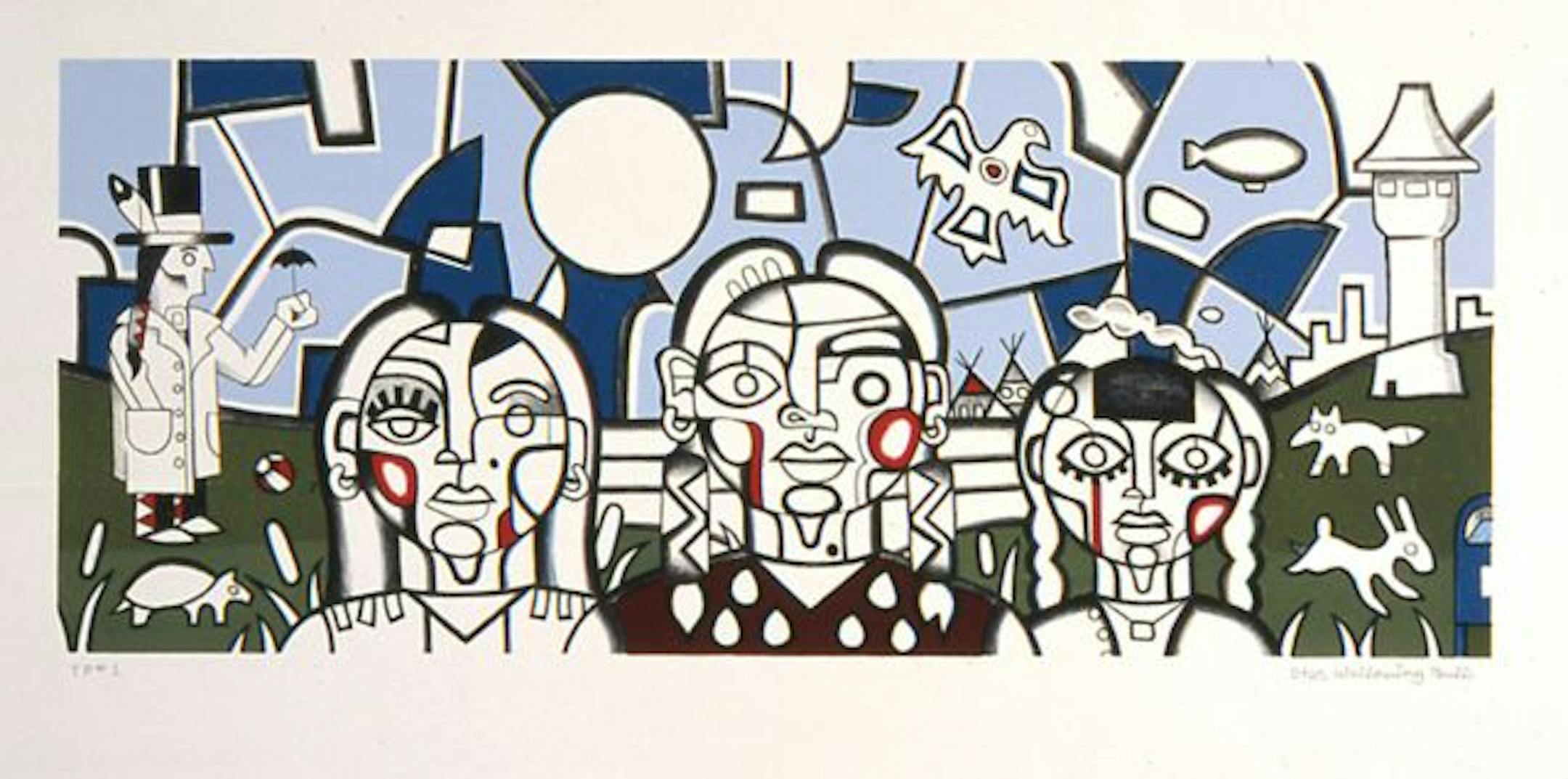
Their education is as diverse as their geographic and tribal origins: Star Wallowing Bull, a Chippewa from Minnesota's White Earth Reservation, taught himself to draw by watching his celebrated father, Frank Big Bear, at work in their south Minneapolis home, while Marie Watt, a Seneca born in Seattle, honed her conceptual feminism while completing an MFA at Yale University. The six were selected from dozens of nominees by a five-member panel including Siri Engberg, a Walker Art Center curator.
Equal parts of conceptual subtlety and technical sophistication underscore the show. Many of the themes and references are to Indian history and experiences, as befits artists who wear their heritage with comfortable, sometimes ironic pride. Yet, what could be more universal than Steven Deo's sculpture of a father and son fishing? The show opens with that disarming tableau, the life-sized figures made of colorful jigsaw puzzle pieces and holding bamboo poles.
Nearby stands his more politically potent sculpture of an adult and two kids playing war games with plastic trucks and helicopters. The figures themselves are composed of hundreds of little plastic soldiers fastened to an armature, their entwined boots, guns and helmets suggesting that militarism is the very flesh of the human experience -- or the American experience, since some are waving U.S. flags. Deo's lithographs -- of swooping birdlike forms, industrial machinery and ghostly photos -- are more abstract and hermetic.
Oklahoma artist Ryan Lee Smith, a Cherokee, uses abstraction to veil his content. Lively swoops and swirls of white paint mask parts of his colorful mixed-media collages, leaving jagged jigsaw shapes peeping out like fragments of graffiti glowing through clouds of whitewash.
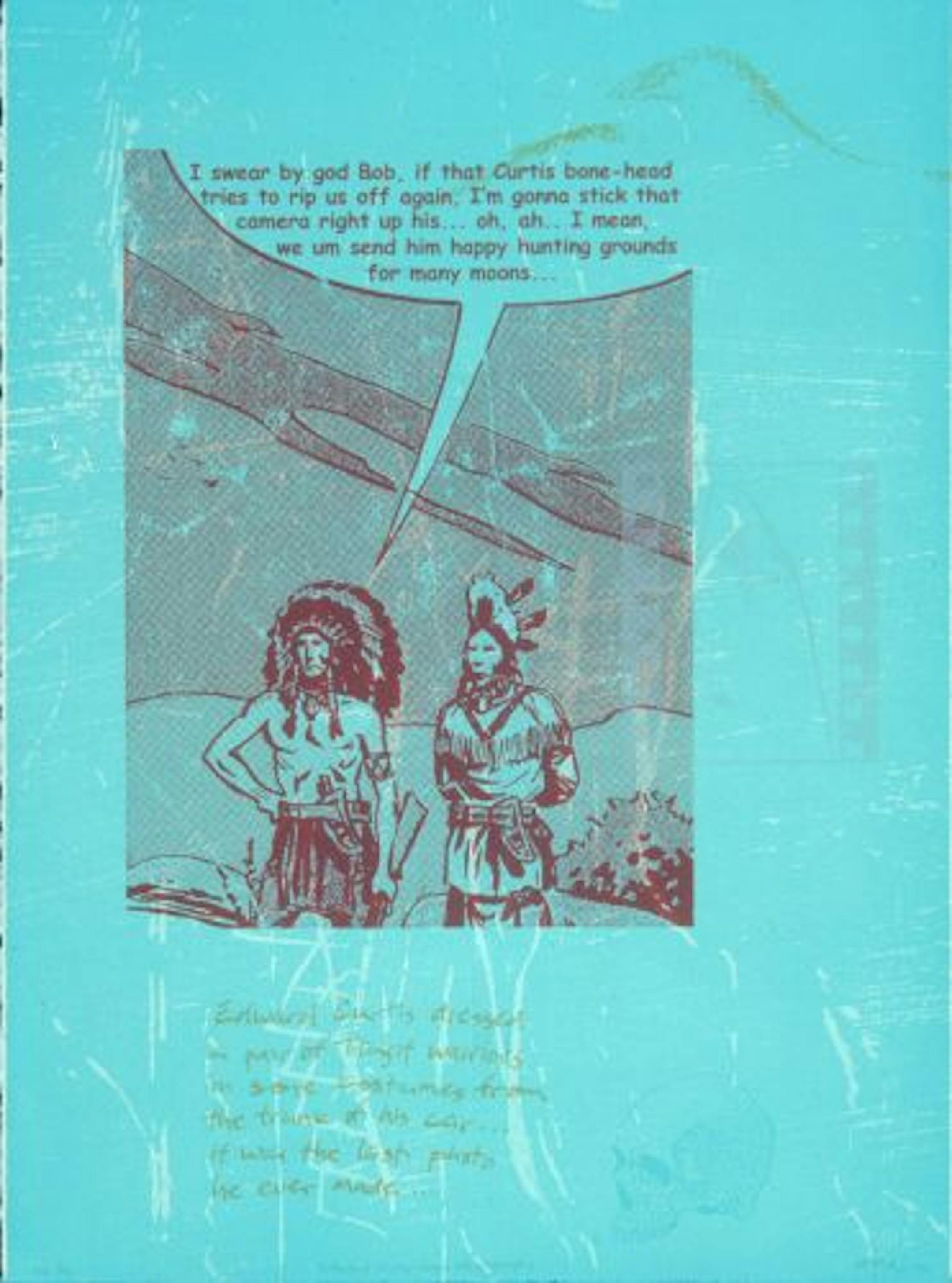
The work with more specific "Indian" themes is particularly potent. In lithographs and photos, Larry McNeil, a photography professor at Boise State University in Idaho, mines his Tlingit/Nisga heritage for pointed cultural commentary. He embeds poignant narratives and family photos in his prints, and riffs on how "Manifest Destiny" compelled him to steal a car to search for America because, as the white men often said, it was "God's will."
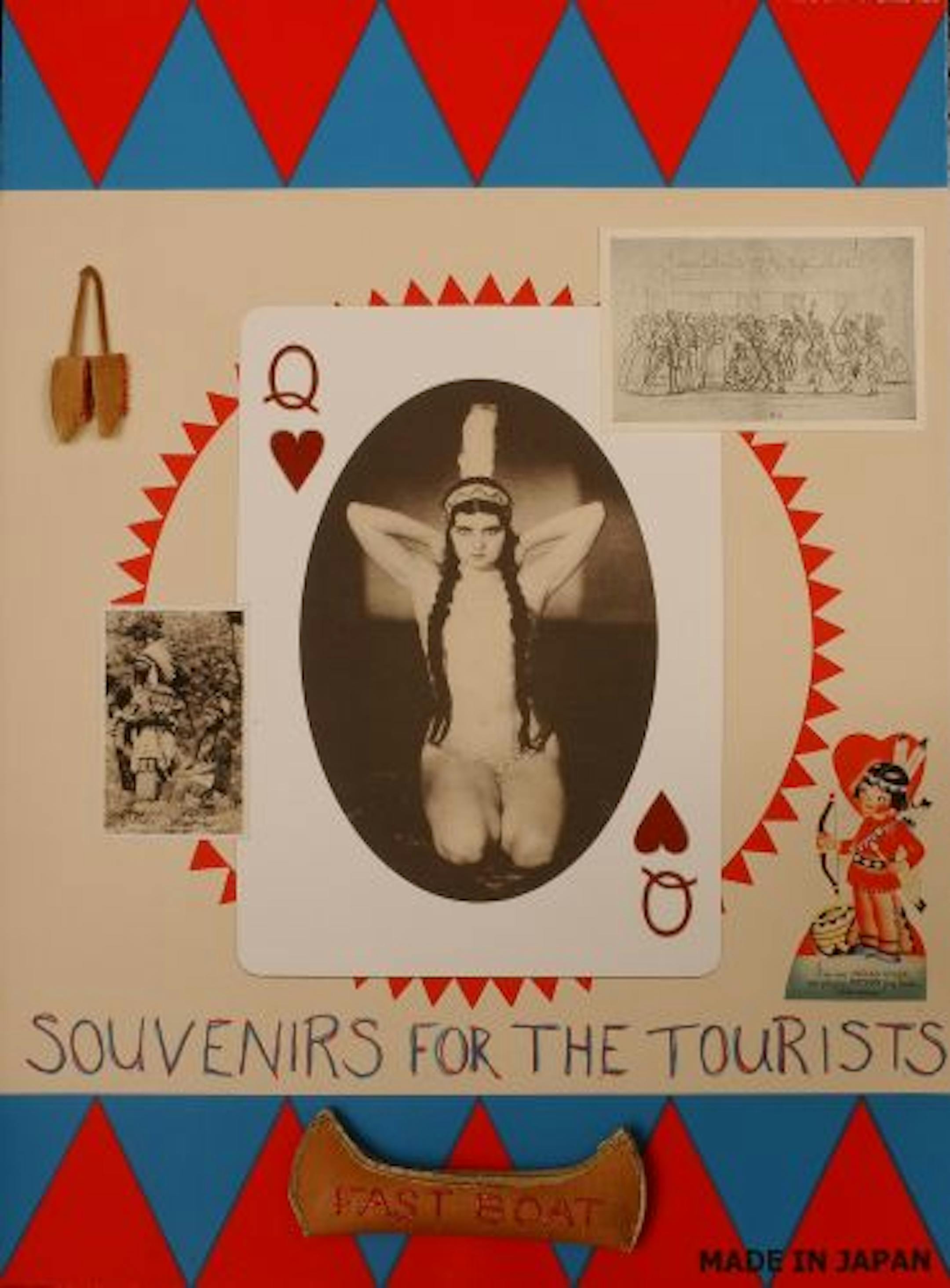
Tom Jones, a Ho-Chunk living in Wisconsin, documents contemporary Indian life in photos, parodies in lithographs the touristic exploitation of Indian artifacts, and delivers one of the show's most topical references in "Sweet Land of Liberty," a beautiful inkjet print memorializing the infamous 1862 hanging of 38 Sioux and Ho-Chunk. He heightens the event's horror and immediacy by locating it precisely "just south of Mankato, near the current Holiday Inn and Minnesota Valley Regional Library." Hallowed ground, indeed.
Wallowing Bull's amazing talent with colored pencil is in full flair here in eight colorful lithographs and drawings densely packed with symbols and figures from Indian lore and popular culture (Mickey Mouse, Statue of Liberty).