

For some fans, the quintessential Herbie Hancock song is "Maiden Voyage," a sophisticated bebop jazz tune that nevertheless imparts, as its title implies, a pacific confidence and serenity even as one embarks on uncharted territory.
Others would opt for "Cantaloupe Island" or "Watermelon Man," songs that nail the laconic syncopation of Afro-Latin brass and percussion so neatly that they are beloved standards south of the border. Still others would choose "Chameleon," a slab of electronic fatback funk built around a two-chord vamp, or perhaps "Rockit," a jittery stylistic forerunner of electronica and hip-hop and one of the first hit videos on MTV.
Considering the breadth of moods and textures on that formidable list, pulling off a career-spanning concert tour is no mean feat. And doing justice to that catalog in a solo performance would seem nigh on impossible.
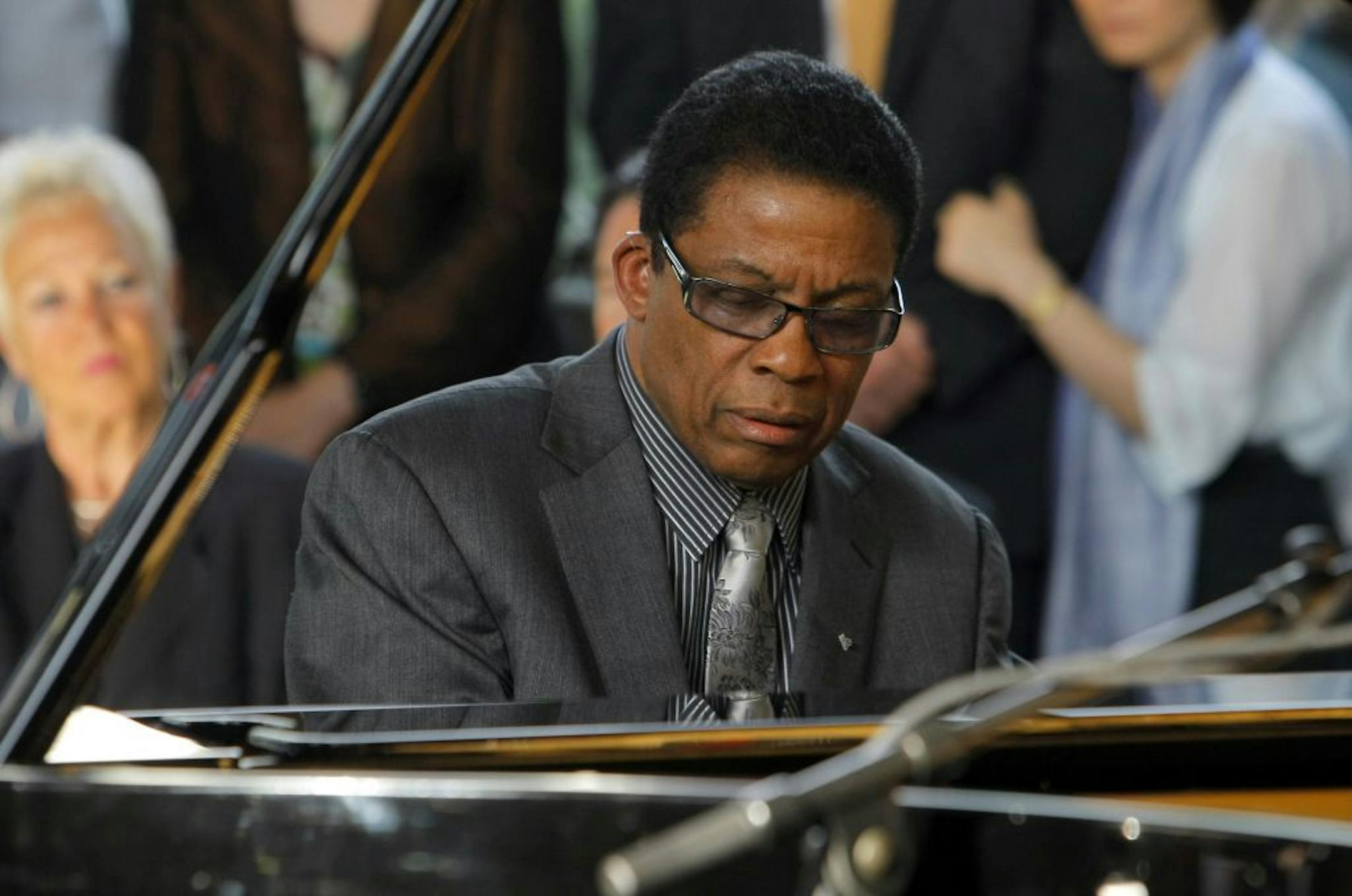
But that's what Hancock will attempt to do at Orchestra Hall on Friday. It is the next stop on an extraordinary tour where on some nights the 71-year-old keyboardist collaborates with Euro-classical groups such as the Los Angeles Philharmonic or the Seattle Symphony, and other nights, as in Minneapolis, where he plays onstage all by his lonesome.
"I actually did a very short solo tour in Europe about 30, 35 years ago, with just an acoustic piano," said Hancock by phone from a New York hotel. "The difficult thing is that there is no one to lean on and no interaction with another human being. It takes a lot of courage -- you are actually very naked."
True enough. For all his individual acclaim, Hancock has always been most comfortable as a master interpreter and collaborator with other artists. He was the rhythmic glue in Miles Davis' legendary quintet of the 1960s. His most recent triumphs have been creative arrangements of songs by George Gershwin ("Gershwin's World" in 1998) and Joni Mitchell ("River: The Joni Letters" in 2007), both multiple Grammy winners.
Even now he bridges the gap between musical styles as the ongoing creative chair for jazz at the L.A. Philharmonic, and was in that New York hotel so he could participate in a 60th birthday concert for Sting the following night.
But as a natural collaborator trying to trace his versatile career via a solo performance, Hancock has ingeniously killed two birds with one stone by employing computer-assisted instruments and other electronics.


