

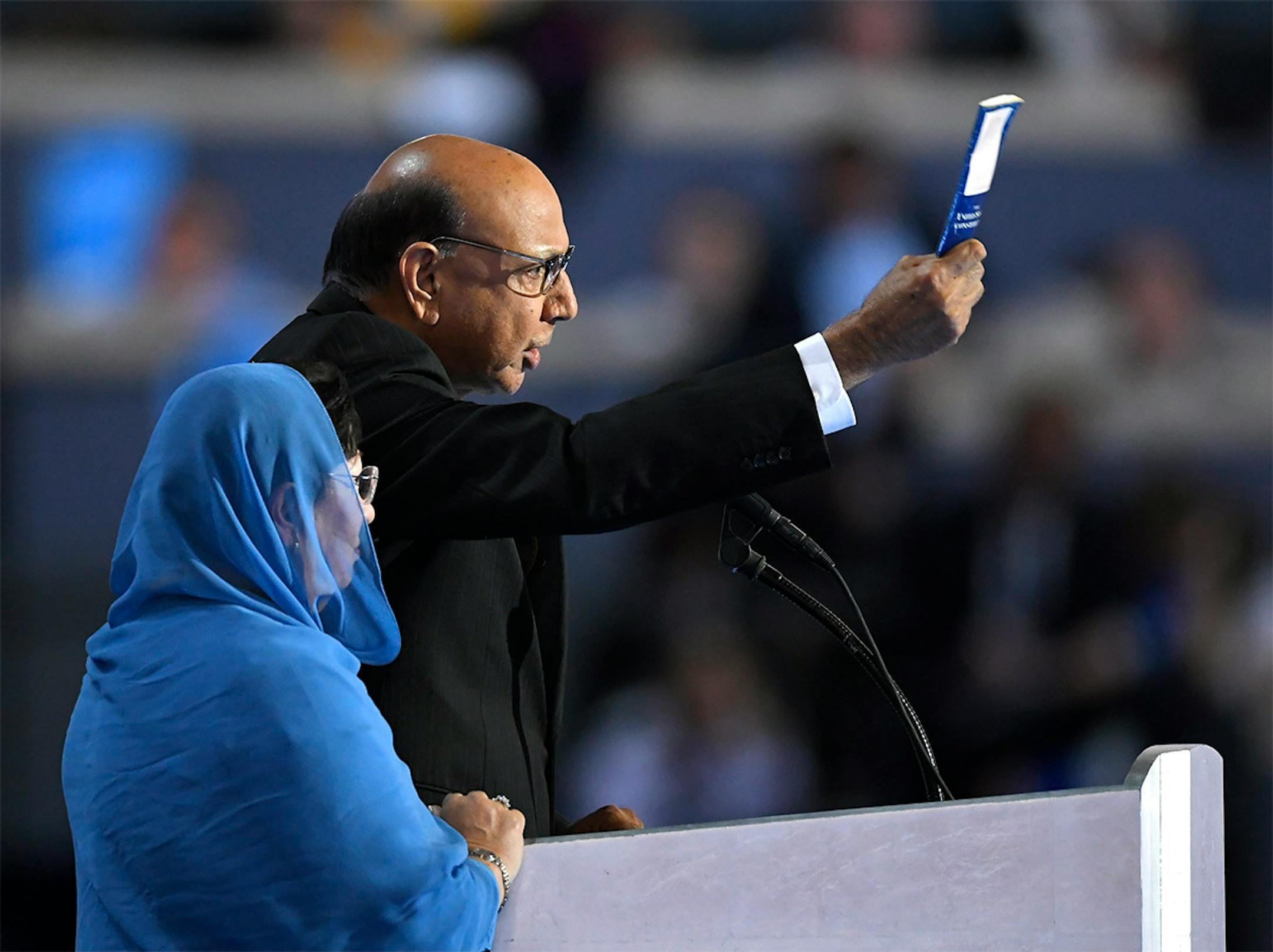
Improbably, the U.S. Constitution has become a runaway bestseller. The reason, of course, is Khizr Khan's speech at the Democratic convention, and in particular these words posed to the Republican presidential nominee: "Let me ask you: Have you even read the United States constitution? I will gladly lend you my copy."
Pointedly, Khan added, "In this document, look for the words 'liberty' and 'equal protection of law.' "
Khan's words have pointed the Constitution's thousands of fresh readers toward a text that might well surprise them. Still, James Madison, father of the founding document, would be pleased.
What many new readers will discover is that Articles I through V emphasize not individual rights, but the structure of government. They specify, in sometimes mind-numbing detail, which branch can do what.
To find the word "liberty," you have to look pretty hard. It appears only three times, and the first mention comes late in the preamble (well after "common defense"). The phrase "equal protection of the laws" appears just once — not in the original Constitution or even the Bill of Rights (the first 10 amendments, added in 1791). It took a Civil War to get them there.
The heart of the Constitution consists of Articles I, II and III, which create the legislative, executive and judicial branches. If you read these articles afresh and without predispositions, you see that the structure protects liberty not by abstract declarations, but by specifying the institutions that safeguard it.
There's a lesson there. Madison himself had little faith in what he disparaged as "parchment barriers." When the Constitution was ratified in 1789, it contained no Bill of Rights at all — and at the time, Madison thought it shouldn't.
Consider the relationship between Article I, which spells out the role of Congress, and Article II, which involves the president. Congress's powers are specifically enumerated; it lacks the general authority to make law.


