

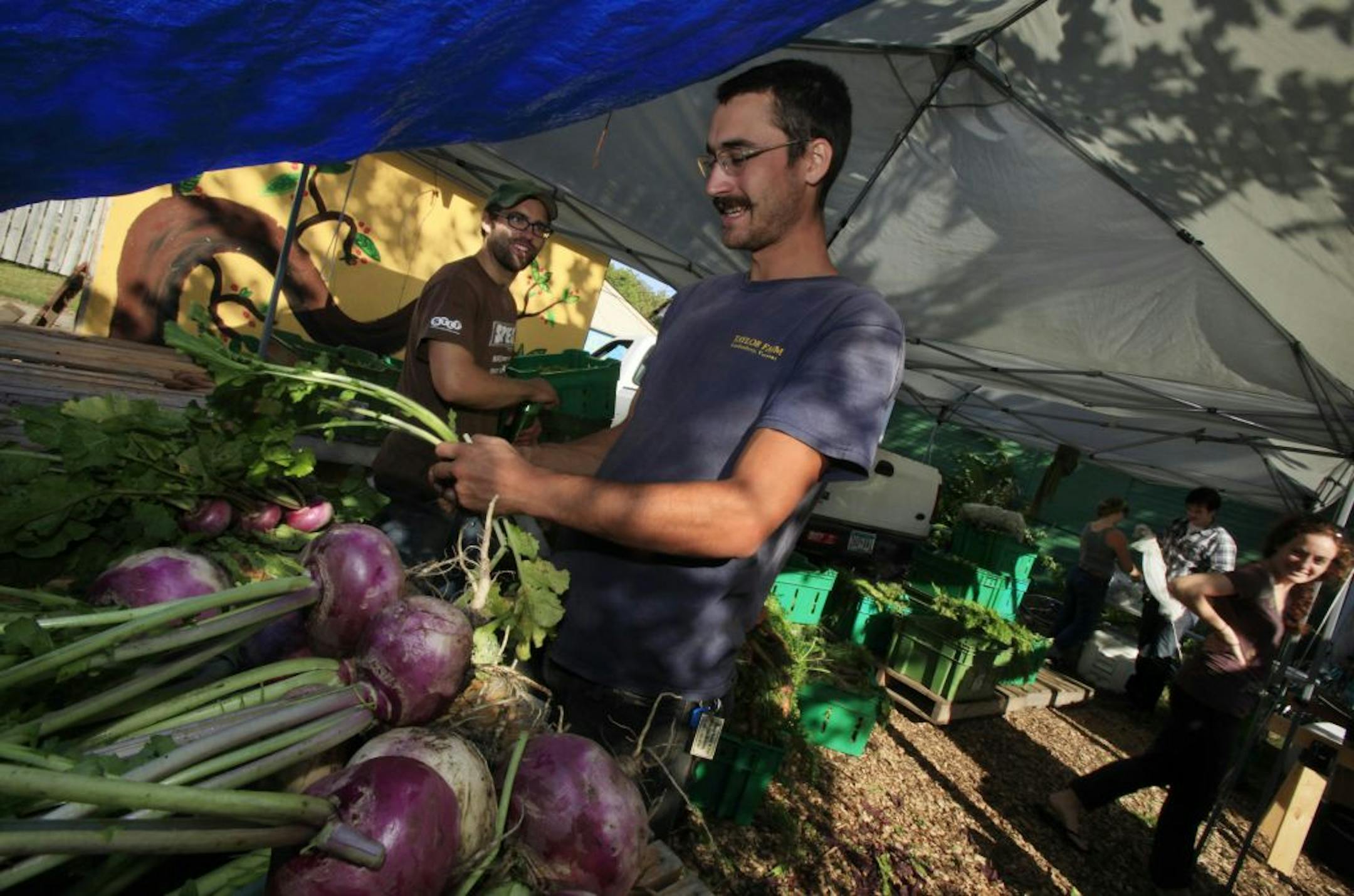
It was harvest day at the farm. Emily Hanson bagged salad mix and Alex Liebman hosed the dirt off just-picked turnips, while helpers served as human lettuce spinners, their arms windmilling as they twirled mesh bags of wet greens.
Stone's Throw Urban Farm isn't your average sprawling farm field -- it's 16 vacant city lots scattered across Minneapolis and St. Paul. The food Stone's Throw produces is distributed to its CSA members and sold at two urban farmers markets, with surplus donated to a food shelf. It's also sold informally to neighbors, in appreciation of their welcoming the farm into their residential neighborhood.
"What we're doing is weird," acknowledged farmer Nate Watters.
Farming in the city is a lot less weird than it used to be. Neighborhoods all over the Twin Cities, from gritty inner-city blocks to upscale enclaves, have seen tiny food-producing enterprises sprout in their midst this growing season.
The urban agriculture movement has been building for several years, but it firmly took root in Minneapolis this summer following the city's approval in March of zoning rules that allow commercial food growing in residential areas for the first time since 1963. That includes small "market gardens" on vacant lots and even selling homegrown food.
That's not to say those activities weren't already happening.
"It made what we were doing legal. Before, we were in a gray area," said Eric Larsen, a farmer with Stone's Throw, a first-year operation that is a merger of three smaller urban farms (Uptown Farmers, Concrete Beets and Pig's Eye Urban Farm). The farmers joined forces in hopes of turning their "sustainable hobby" into a livelihood.
"We knew what we were doing was good for the city and the community," Hanson said. "We were waiting for the bureaucracy to catch up."


