

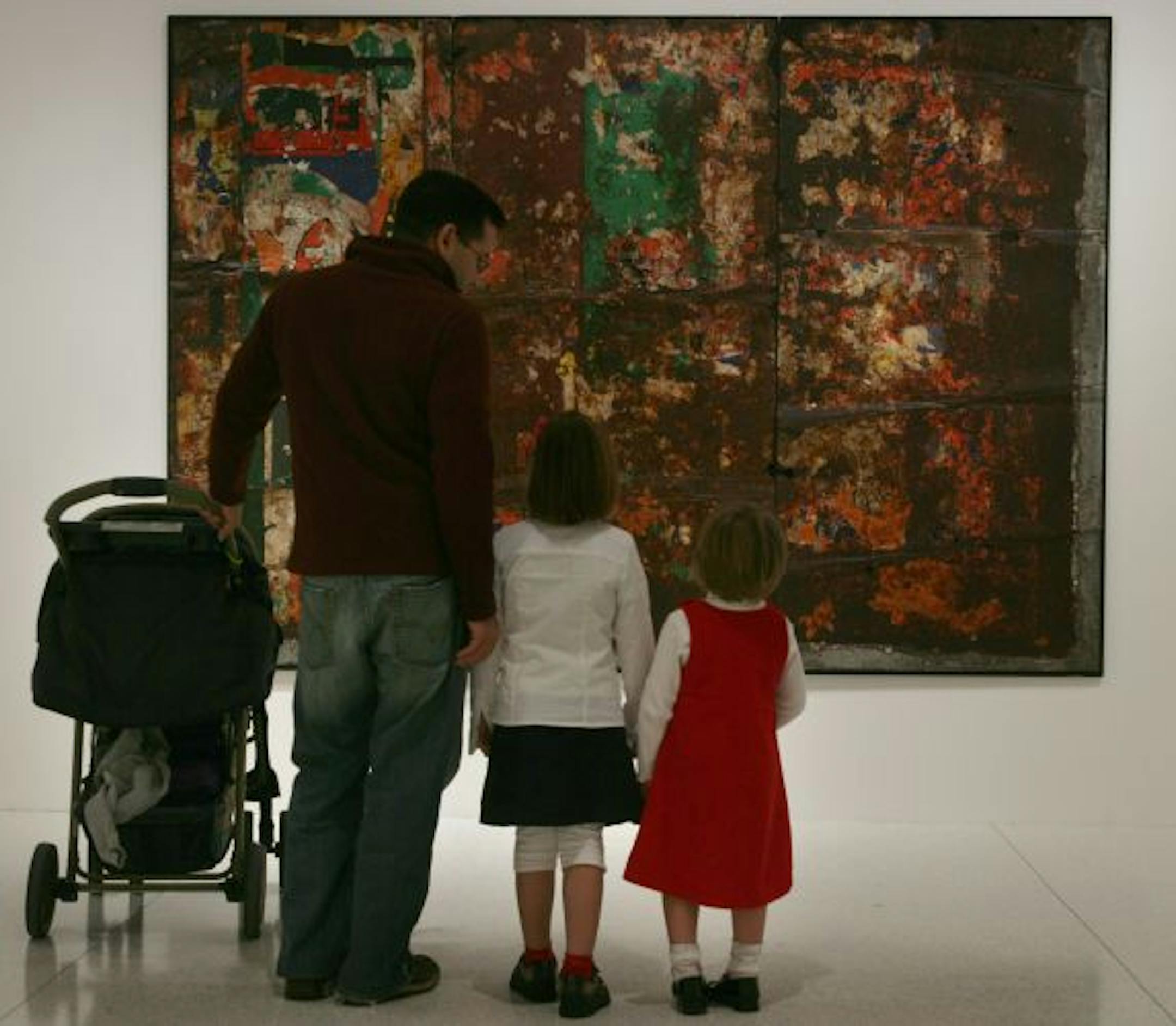
Were the past 50 years really a period of endless dissolution and anomie, fragmentation and fracture, repression, angst and bad housekeeping, all lived under the specter of a mushroom cloud of atomic dust? Are a beggar's hand, a sighing mirror and prayers in an unfamiliar script the best we can cough up to mitigate the pervasive gloom of recent decades?
Bummer.
Would that it were otherwise, but "Event Horizon," Walker Art Center's three-gallery sample of topical and personal art from its collection -- films, videos, photos, installations, paintings, sculpture, collages -- is really heavy weather. And it's going to be up for nearly three years. True, there will be changes along the way. Films and videos will be switched periodically. Performances will be injected, and paintings and photos may change, too. But it's difficult to imagine a significant alteration to the pervasive mood, which is glum, somber, bleak. Every gallery has dismembered body parts dangling somewhere, social ills and issues simmer throughout and the third gallery's bright spots -- clearly intended as injections of hope and benediction -- are too little, too late.
Reinstalling a museum's collection is an intellectually and aesthetically demanding balancing act in which curators attempt to lay out a cultural narrative using a small subset of the available art. Because the Walker owns more than 12,000 works in various fields, and the collection galleries can hold only 200 or so, tough choices must be made. Chief curator Darsie Alexander, who joined the Walker's staff a year ago, decided on broad themes that allow maximum flexibility. "Event Horizon" deploys about 100 works in various media. Its companion show, "Benches and Binoculars," features nearly 100 figurative and abstract paintings stacked floor-to-ceiling in a free-associative melange.
The title comes from physics and astronomy, where, loosely speaking, "event horizon" refers to perceptual shifts in space and time as objects approach black holes. It's sometimes thought of as the point where a black hole seems to gobble up everything that reaches it -- dust, meteors, even light itself. Metaphorically, it might be imagined as the end of the known universe, the spot on ancient maps where ships toppled off the edge of the Earth. For the Walker's purposes it's a classy play on words that lends a patina of scientific sophistication.
Psychology vs. chronology
While historic events are alluded to, the display downplays chronology in favor of psychological continuity between past and present.
Human fragility and vulnerability are dominant motifs in the first gallery. It opens with an enormous Andreas Gursky photo of a 1999 prize fight in which thousands of spectators mill about in a vast stadium, anonymous witnesses to commercialized brutality. Several works from the 1960s amplify that undercurrent of violence: Andy Warhol's poignant "Sixteen Jackies," which contrasts 1963 news images of the First Lady as glamorous celebrant and stricken widow; a 1964 Niki de Saint Phalle canvas whose colors explode from pigment-filled balloons shot by the artist; Robert Indiana's iconic Pop diptych emblazoned with the words "Eat" and "Die."


