

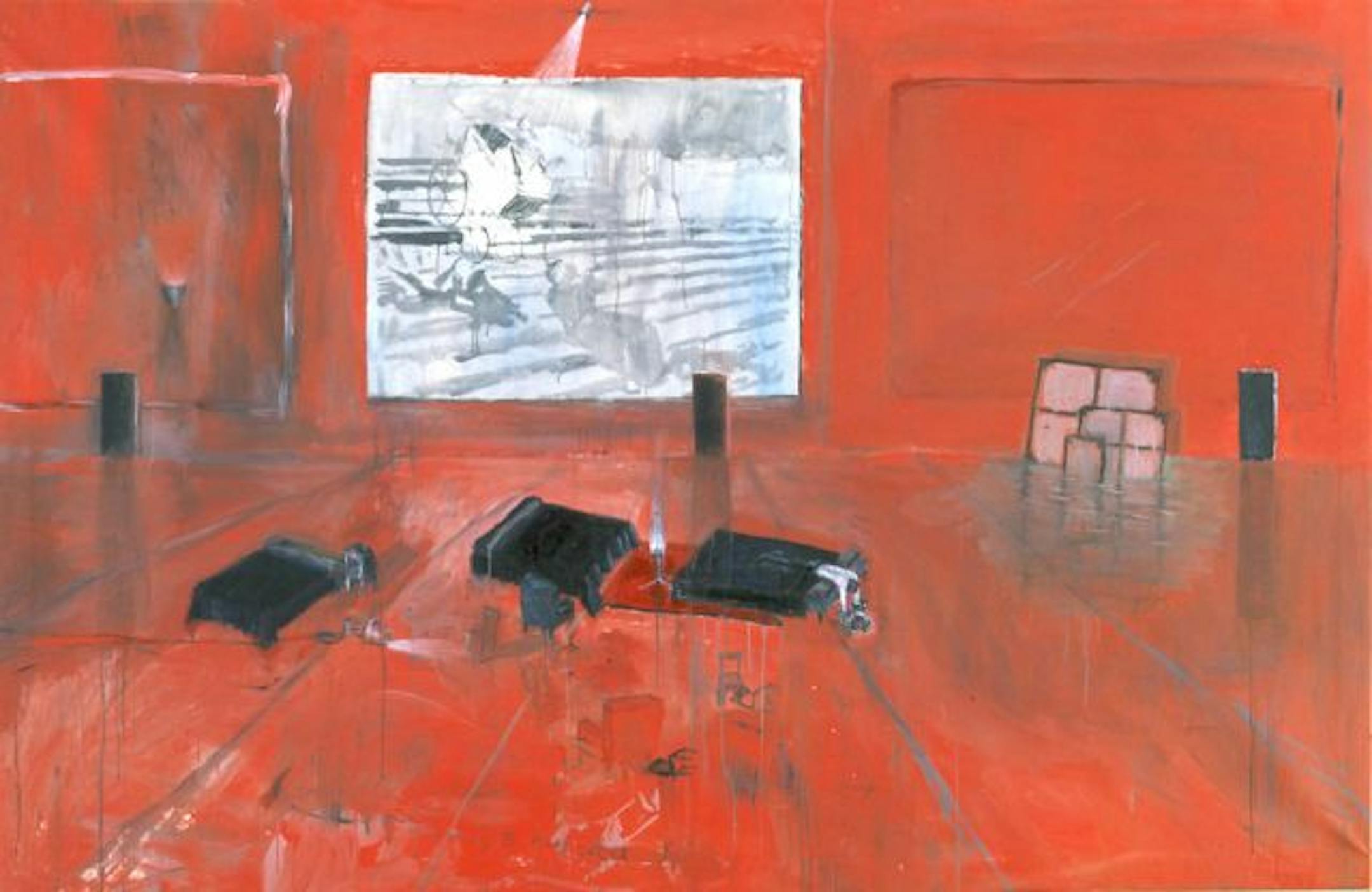
You've never heard of Guillermo Kuitca, the Argentine-born painter whose work is celebrated in a 30-year survey at Walker Art Center? Not to worry. He is well-known among the international avant-garde and prescient collectors, but at 49 he's definitely not a household name in the United States.
The Walker's elegant exhibition should go a fair way toward expanding Kuitca's reach in the heartland. Organized in part by Walker director Olga Viso, it is the most beautifully installed show the Walker has presented in years. Psychologically subtle and intellectually rich, his mostly abstract paintings are sophisticated but accessible.
He paints beds and chairs as stand-ins for people, alludes to theatrical spaces and cinematic events, draws maps and floor plans as a shorthand evocation of distant or unknown places. He prefers bruised-berry reds, muted blues, black-and-white. But just when you might assume he's a minimal colorist, he'll introduce a sensual and romantic wash of pink, orchid or gold.
In short, Kuitca comes across as an old-fashioned yet very up-to-the minute painter, a guy who has found a visual vocabulary that's clearly personal but still universal in its appeal. With a delicious variety of forms, lines, textures, tones and washes, he quietly demonstrates the essential vitality of painting at a time when it has, sadly, been neglected and overshadowed by film, video and performance.
Fans of the Walker's 1971 brick building designed by the late Edward Larrabee Barnes also will be pleased to see that Viso and Kuitca, who planned the installation together, have restored some of the nuances that initially earned the building international acclaim. They've reopened skylights and removed most internal walls to reveal the galleries' spacious proportions, shifting heights and the floor-level kick spaces that make the walls appear to float. The few temporary walls they added have tall openings that gracefully align with the ceiling coffers to ideal effect. The whole is a pitch-perfect installation.
Natural-born painter
Born in Buenos Aires in 1961, Kuitca committed to painting in early childhood and had his first professional show at 19. Then he fell under the influence of German impresario Pina Bausch and her bleakly existential dance/theater performances. His own paintings from the time reflect the harsh beauty of Bausch's environments with their vast, empty stages furnished with scattered chairs, rumpled beds and isolated, despairing figures. It was only much later that he recognized the sociopolitical edge in his work from a time (1976-83) when a military dictatorship tortured, murdered or "disappeared" thousands of Argentines.
Moving onto the international stage, he was just 30 when his work was first shown at the Museum of Modern Art in New York City in 1991. Subsequent shows blossomed in Mexico City, Zurich, London, Washington, D.C., and elsewhere. Highlights of the past decade include his controversial set designs for a production of Richard Wagner's "The Flying Dutchman" in Buenos Aires (figures arrive on an airport luggage conveyor belt) and a successful appearance at the Venice Biennale in 2007.


